
Browse by category
100 tips · 10 sections · A drill for every entry
Good Advice. Better Practice
Golfers rarely suffer from a shortage of swing advice. The challenge is knowing which bits help, which need context, and which leave you gripping harder and moving less.
Familiar swing tips can cause problems when taken literally or applied to the wrong golfer. Some cues can help particular players or work well during rehearsals; use the alternatives below to find a more useful approach for your own game.
Pick one useful change. Follow the introductory links to jump straight to a table. Open the linked drill for its full instructions. Mirror the side-specific examples if you play left-handed.
Start with your grip and setup, then work through the takeaway, backswing and transition. Explore the downswing, impact and follow-through, or focus on rhythm and balance and practice habits.
Tips 1–10
Grip and Tension

| No. | ✕ Bad advice | ✓ Good advice |
|---|---|---|
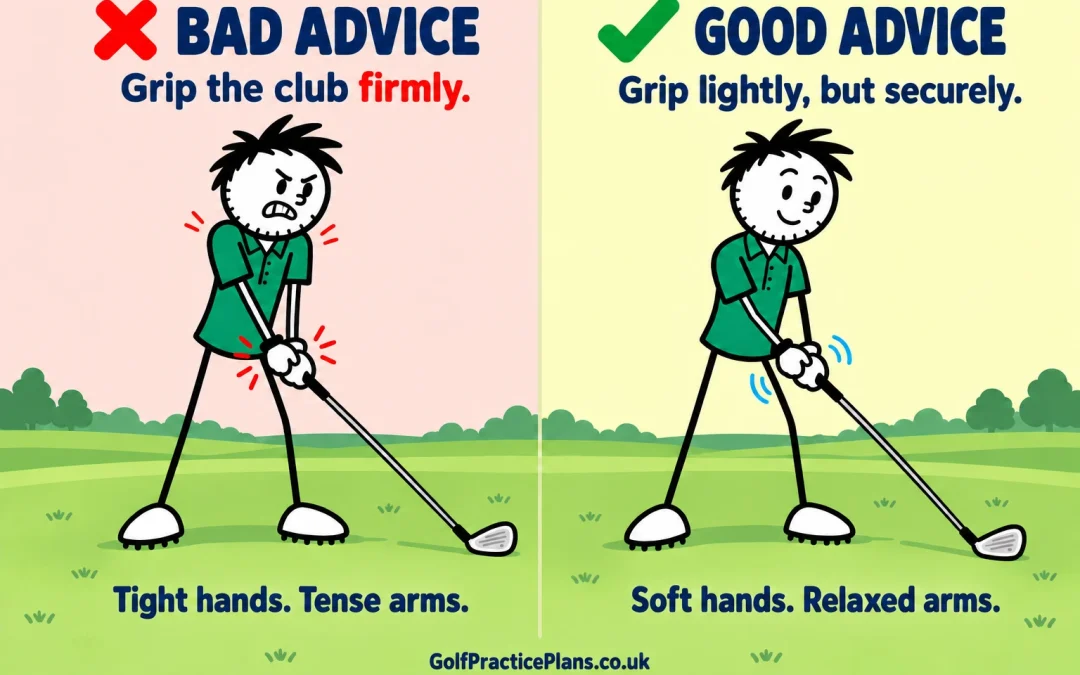
| 1 | “Grip the club firmly.” | 999 out of a 1000 amateur golfers grip the club too firmly. Only 1 out of 1000 grips the club too lightly. Think about that, then grip the club lightly. Go from squeeze to ease. Compare your normal pressure with a lighter, secure hold using the Grip-Pressure Drill. |
| 2 | “Grip the club so lightly it can almost fall out.” | Keep enough pressure to control the club throughout the swing. Relaxed hands still need a secure grip. Try Grip-Pressure Drill. |
| 3 | “Constantly experiment with your grip.” | Get a lesson from a professional, and ask him or her to focus the entire lesson on getting your grip right. Once you’ve got “your grip”, stick with it. Try Common Setup Mistakes Drill. |
| 4 | “A stronger grip fixes every slice.” | Check strike, clubface and swing path together. Explore our Slice Drills. |
| 5 | “A weaker grip fixes every hook.” | Identify why the ball hooks before changing your hands. Grip is one influence on delivery. Try Johnny Miller’s Impact Drill. |
| 6 | “Your left thumb must point straight down the shaft.” | Place your left thumb slightly off-centre on the top-right corner of the grip (2 o'clock position) verses straight down the middle. Try Common Setup Mistakes Drill. |
| 7 | “Your trail hand should do absolutely nothing.” | Let both hands contribute to controlling the club. Explore coordinated pressure with the Towel-Wringing Drill. |
| 8 | “Copy a tour player’s grip exactly.” | Use professional grips as references, then judge your own grip by comfort, contact and ball flight. Try Common Setup Mistakes Drill. |
| 9 | “Squeeze harder just before impact.” | Avoid adding a sudden burst of tension. Practise maintaining a secure hold through a flowing swing. Try Grip-Pressure Drill. |
| 10 | “Make your forearms rigid to control the face.” | Develop club face awareness without locking your arms. Try Johnny Miller’s Impact Drill. |
Tips 11–20
Setup, Posture and Alignment

| No. | ✕ Bad advice | ✓ Good advice |
|---|---|---|
| 11 | “Bend from your waist and round your back.” | Hinge comfortably from your hips and let your arms hang. Explore our Golf Setup Drills. |
| 12 | “Arch your lower back as much as possible.” | Find a comfortable posture without forcing an exaggerated arch. Leave yourself room to turn. Try Common Setup Mistakes Drill. |
| 13 | “Sit down as though you’re doing a deep squat.” | Use enough knee flex to feel balanced while hinging from your hips. Excessive crouching can restrict movement. Try Jim Furyk Drill. |
| 14 | “Lock both knees straight at address.” | Begin with comfortable knee flex so your legs can support the movement. Try Common Setup Mistakes Drill. |
| 15 | “Put all your weight on your toes.” | Find balanced pressure across your feet rather than pitching forwards. Test your stability with small rehearsals. Try Moe Norman Feet Pressure Drill. |
| 16 | “Sit back onto your heels.” | Stay balanced across your feet, with room for pressure to move during the swing. Try Moe Norman Feet Pressure Drill. |
| 17 | “Use exactly the same ball position for every club.” | Match ball position to the club, lie and intended shot. Check the resulting contact and flight. Try Common Setup Mistakes Drill. |
| 18 | “Aim your feet at the target and ignore the club face.” | Check the club face first, then organise your body around the intended starting line and shot shape. Try Club Face Alignment Drill. |
| 19 | “Stand as far from the ball as possible.” | Find a distance that lets your arms hang comfortably and the club sole sit appropriately. Try Common Setup Mistakes Drill. |
| 20 | “Use a really wide stance to help with balance.” | Match stance width to the shot. An exaggerated stance, such as the Solid Foundation Drill, is a specific practice exercise. |
Tips 21–30
Takeaway

| No. | ✕ Bad advice | ✓ Good advice |
|---|---|---|
| 21 | “Whip the club away quickly to create speed.” | Start with a movement you can repeat, then allow speed to build. Try our Takeaway Drills. |
| 22 | “Drag the club head along the ground for as long as possible.” | Let the club rise as your body turns and wrists begin to hinge. Try Adam Scott Takeaway Drill. |
| 23 | “Roll your wrists open immediately.” | Build awareness of the club face as you start back rather than deliberately adding a large early roll. Try Rory’s Club in Front Drill. |
| 24 | “Whip the club inside on the takeaway.” | Explore a takeaway that keeps the club organised in front of you using Rory’s Club in Front Drill. |
| 25 | “Push the club straight down the target line throughout the backswing.” | Allow the club to move around your body as you turn. The swing follows an arc. Try Down Out Up Drill. |
| 26 | “Keep your hips frozen during the takeaway.” | Let your hips contribute naturally to the turn. Explore our Hip Turn Drills. |
| 27 | “Lock your arms and chest together.” | Practise coordination while allowing your arms room to move. Try our Connection Drills. |
| 28 | “Lift the club using only your hands.” | Explore how your turn, arms and wrists work together to move the club back. Try Pete Cowen’s Signature Stick Drill. |
| 29 | “There’s one perfect takeaway position for everyone.” | Use checkpoints to investigate your movement, then judge whether they improve your delivery and contact. Try Smoother Takeaway Drills. |
| 30 | “A good takeaway guarantees a good shot.” | Treat the takeaway as one part of the swing. Check what happens through impact and where the ball goes. Try Adam Scott Takeaway Drill. |
Tips 31–40
Backswing and Wrist Set
| No. | ✕ Bad advice | ✓ Good advice |
|---|---|---|
| 31 | “Keep your lead arm rigid.” | Aim for useful structure without forcing the elbow straight or adding tension. Try Loose Arms Drill. |
| 32 | “Pin your trail elbow tightly against your ribs.” | Allow it to fold and move as you turn. Explore arm-and-body coordination with the Signature Stick Drill. |
| 33 | “Your lead heel must never leave the ground.” | Allow heel movement when it helps you make a comfortable, balanced turn. Try Sam Snead Fancy Footwork Drill. |
| 34 | “Slide your whole body over your trail foot.” | Explore turning and loading without excessive sideways movement using our Sway Drills. |
| 35 | “Turn your shoulders while keeping your hips square.” | Let your hips turn enough to support your movement rather than forcing separation. Try Hip Preset Drill. |
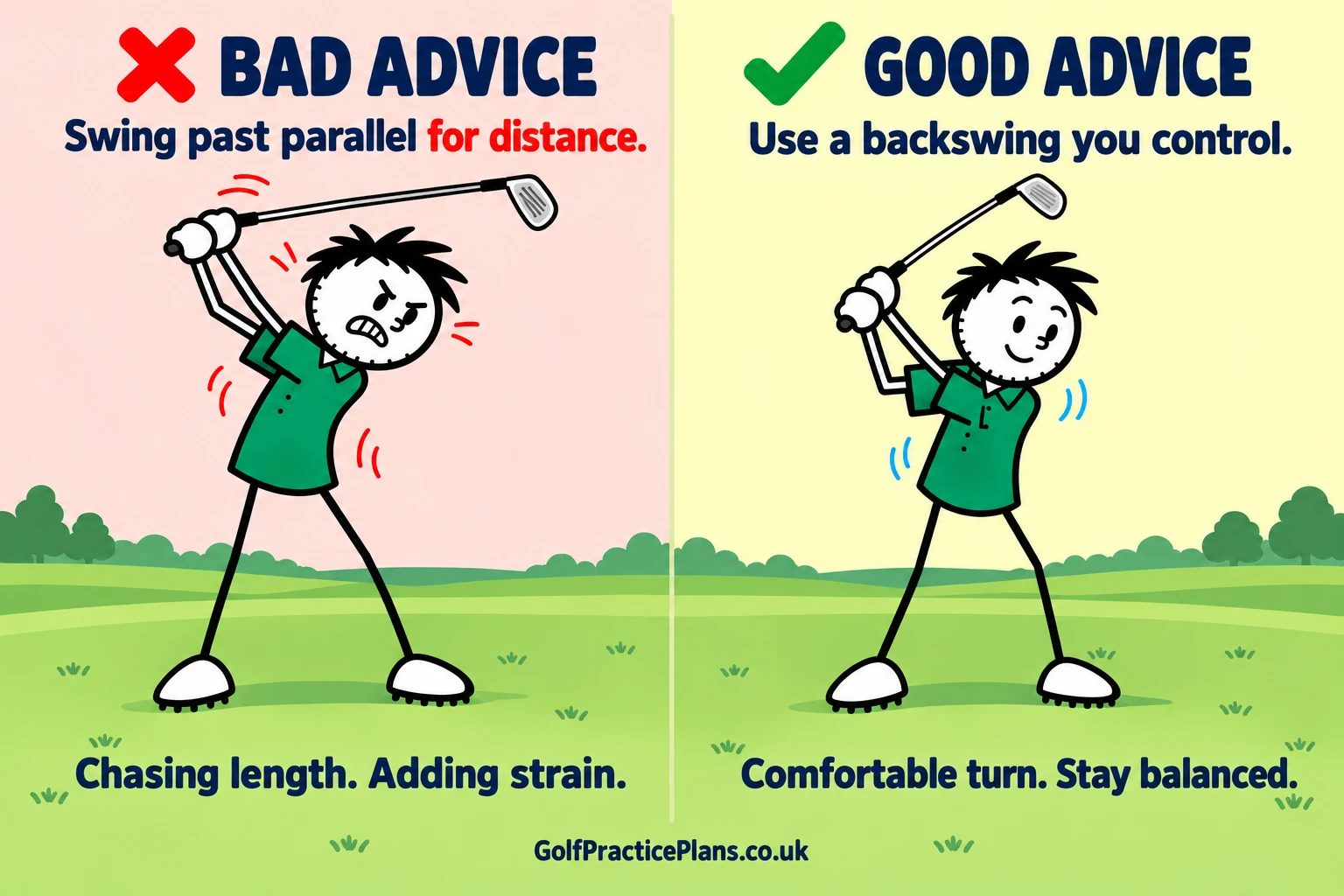
| 36 | “Swing past parallel to hit it further.” | Choose a backswing length you can control. Extra length is useful only when it improves the result. Try Simon Dyson Feet Together Drill. |
| 37 | “Your club must reach parallel at the top.” | Match backswing length to your movement capabilities and the shot. A shorter swing can still be effective. Try L-to-L Drill. |
| 38 | “Every golfer needs the same wrist position at the top.” | Consider wrist position alongside grip and delivery. Explore the options with our Wrist Position Drills. |
| 39 | “Set your wrists as hard and early as possible.” | Find a wrist-set pattern that fits your turn and rhythm without forcing the movement. Try Down Out Up Drill. |
| 40 | “Keep your wrists completely unhinged.” | Allow the wrists to contribute naturally. Explore setting and releasing with the Chalk Line Drill. |
Tips 41–50
Transition and Sequencing

| No. | ✕ Bad advice | ✓ Good advice |
|---|---|---|
| 41 | “Start down by yanking the handle towards the ball.” | Rehearse a coordinated change of direction that gives your arms and club room to return. Try Golf Transition Drill. |
| 42 | “Fire your hips as fast as possible.” | Match your lower-body movement to the rest of your swing. Explore our Hip-Clearing Drills. |
| 43 | “Throw your shoulders at the ball from the top.” | Explore a transition in which your body and arms work together rather than lunging forwards. Try Golf Transition Drill. |
| 44 | “Stay entirely on your trail foot until impact.” | Explore how pressure moves towards your lead side using our Weight Transfer Drills. |
| 45 | “Shift every bit of your weight before moving your arms.” | Practise the movements flowing together rather than separating the swing into rigid stages. Try Hip Bump Drill. |
| 46 | “Make a long pause at the top on every shot.” | Use a pause as a rehearsal if helpful, then find a transition that suits your playing rhythm. Try Xander Schauffele Step Drill. |
| 47 | “Rush the change of direction to create power.” | Build speed without losing your sequence. Try our Swing Rhythm Drills. |
| 48 | “Drop your hands straight down and keep your body still.” | Let your arm movement work with your body turn. Avoid turning a rehearsal feeling into a rigid rule. Try Pete Cowen’s Signature Stick Drill. |
| 49 | “Actively loop the club as far behind you as possible.” | Seek enough room for the club to return without exaggerating its position behind your body. Try Stop Getting Stuck Drill. |
| 50 | “Copy a professional’s transition without changing anything else.” | Consider how the movement fits your setup, backswing and physical capabilities before adopting it. Try Golf Transition Drill. |
Tips 51–60
Downswing and Swing Path

| No. | ✕ Bad advice | ✓ Good advice |
|---|---|---|
| 51 | “Swing as far from the inside as possible.” | Match swing direction to club face control and your intended flight. More inside is not automatically better. Try Three Ball Swing Path Drill. |
| 52 | “Swing left as hard as possible to stop a hook.” | Check the relationship between face and path before making a large directional change. Try Three Ball Swing Path Drill. |
| 53 | “Every shot needs a perfectly straight club path.” | Match face and path to the shot you intend to play. Curved shots are useful options. Try Wedge Nine Ball Flights Drill. |
| 54 | “The club head must travel down the target line throughout the swing.” | Allow the club to follow an arc around your body rather than forcing a straight-line motion. Try Broom Swing Drill. |
| 55 | “Keep your trail elbow behind your hip.” | Give the arms room to work through. Explore the movement with the Signature Stick Drill. |
| 56 | “Move your hips towards the ball to reach impact.” | Explore maintaining room for your arms using our Early Extension Drills. |
| 57 | “Slide your hips towards the target for the whole downswing.” | Explore a comfortable blend of pressure shift and rotation rather than an uninterrupted sideways slide. Try Hip Bump Drill. |
| 58 | “Your head must remain exactly where it started.” | Allow the movement your swing needs while developing control of your strike and balance. Try Annika Sorenstam Turn-Through Drill. |
| 59 | “Keep your chest pointing at the ball until the club hits it.” | Let your chest turn as part of the delivery rather than trying to freeze it in place. Try Annika Sorenstam Turn-Through Drill. |
| 60 | “A slice always means your swing path is wrong.” | Check club face, path and strike location. Use our Slice Drills to investigate the pattern. |
Tips 61–70
Impact, Strike and Ball Contact

| No. | ✕ Bad advice | ✓ Good advice |
|---|---|---|
| 61 | “Lift the ball into the air with your irons.” | Use the club’s loft and practise contacting the ball before the turf. Try our Ball-Striking Drills. |
| 62 | “Hit down as steeply as possible with every club.” | Match delivery to the club and lie. A steeper strike is not automatically a better one. Try Pete Cowen Chalk Line Drill. |
| 63 | “Take the biggest divot you can.” | Judge contact and ball flight first. Divot size varies with the club, delivery and ground conditions. Try Ball-Striking Coin Drill. |
| 64 | “Pick every iron shot perfectly clean.” | On ordinary turf lies, practise controlling where the club meets the ground after contacting the ball. Try Ball-Striking Coin Drill. |
| 65 | “Push your hands as far ahead as possible.” | Seek an impact position suited to the shot. Avoid forcing excessive shaft lean, particularly on lofted short shots. Try Pete Cowen Chalk Line Drill. |
| 66 | “Keep your head down to stop topping it.” | Investigate posture, balance and contact rather than fixing your gaze downwards. Try our Topping Drills. |
| 67 | “Throw your trail hand underneath to help the ball up.” | Practise controlling the club’s low point and loft without adding a last-second scoop. Try One Arm Wedge Drill. |
| 68 | “Recreate your address position exactly at impact.” | Recognise that impact happens during movement. Explore the differences with our Impact Position Drills. |
| 69 | “A good strike should feel like you’re hitting the ground hard.” | Assess face contact, turf contact and flight. A heavy thump alone does not prove a good strike. Try Pete Cowen Chalk Line Drill. |
| 70 | “One impact position works for every shot.” | Adjust your delivery to the intended shot, club and lie. Explore our Wedge Ball-Flight Drills. |
Tips 71–80
Release and Follow-Through

| No. | ✕ Bad advice | ✓ Good advice |
|---|---|---|
| 71 | “Hold your wrist angle for as long as possible.” | Explore a release that fits your movement rather than trying to preserve an angle indefinitely. Try our Lag Drills. |
| 72 | “Flip your wrists at the ball to square the face.” | Work on grip, face awareness and delivery instead of relying on a precisely timed last-second flip. Try Pete Cowen Chalk Line Drill. |
| 73 | “Keep the club face pointing at the target throughout the follow-through.” | Allow the club face to change orientation as the club travels around you. Try Collarbone to Collarbone Drill. |
| 74 | “Force your forearms to cross immediately after impact.” | Let the release fit the shot. Avoid adding an aggressive roll simply to copy a finish position. Try Lead-Arm Rotation Drill. |
| 75 | “Keep both arms locked straight after impact.” | Allow the arms to extend and then fold naturally as the swing continues. Try Tiger Woods Follow-Through Drill. |
| 76 | “Keep your trail heel nailed to the ground.” | Let the trail foot respond to your turn and balance. Explore our Follow-Through Drills. |
| 77 | “Stop your body at impact so the club can catch up.” | Practise a coordinated movement through the ball. Explore a release task with the Tennis Ball Drill. |
| 78 | “Keep looking at the ground until the swing is over.” | Allow your head and eyes to follow the movement through towards the target. Try Annika Sorenstam Turn-Through Drill. |
| 79 | “Force every shot into a high, full finish.” | Let finish length reflect the shot. A controlled wedge or flighted shot may finish much shorter. Try Pelvic-Punch Wedge Drill. |
| 80 | “A perfect-looking finish proves the swing was good.” | Use the finish as feedback alongside balance, contact and flight. Try our Balance Drills. |
Tips 81–90
Rhythm, Speed and Balance

| No. | ✕ Bad advice | ✓ Good advice |
|---|---|---|
| 81 | “Swing the club slowly.” | Use slow swings for rehearsal when helpful. For playing shots, develop a flowing rhythm with committed acceleration. Try Swing Rhythm Drills. |
| 82 | “Swing at maximum effort on every shot.” | Choose an effort level (e.g. 80%) that lets you control the strike and deliver the intended shot. Try Hit Hold Check Drill. |
| 83 | “Make your backswing and downswing take the same time.” | Develop a rhythm you can repeat rather than forcing equal timing in both directions. Try Simon Dyson Feet Together Drill. |
| 84 | “Start accelerating as hard as possible from address.” | Build speed through a coordinated swing rather than trying to reach maximum speed immediately. Try Dustin Johnson Swing Trigger Drill. |
| 85 | “Power comes entirely from your arms.” | Explore how your feet, body, arms and club contribute together using our Swing Speed Drills. |
| 86 | “Power comes entirely from your body turn.” | Let your arms and club contribute freely alongside your turn. Avoid trying to drag everything through with your torso. Try Lightning Hands Drill. |
| 87 | “Keep your feet completely still for consistency.” | Develop repeatable pressure changes and balanced movement. Try our Weight Transfer Drills. |
| 88 | “Falling backwards shows you’ve really hit it.” | Develop speed you can control while finishing in balance. Explore our Balance Drills. |
| 89 | “A smooth-looking swing must be slow.” | Judge speed separately from appearance. Efficient movement can look smooth while producing considerable club head speed. Try Lightning Hands Drill. |
| 90 | “More effort always produces more distance.” | Compare effort with strike quality and actual distance. Extra effort is useful when it improves the outcome. Try Hit Hold Check Drill. |
Tips 91–100
Swing Thoughts and Practice Habits
| No. | ✕ Bad advice | ✓ Good advice |
|---|---|---|
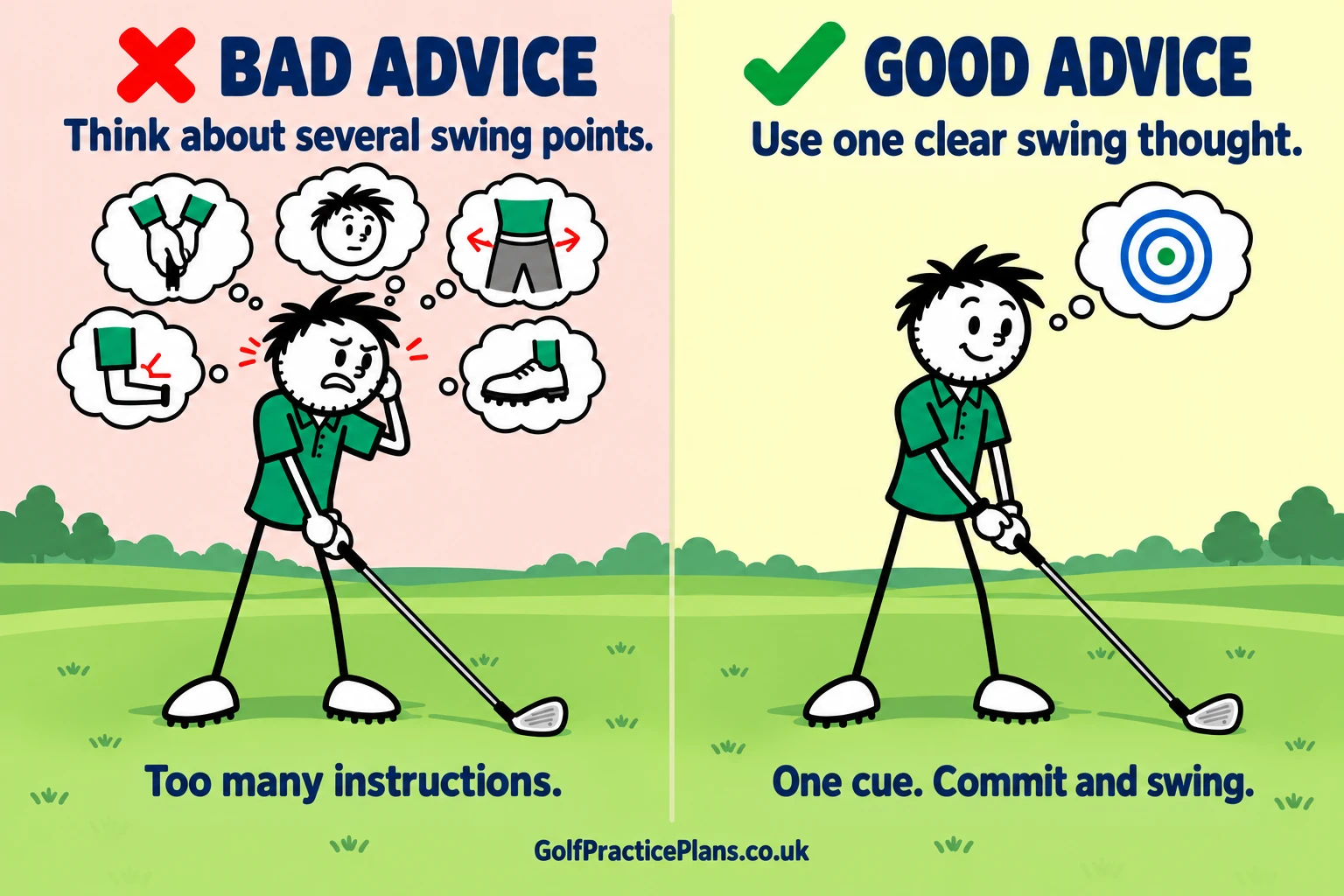
| 91 | “You can think about more than one technical point while you swing.” | Use one clear technical point. Explore our Pre-Shot Routine. |
| 92 | “Try a different YouTube tip after a poor round.” | Choose one relevant change and give it a structured test before moving on. Try Anthony Kim Checkpoint Drill. |
| 93 | “Hit a hundred balls without stopping and you’ll improve.” | Give each group of shots a purpose, pause for feedback and record what happened. Try our Range Games. |
| 94 | “You need a picture-perfect swing before playing golf.” | Develop useful shots while improving your movement. Track contact, direction and scoring alongside technique. Try Nick Faldo Go-To Shot Drill. |
| 95 | “Copy your favourite professional’s entire swing.” | Borrow useful ideas while building a movement that suits your body and game. Try Jim Furyk Drill. |
| 96 | “If a drill feels strange, it must be wrong.” | Expect unfamiliar feelings during change, then judge the drill by its purpose and results. Try Rory’s Split-Hand Drill. |
| 97 | “If a drill feels good, it must be working.” | Check whether it improves the intended outcome and whether that improvement carries into ordinary shots. Try Hit Hold Check Drill. |
| 98 | “Never practise without hitting a ball.” | Use rehearsals to explore movement, then test the feeling with shots. Try our Indoor Drills. |
| 99 | “A good player’s advice must suit every golfer.” | Consider the problem, the player and the intended outcome before applying someone else’s cue. Try Jim Furyk Drill. |
| 100 | “One magic swing thought will fix your golf forever.” | Build a small, repeatable practice routine and review your patterns over time. Start with our Seven Favourite Drills. |
George’s Practice Tip
Choose the piece of advice that sounds most familiar, then try its linked drill. Keep the club, target and practice conditions consistent enough to compare what happens. Look for a pattern across a small set of attempts, rather than changing direction after one poor shot.
Write down one useful cue and take it into your next session. A hundred tips make a useful reference; you only need one useful task for today.