

Browse by category
Soft Arms. Responsive Wrists. A Flowing Swing.
Your practice at a glance
These golf drills are from the Golf Practice Made Fun App.
Exploring lag is more useful when you focus on relaxed movement and timing instead of trying to hold a fixed wrist angle.
Begin with the Triple Lag Drill for a small lead-arm rehearsal, use the 2 Minute Lag Drill to explore softer arms at the top, then test a later wrist set with the Create Lag Drill. Each routine pairs one slow rehearsal with one easy normal swing; complete eighteen pairs per drill in two sets of nine, or practise one drill per session. Start without a ball and add gentle range shots only to the normal swing where appropriate.
Drill 1. Triple Lag: Feel the Club Hinge with Your Lead Arm
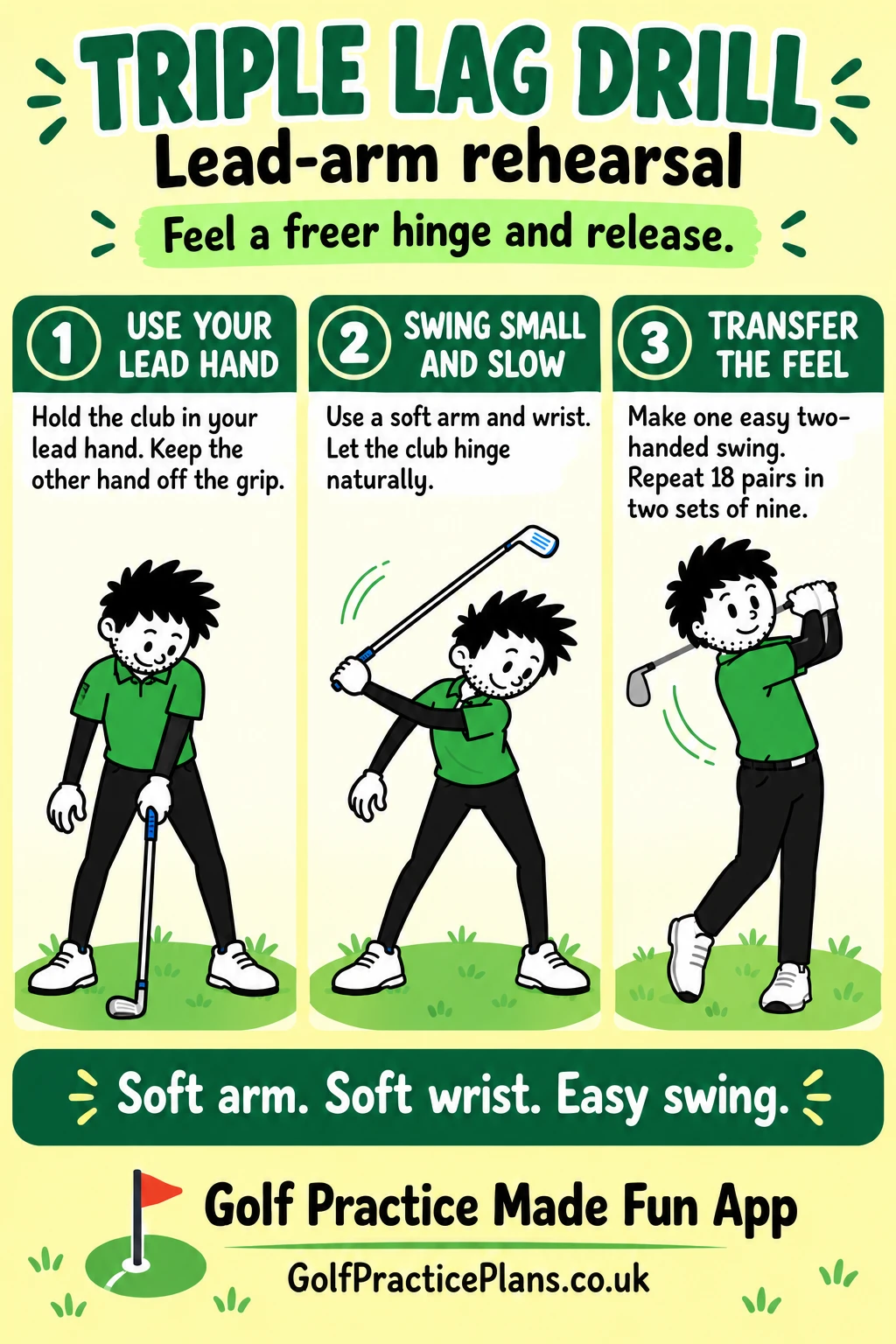
The Triple Lag Drill helps you feel the club hinge with a relaxed lead arm, then carry that easy movement into a normal two-handed swing.
Removing the trail hand makes the relationship between the lead arm, wrist and club easier to notice in a small rehearsal. The useful task is to stay in control without stiffening the wrist. Replacing the second hand afterwards lets you test whether you can keep that softer feeling in your normal motion.
| Step | What to do |
|---|---|
| 1 | Hold the club with your lead hand only and take the other hand off the grip. For a right-handed golfer the lead hand is the left; reverse for a left-handed golfer. Take a comfortable posture with enough clear space for the club. |
| 2 | Without a ball, make a small, slow swing. Keep your arm and wrist relaxed with enough grip pressure to control the club. Let the wrist hinge naturally rather than trying to preserve a fixed angle throughout the movement. Avoid full-speed one-handed shots. |
| 3 | Put both hands back on the grip and make one easy normal swing with the same relaxed feeling. This rehearsal-and-swing pair counts as one repetition. Complete nine pairs, pause, then nine more. At the range, the normal swing can be a gentle shot; keep the one-handed rehearsal ball-free. |
Drill 2. 2 Minute Lag: Soften Your Arms at the Top
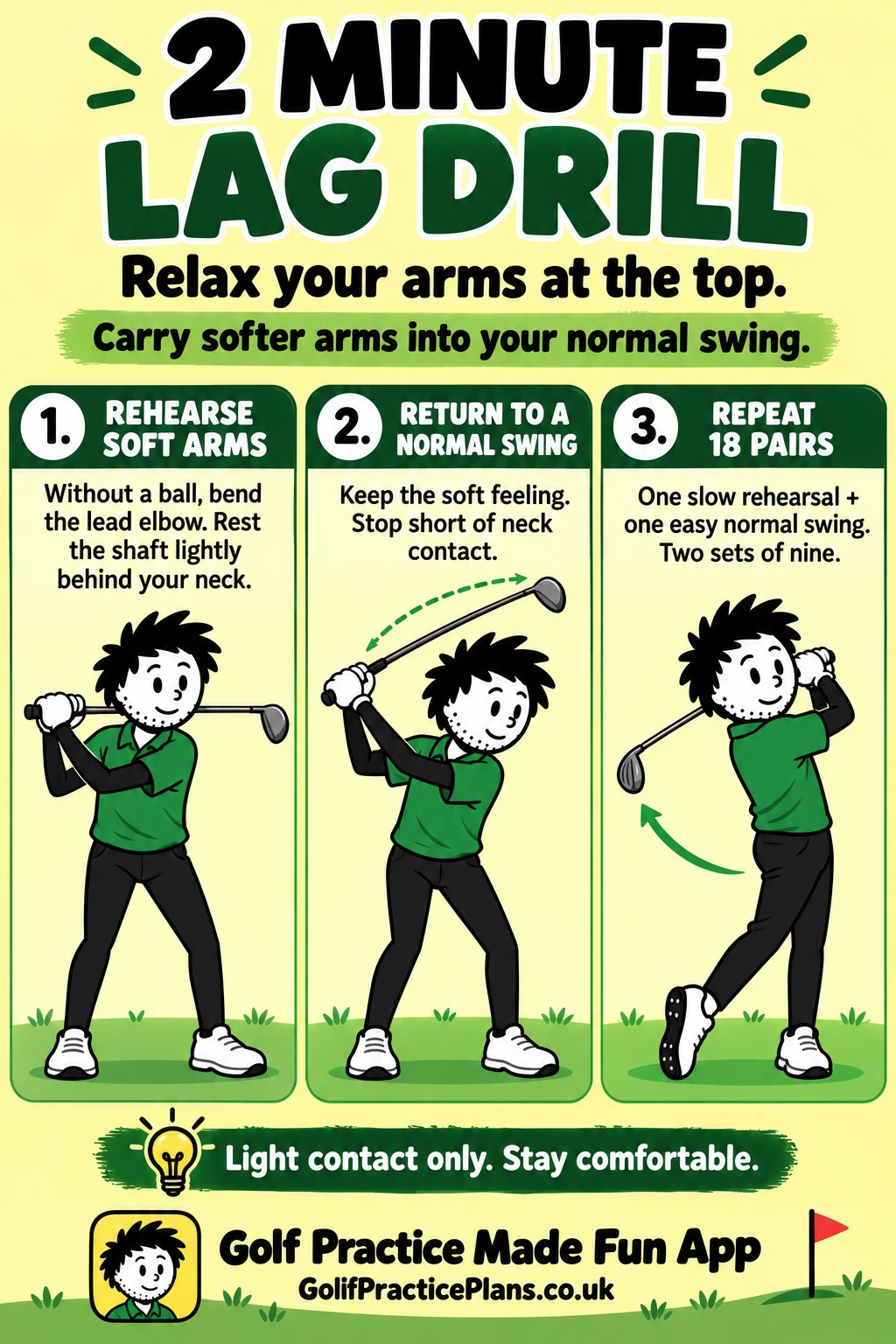
The 2 Minute Lag Drill helps you notice the difference between rigid and relaxed arms, then bring the softer feeling back to your usual backswing.
The deliberately bent lead elbow offers a clear contrast with an overly stiff top-of-backswing position. Treat the shaft contact as a light rehearsal reference rather than something to reproduce in a normal shot. The drill’s name describes the quick feel exercise; the full eighteen-pair practice round can take longer.
| Step | What to do |
|---|---|
| 1 | Hold a driver with both hands and make a slow backswing without a ball. Deliberately let the lead elbow bend, then bring the shaft gently behind your neck, roughly parallel to the ground as shown in the video. Use light contact only; stop short if the position is uncomfortable. |
| 2 | From the rehearsal position, make an easy downswing and finish in balance. Then take a normal backswing with the same soft-arm feeling, stopping short of neck contact. Let the club move freely rather than locking the wrists into an angle. |
| 3 | Complete eighteen controlled pairs in two sets of nine. Each pair is one slow shaft-on-neck rehearsal followed by one easy normal swing that stops short of touching the neck. Reset before each pair. Keep the rehearsal ball-free; only the normal swing may become a gentle range shot. |
Drill 3. Create Lag: Explore a Later Wrist Set
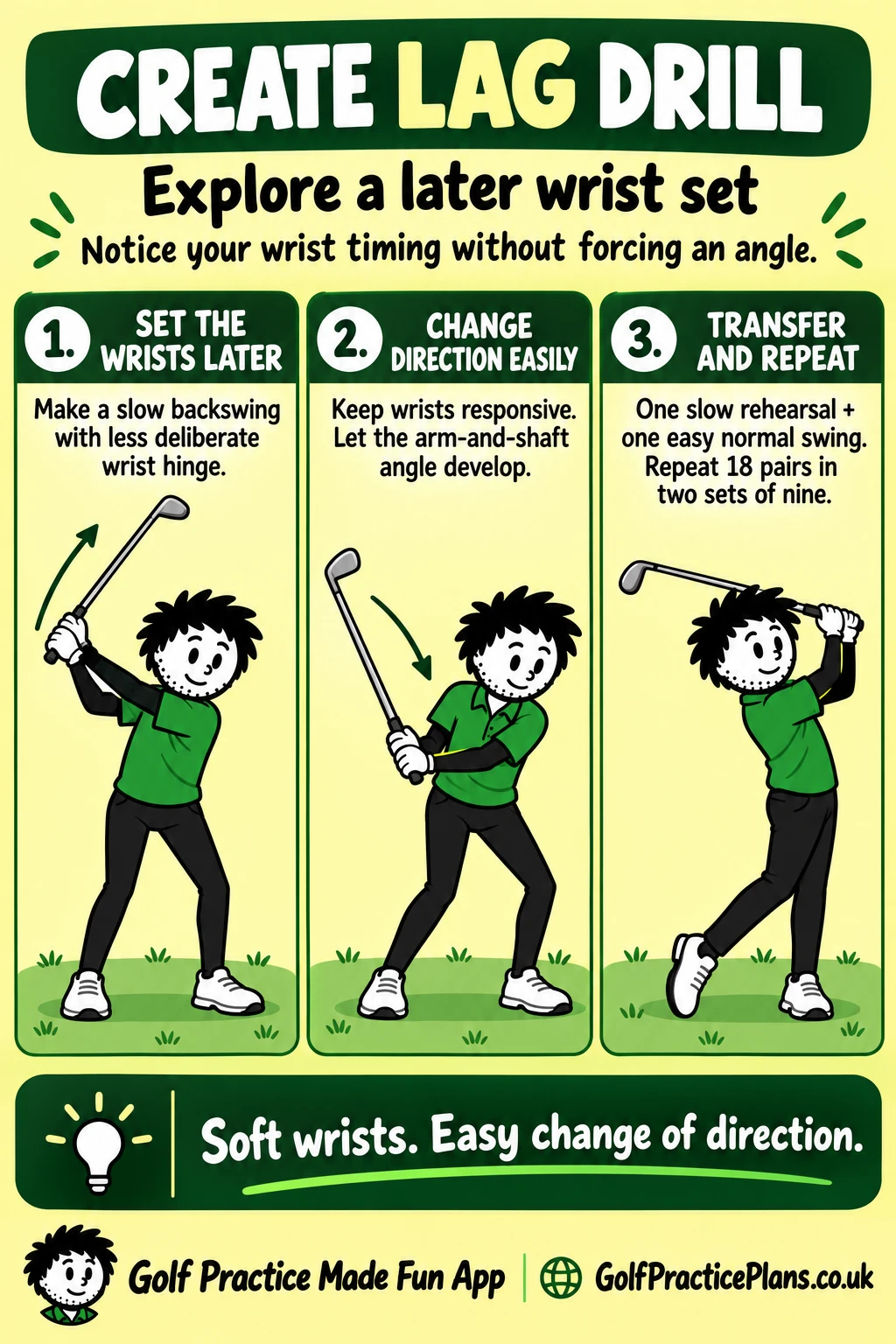
The Create Lag Drill helps you explore wrist-set timing and notice tension as you change direction into the downswing.
Using less deliberate hinge in a slow backswing gives you a different timing sensation to compare with your usual swing. Notice how the lead arm and shaft relationship develops as you move down, then return to a comfortable normal swing. Avoid chasing the biggest lag angle or trying to hold that angle through impact.
| Step | What to do |
|---|---|
| 1 | Hold the club with both hands and make a slow backswing with a comfortable shoulder turn. Use the feeling of less deliberate wrist hinge on the way back. The club may feel more upright, but keep the wrists responsive rather than locking them or stretching for a longer swing. |
| 2 | Begin an easy downswing and notice the changing relationship between the lead arm and shaft. The original back-of-shoulder cue is an exaggerated direction feeling: keep the club clear of your body and do not try to hit your shoulder or force the wrist angle. |
| 3 | Make one easy normal swing after the slow rehearsal, then reset. Complete eighteen rehearsal-and-swing pairs in two sets of nine, counting each pair once. At the range, use a gentle normal shot after the rehearsal. Judge comfortable contact, control and balance. |