
How to Clear Your Hips in the Golf Swing: 3 Drills for Better Movement
Room through impact
Better hip movement can give your arms and club more room to travel through the strike.
Start with the Hip Preset Power Drill to explore your backswing turn, use the Hip Bump Drill to feel a small lower-body movement before your shoulders unwind, then try the Clear Hips Drill to turn through with space for your arms. Follow each drill’s eighteen-attempt routine at a comfortable pace. Begin with slow rehearsals and add easy shots where the drill calls for them.
↓ Download free infographicSave to your device or print for practice.
Drill 1. Hip Preset Power: Give Your Turn a Head Start

The Hip Preset Power Drill helps you explore a freer backswing turn by giving your hips a small head start at address.
Presetting the hips separates the start of the turn from the rest of the backswing, giving you time to notice how your upper body completes the movement. Slow rehearsals help you find a comfortable range without chasing extra rotation. Return to your normal setup afterwards and see whether the same feeling makes your turn easier.
| Step | What to do |
|---|---|
| 1 | Take your normal address position. For a right-handed golfer, turn the right hip into the top-of-backswing position at address, using only a comfortable amount of rotation. Left-handed golfers reverse the sides. |
| 2 | With your hips already turned, let your upper body complete a slow backswing. Pause briefly at the top, then return to address and reset. Keep the knees soft and avoid sliding sideways or forcing a bigger turn. |
| 3 | Complete nine slow hip-preset backswing rehearsals, then nine smooth swings through from the preset position to a balanced finish, with or without a ball. Let the second set flow without pausing at the top. Afterwards, return to your usual setup and recall the comfortable turn. |
Drill 2. Hip Bump: Feel the Lower Body Move First

The Hip Bump Drill helps you feel a small lead-side movement start the downswing before your shoulders unwind.
The upright stick gives your lead hip a clear checkpoint, while the club across your shoulders helps you notice whether your upper body turns too soon. Keeping this rehearsal small makes the sequence easier to feel. Use it to explore the order of movement rather than to practise a large sideways slide.
| Step | What to do |
|---|---|
| 1 | Place an alignment stick upright in the ground just outside your lead foot, on the target side. Hold a club across your shoulders with your arms crossed. Turn into your backswing, leaving a small gap between your lead hip and the stick. |
| 2 | Move your lead hip gently towards the stick while keeping your shoulders in their turned backswing position. Let the hip meet the stick lightly, keeping both feet grounded and your knees soft. For a right-handed golfer the lead side is the left; reverse this if you play left-handed. |
| 3 | Pause, return to the starting position and reset. Complete eighteen slow rehearsals in two sets of nine. If your shoulders unwind before the hip moves, reduce the speed and size of the bump. This exercise is a no-ball rehearsal. |
Explore the full Hip Bump Golf Drill →
Watch the demonstration on YouTube.
Your focus: Room through impact
Drill 3. Clear Hips: Make Room for Your Arms
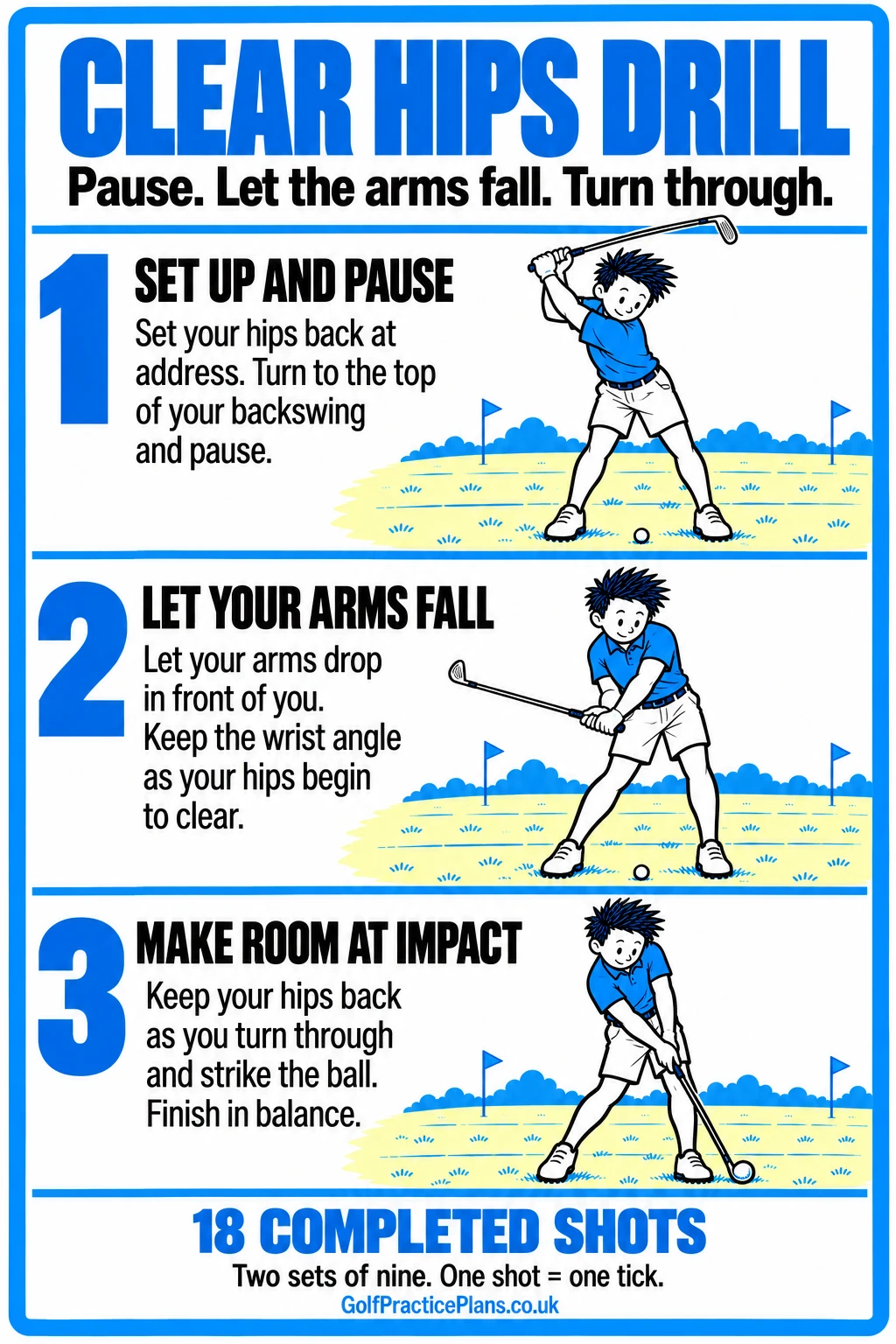
The Clear Hips Drill helps you create room for your arms and club at impact by turning through without thrusting your hips towards the ball.
A brief pause at the top gives you time to notice how the arms and lower body work together. Hogan’s gentle throwing feel offers a simple way to explore turning to make room for an arm movement. Begin slowly, then check whether the same sequence helps your contact and balance when you add a ball.
| Step | What to do |
|---|---|
| 1 | Rehearse a gentle sidearm throwing motion without a ball, letting your hips turn as the arm moves through. Then take your club and address the ball with your hips comfortably back and your knees soft. |
| 2 | Turn to the top of your backswing and pause briefly. Let your arms fall in front of you as you turn through, allowing the wrist angle to remain rather than throwing the clubhead out early. Keep your grip and arms relaxed; avoid trying to hold a rigid wrist position. |
| 3 | Begin with slow no-ball rehearsals, then play eighteen controlled shots with one club in two sets of nine. Pause at the top, let the arms fall and turn through while keeping the feeling of your hips staying back. Finish in balance instead of trying to spin the hips as fast as possible. |
FAQs
What equipment do I need?
Club, stick and balls.
How do I set up Hip Preset Power?
The Hip Preset Power Drill helps you explore a freer backswing turn by giving your hips a small head start at address.
Presetting the hips separates the start of the turn from the rest of the backswing, giving you time to notice how your upper body completes the movement. Slow rehearsals help you find a comfortable range without chasing extra rotation. Return to your normal setup afterwards and see whether the same feeling makes your turn easier.
How do I practise Hip Bump?
The Hip Bump Drill helps you feel a small lead-side movement start the downswing before your shoulders unwind.
The upright stick gives your lead hip a clear checkpoint, while the club across your shoulders helps you notice whether your upper body turns too soon. Keeping this rehearsal small makes the sequence easier to feel. Use it to explore the order of movement rather than to practise a large sideways slide.
How does Clear Hips work?
The Clear Hips Drill helps you create room for your arms and club at impact by turning through without thrusting your hips towards the ball.
A brief pause at the top gives you time to notice how the arms and lower body work together. Hogan’s gentle throwing feel offers a simple way to explore turning to make room for an arm movement. Begin slowly, then check whether the same sequence helps your contact and balance when you add a ball.
Do I need to practise every drill in one session?
Choose one drill that matches what you want to work on. Follow its setup and practice task, then use what you notice to decide what to repeat next time.
Should I use the same score for every drill?
Follow the practice record given for each drill. Keep its distance, target and equipment consistent when you compare sessions.
What drill do you recommend I do next?
Try Anti Hip Sway Drill next to use a stick to check for sideways hip movement.
You could also use Hip Bump to rehearse the lead-hip bump with a stick as a reference. For another focused practice task, try Connected Backswing Drill to practise turning your chest and arms together.
Give your next practice a purpose.
Find illustrated drills, save your favourites and record your practice in the Golf Practice Made Fun App.
Try the App Free ↗14 days free · No card required