

How to Improve Your Golf Hip Turn: 3 Simple Drills
Freer, balanced turn
A comfortable hip turn gives your swing room to move without forcing it.
Use Tiger Woods Hip Move to feel the trail hip turning back, Rotational Swing Feel to connect that movement to a relaxed rotational swing and Tiger Woods Magic Box to review your lower body on video. Start without a ball and work through one drill at a time, keeping the movement easy and resetting between repetitions. Use one clear cue in each drill and compare your own balance and movement as you practise.
↓ Download free infographicSave to your device or print for practice.
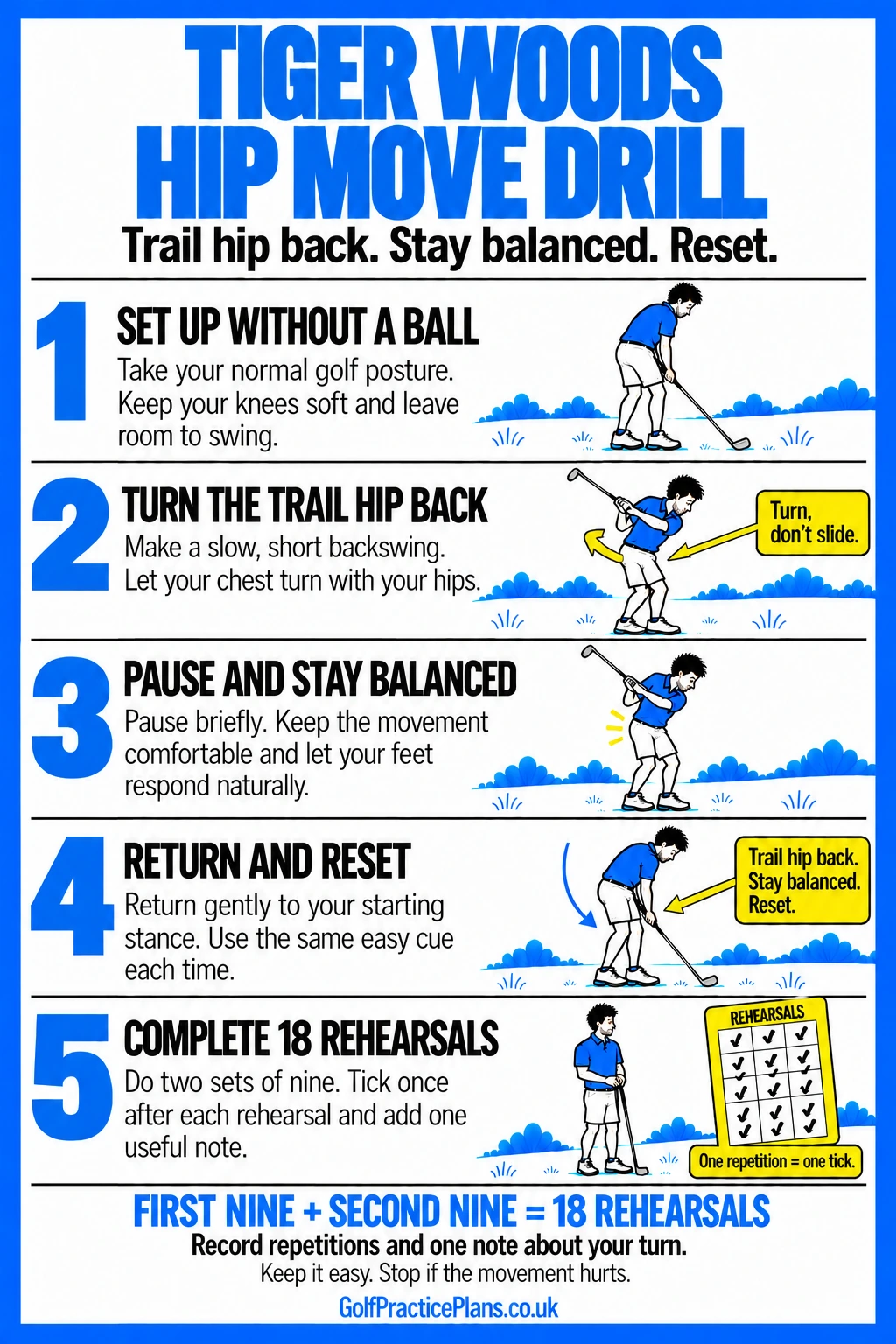
Drill 1. Tiger Woods Hip Move: Turn the Trail Hip Back
| Step | What to do |
|---|---|
| 1 | Take your normal golf posture without a ball, with space to swing. Keep your knees soft and your stance comfortable. Begin with a short, slow movement so you can notice the turn and your balance. |
| 2 | Make a small backswing, feeling your trail hip turn behind you as your chest turns with it. Pause briefly, then return gently to your starting stance. Let your feet respond naturally rather than forcing your toes up or exaggerating the movement. |
| 3 | Complete eighteen slow rehearsals in two sets of nine, resetting each time. Use the cue “Trail hip back. Stay balanced. Reset.” Note one useful feeling about the turn. Once it feels comfortable, explore a few gentle half-shots at the range. |
See the full Tiger Woods Hip Move Drill and hip-turn demonstration →
Drill 2. Rotational Swing Feel: Stand Tall and Turn

| Step | What to do |
|---|---|
| 1 | Stand upright and hold the club out in front of you with your normal grip. Turn your shoulders into a small backswing, then turn through to a balanced finish. Let your head move naturally with your body. |
| 2 | Repeat the turn while gradually lowering the club towards your usual golf posture. Keep the relaxed rotational feeling. If it becomes a forced lifting-and-chopping movement, raise the club again and rediscover the easy turn. |
| 3 | Complete eighteen sequences in two sets of nine: rehearse the upright turn, lower the club and make one easy swing, then reset. Practise without a ball first. At the range, carry the feeling into gentle shots of around fifty yards or shorter, using normal golf posture when striking the ball. |
Explore the full Rotational Golf Swing Feel Drill and upright rehearsal →
Your focus: Freer, balanced turn
Drill 3. Tiger Woods Magic Box: Check Your Movement

| Step | What to do |
|---|---|
| 1 | Set your phone in a stable position behind you, looking down the target line, with your feet, knees and club visible. Keep it clear of the swing area. Film a comfortable swing, then pause the video at the top of the backswing. |
| 2 | Draw a reference box with vertical lines outside the lead knee and inside the trail knee, connecting them above and below the knee area. Keep the box fixed as you review the early downswing and notice where your knees move. Use it to observe your own swing rather than forcing your knees into a position. |
| 3 | Choose one useful cue, such as “soft knees”, and make eighteen slow, balanced practice swings in two sets of nine. Film the last swing from the same camera position. Compare the same early-downswing checkpoint and write down one observation. |
Watch the full Tiger Woods Magic Box Drill and reference-box demonstration →
FAQs
What equipment do I need?
Club + phone.
How do I set up Tiger Woods Hip Move?
Take your normal golf posture without a ball, with space to swing. Keep your knees soft and your stance comfortable. Begin with a short, slow movement so you can notice the turn and your balance. Make a small backswing, feeling your trail hip turn behind you as your chest turns with it. Pause briefly, then return gently to your starting stance. Let your feet respond naturally rather than forcing your toes up or exaggerating the movement. Complete eighteen slow rehearsals in two sets of nine, resetting each time. Use the cue “Trail hip back. Stay balanced. Reset.” Note one useful feeling about the turn. Once it feels comfortable, explore a few gentle half-shots at the range.
How do I practise Rotational Swing Feel?
Stand upright and hold the club out in front of you with your normal grip. Turn your shoulders into a small backswing, then turn through to a balanced finish. Let your head move naturally with your body. Repeat the turn while gradually lowering the club towards your usual golf posture. Keep the relaxed rotational feeling. If it becomes a forced lifting-and-chopping movement, raise the club again and rediscover the easy turn. Complete eighteen sequences in two sets of nine: rehearse the upright turn, lower the club and make one easy swing, then reset. Practise without a ball first. At the range, carry the feeling into gentle shots of around fifty yards or shorter, using normal golf posture when striking the ball.
How does Tiger Woods Magic Box work?
Set your phone in a stable position behind you, looking down the target line, with your feet, knees and club visible. Keep it clear of the swing area. Film a comfortable swing, then pause the video at the top of the backswing. Draw a reference box with vertical lines outside the lead knee and inside the trail knee, connecting them above and below the knee area. Keep the box fixed as you review the early downswing and notice where your knees move. Use it to observe your own swing rather than forcing your knees into a position. Choose one useful cue, such as “soft knees”, and make eighteen slow, balanced practice swings in two sets of nine. Film the last swing from the same camera position. Compare the same early-downswing checkpoint and write down one observation.
Do I need to practise every drill in one session?
Choose one drill that matches what you want to work on. Follow its setup and practice task, then use what you notice to decide what to repeat next time.
Should I use the same score for every drill?
Follow the practice record given for each drill. Keep its distance, target and equipment consistent when you compare sessions.
What drill do you recommend I do next?
Try Anti Hip Sway Drill next to use a stick to check for sideways hip movement.
You could also use Connected Backswing Drill to practise turning your chest and arms together. For another focused practice task, try Rory McIlroy Mini-Club Drill to check your grip and feel a weighted clubhead.
Give your next practice a purpose.
Find illustrated drills, save your favourites and record your practice in the Golf Practice Made Fun App.
Try the App Free ↗14 days free · No card required