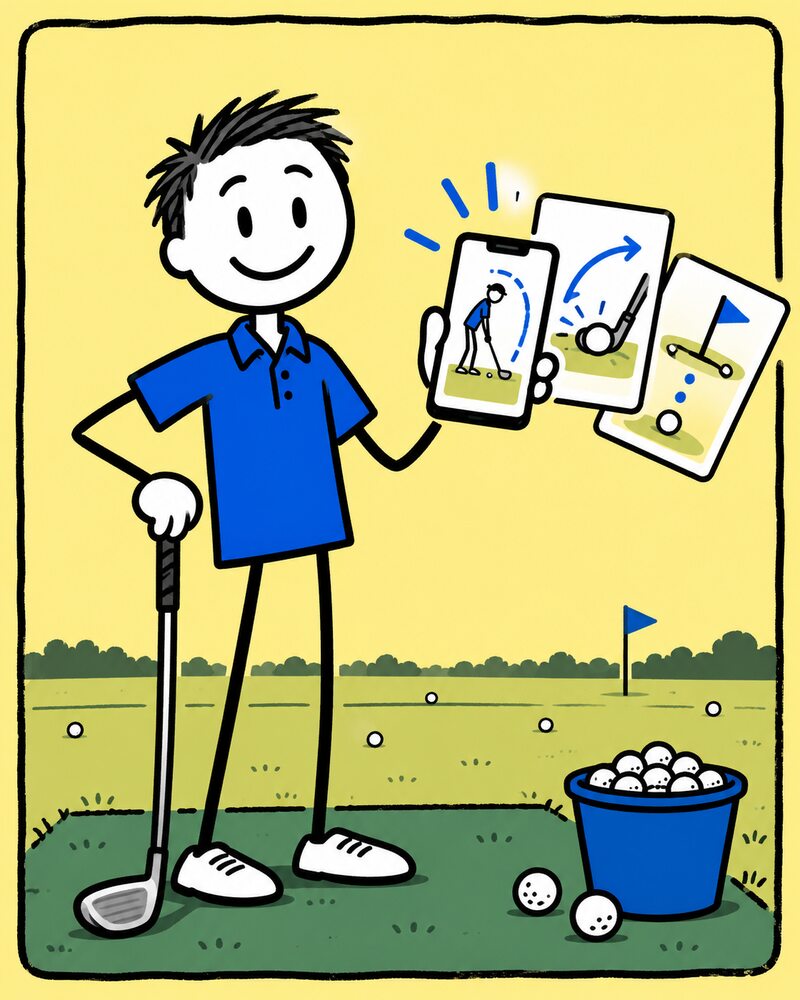

Wedge Clock Drill: Build Your Carry-Distance Chart.
Three swing lengths. Your own carry numbers.
This wedge clock drill helps you build a useful distance chart with one wedge and three repeatable backswing lengths.
“About that far” is a wonderfully flexible yardage. A few carry numbers written down can be rather more helpful when there is a bunker between you and the flag.
This is Wedge Play Card 9, Wedge Clock Yardage Matrix, in the Golf Practice Made Fun App. Play six shots each at 7:30, 9:00 and 10:30, then record the average carry for each length.
↓ Download free infographicSave to your device or print for practice.
Your drill at a glance
| Drill detail | Your session |
|---|---|
| Category | Wedge play · Card 9 |
| Benefit | Build a personal carry-distance chart for three repeatable wedge swings. |
| Practice format | One wedge; six shots each at 7:30, 9:00 and 10:30. |
| Practice record | Shots completed out of 18, plus average carry for each swing length. |
| Equipment | One wedge, practice balls, a suitable target and a way to judge and write down carry distances. |
Watch the wedge clock demonstration
Watch the video, then follow the steps below.
Step 1. Choose One Wedge and Three Swing Lengths

What to do
| Action | What to do |
|---|---|
| Pick one wedge | Use the same wedge for this 18-shot session. Write its name or loft on your practice sheet. |
| Picture the clock | Use your lead arm as the reference for 7:30, 9:00 and 10:30 on an imagined clock face. |
| Find the three lengths | Rehearse each backswing slowly so you can recognise its height. |
| Choose a steady tempo | Use a comfortable tempo you can repeat as you move between the three lengths. |
The clock position describes your lead arm. The club shaft can point at a different angle because of the wrist hinge.
Your cue: “Same wedge. Steady tempo. Three lengths.”
Step 2. Play Six Shots at Each Length
What to do
| Action | What to do |
|---|---|
| Start with 7:30 | Play six shots with the low backswing. Record each carry distance where you can judge it. |
| Move to 9:00 | Play another six with the lead arm around horizontal, keeping your tempo steady. |
| Finish with 10:30 | Play six with the higher backswing, using the same wedge. |
| Record carry | Write down the distance to the ball’s first landing point. Use yards or metres consistently throughout the session. |
Keep the practice conditions as similar as you can. On a marked range, use the available distance references to judge carry and label estimated measurements as estimates.
| Backswing length | Shots to play |
|---|---|
| 7:30 | 6 shots |
| 9:00 | 6 shots |
| 10:30 | 6 shots |
| Session total | 18 shots |
Step 3. Record Your Average Carries
What to do
| Action | What to do |
|---|---|
| Average each set | Add the recorded carries for one swing length and divide by the number of carry measurements in that set. With all six measured, divide by six. |
| Write down three numbers | Record a separate average for 7:30, 9:00 and 10:30. Keep a note of the wedge and units. |
| Record completion | Tick the shots you played and add your completed-shot total out of 18. The App records shots completed. |
| Add another wedge later | Use a later session with another wedge to build up your distance chart, one club at a time. |
Mark an unmeasured carry with a dash and note how many measurements went into its average. The shot still counts as completed. Note obvious mishits so you can judge how representative each set is.
Average carry = total recorded carry ÷ number of recorded carries.
| Your record | Write it down |
|---|---|
| Shots completed | _____ / 18 |
| 7:30 average carry | _____ yd / m |
| 9:00 average carry | _____ yd / m |
| 10:30 average carry | _____ yd / m |
George’s Practice Tip
Keep your tempo steady for the whole session. Write down the wedge, ball type and conditions beside your numbers, then repeat the session another day to see how closely the carries match.
FAQs
Does the clock position refer to my arm or the club shaft?
Use your lead arm as the reference. The shaft may point elsewhere because your wrists hinge during the backswing.
What is carry distance?
Carry is the distance the ball travels before its first landing. Record that first landing point rather than the distance after the ball has rolled.
How many balls do I hit?
Play 18 shots with one wedge: six at 7:30, six at 9:00 and six at 10:30.
How do I calculate the averages?
Add the measured carries for one swing length and divide by the number recorded. When all six are measured, divide by six. Keep the three swing lengths separate.
What if I cannot measure every shot?
Mark unmeasured carries with a dash, record how many measurements you used and calculate the average from those recorded carries. Tick every shot played for your completed-shot total.
Is the App score based on accuracy?
This card records shots completed out of 18. The three carry averages are useful extra notes for your distance chart.
Do I need to use every wedge in one session?
Use one wedge for this session. Add another wedge in a later session to build the chart gradually.
What drill do you recommend I do next?
Try the £30 Wedge Bank Drill to practise choosing carries for changing targets, or the Three Swing Lengths Drill for another carry-distance session.
Give your next practice a purpose.
Find illustrated drills, save your favourites and record your practice in the Golf Practice Made Fun App.
Try the App Free ↗14 days free · No card required