
Golf Drills Made Fun · Collegiate golf coaches
700+ Fresh practice drills for your college team.
Add variety to team practice with illustrated drill cards your players can follow.
14 days free · No card required
Phone, tablet or computer. Nothing to install.
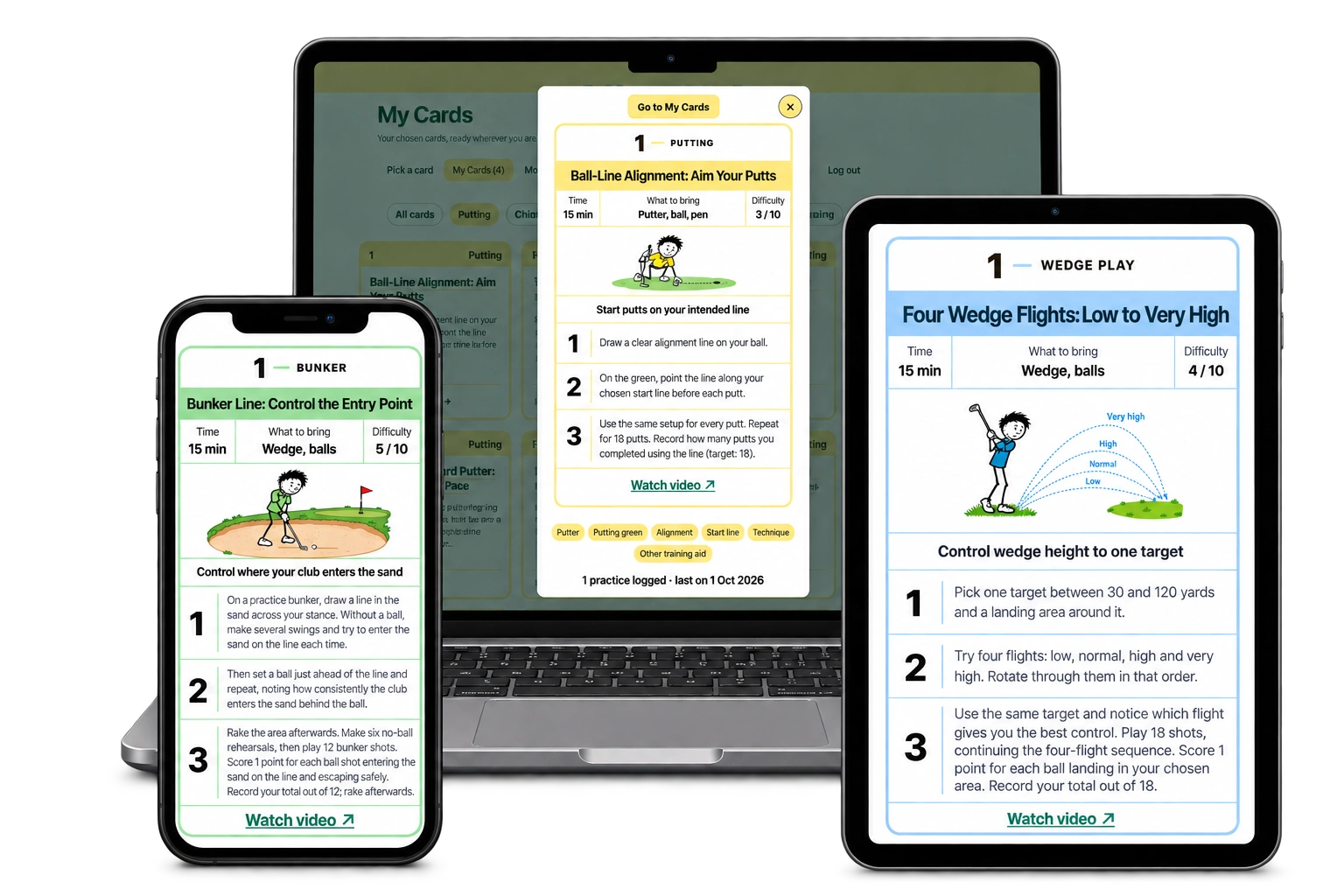
Easy as 1–2–3.
Pick a drill.
Choose a card that fits what your players are working on.
Set the game.
Show the setup, agree the rules and get everyone ready.
Let them play.
Players follow the card while you watch, coach and encourage.
Pick a card and have a play
Six ideas for your next team practice.
Open a free illustrated guide, check the setup and pick a game for your players.
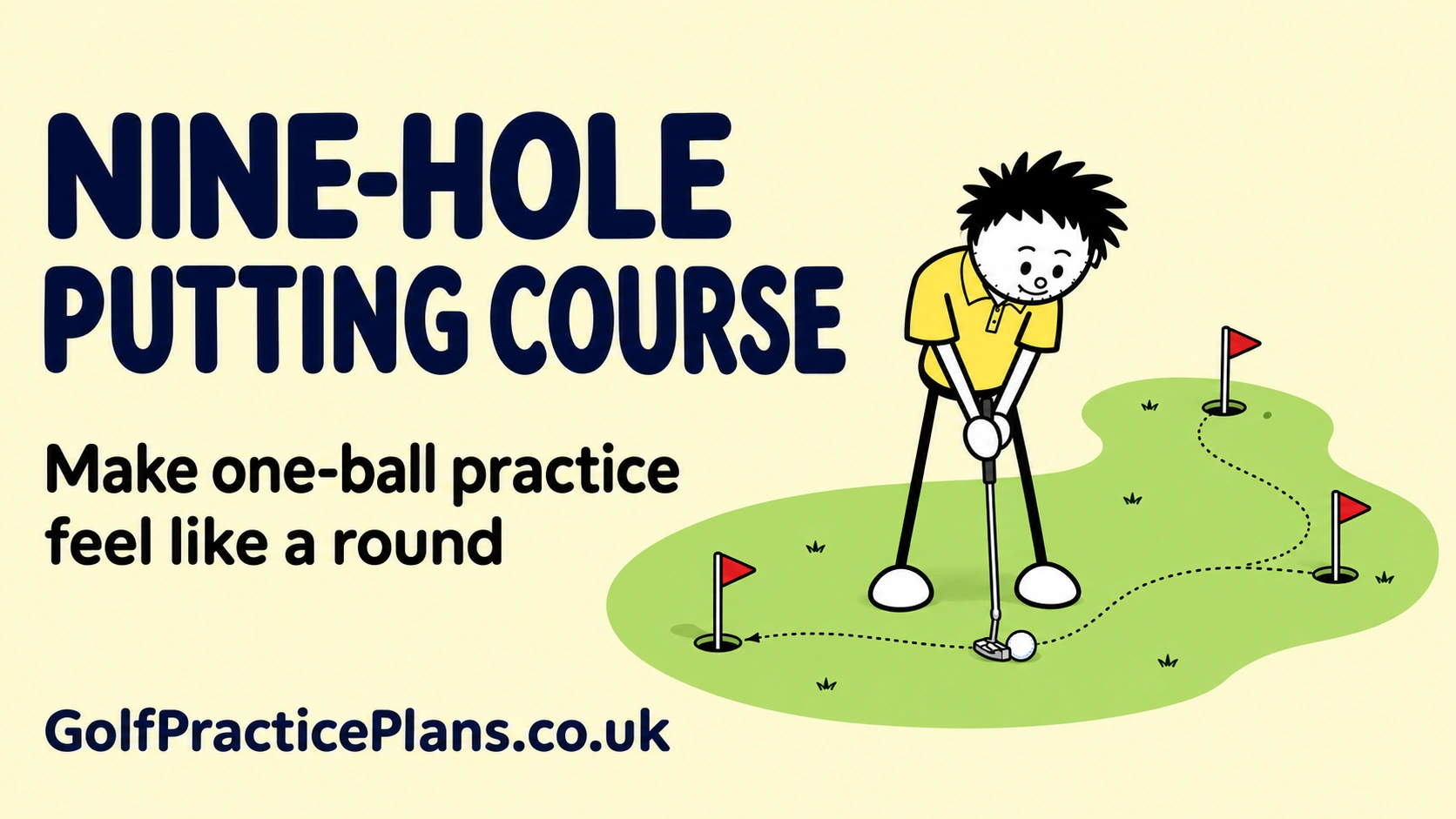
Putting
Nine-Hole Putting Course
A one-ball putting game for pairs or small groups. Can your players beat 18?

Chipping
Nine-Hole Up-and-Down
Set nine starting spots and let players test their scoring around the green.

Wedge play
£30 Wedge Bank
Give wedge practice a score: how much of an imaginary £30 can each player keep?

Bunker
Rory McIlroy Bunker Drill
Use a T in the sand to demonstrate and rehearse Rory’s bunker setup.

Long game
Closed Stance
Compare ball flight from two setups and discuss what changes.

Mind game
Chew the Fat Behind the Ball
A clear sequence for talking through a shot, then stepping in to play.
See all the drills
Browse all seven categories and choose cards for your players. Lifetime-exclusive drills are marked.
Putting104 drills
- 10-20-30 Putting Pace ChallengeLifetime
- 15-Inch Window: Practise Precise Pace
- 40–50–60 Feet: Leave an Easy Second Putt
- Alternate Distances: Reset for Every Putt
- Balance a Coin: Smooth Your Putting Stroke
- Ball-Line Alignment: Aim Your Putts
- Beat Your Best: Finish Strong
- Birdie Putt: 18 Chances, One Ball
- Block Half the Cup: Aim for the High Side
- Board Reference: Square Your Putter Face
- Brad Faxon: Read the Slope and Grain
- Breaking Putts: Match Your Line and Pace
- Breaking Putts: Pick Your High Point
- Carpet Putting: Stop Before the Towel
- Choose Your Entry Point: Picture the Final Roll
- Coin on the Face: Find the Sweet Spot
- Coin Under the Ball: Keep Your Head Still
- Double-Break Putts: Read Both Slopes
- Downhill Putts: Find the Stopping ZoneLifetime
- Eyes Closed: Predict Your Putting Distance
- Eyes on the Hole: Compare Your Putting PaceLifetime
- Film Your Stroke: Spot Unwanted Body Movement
- Find the Fall Line: Locate a Straight Putt
- First Nine vs Second Nine: Beat Your ScoreLifetime
- Five-Foot Circle: Hole Putts Under Pressure
- Flagstick Backstop: Control Your Putting Pace
- Fringe Target: Stop Just Short
- Green-Speed Test: Repeat One Stroke Length
- High, Low, Centre: Find a Better Putting LineLifetime
- Hold Your Finish: Check Your Putting Balance
- Hover or Ground: Compare Your Putting Start
- Impact Tape: Check High and Low Strikes
- Lead-Foot Balance: Steady Your Putting Stroke
- Lead-Hand Putting: Control Your Start Line
- Leapfrog Putting: Roll Just Beyond the Last Ball
- Left, Centre, Right: Choose Your Cup EntryLifetime
- Light, Medium, Firm: Compare Grip PressureLifetime
- Line or Pace? Diagnose Your Misses
- Listen to Your Putts: Recognise Clean Contact
- Long or Standard Putter: Compare Your PaceLifetime
- Long Putt, Short Putt: Practise Two-Putting
- Long Putts: Check the Slope Halfway
- Low-Side View: Read the Break
- Luke Donald: Hammer-a-Nail Putting Feel
- Match-Saving Putt: Handle the Pressure
- Medium Then Short: Reset Your ConfidenceLifetime
- Metre Ruler: Test Your Start Line
- Metronome Putting: Find a Steady Rhythm
- Mirror Check: Align Your Shoulders
- Mirror Check: Find Your Eye Position
- Nearest Without Passing: Beat Your Partner
- Nine-Hole Putting Course: Beat 18
- One Ball, One Chance: Vary Every Putt
- One Look, One Rehearsal: Trust Your Pace
- Partner Calls the Distance: React and Putt
- Partner Green Reading: Compare Your LinesLifetime
- Partner Pace Match: Copy the Stopping Distance
- Pendulum Rehearsal: Smooth Your Putting StrokeLifetime
- Photograph Your Setup: Check Where You Aim
- Picture, Look, Roll: Build Your Routine
- Predict the Break: Mark the First Turn
- Predict the Finish: Test Your Green Reading
- Putter-Head Gate: Miss the Tees
- Putter Sweet Spot: Find Centred Contact
- Putting 21: Race Your Partner to 21
- Putting Arc: Rehearse a Natural Stroke
- Putting Bingo: Call Your Target Square
- Putting Darts: Call Your Stopping Zone
- Putting Gate: Start the Ball on Line
- Putting Match Play: Win the Hole
- Putting Setup: Check Forearms and ShaftLifetime
- Random Distances: Test Your Putting Pace
- Read the Slope: Compare Feet and EyesLifetime
- Rehearse, Then Putt: Repeat the Same Feel
- Remove the Guide: Test Your Start Line
- Reset Your Grip: Release Putting Tension
- Reveal Your Score: Test Your ComposureLifetime
- Reverse Leapfrog: Stop Each Putt Closer
- Rory McIlroy: Soft or Firm Putting Challenge
- Ruler Guides: Picture a Breaking Putt
- Short-Putt Routine: Read, Aim and Settle
- Shrinking Target: Sharpen Your Pace
- Side View: Judge Uphill and Downhill Pace
- Six-Spot Putting Course: Count Every StrokeLifetime
- Split-Grip Putting: Compare Your Control
- String Line: Aim a Breaking Putt
- Striped Ball: Check for a Steady Roll
- Stroke Length: Control Your Putting Distance
- Target Box: Control Where Putts Stop
- Target Gate: Roll the Ball Through
- Ten in a Row: Putting Pressure ChallengeLifetime
- Three-Foot Putting Circle
- Three Stroke Lengths: Learn Your DistancesLifetime
- Through-Stroke Length: Compare Line and Pace
- Toe, Heel, Centre: Recognise Your Strike
- Trail-Hand Putting: Feel the Pace
- Trail Index Finger: Try a Lighter GripLifetime
- Two-Ball Test: Check Your Putter Face
- Two-Tier Putts: Judge the Change in Slope
- Two-to-One Rhythm: Smooth Your Putting StrokeLifetime
- Uphill and Downhill: Adjust Your Pace
- Uphill and Downhill: Birdie Pace Challenge
- Uphill Putts: Keep a Steady Rhythm
- Wedge Putting: Strike the Ball’s MiddleLifetime
Chipping100 drills
- Alignment-Stick Anti-Scoop Chip
- Ball Above Your Feet: Adjust Your Chip
- Ball Below Your Feet: Reach the Ball in Balance
- Belly-Wedge Chip: Escape the Fringe
- Bump-and-Run Landing SpotLifetime
- Buried-Rough Chip: Pop It Out and Run
- Buried-Rough Chip: Set the Handle Forward
- Carry-and-Roll Target Control
- Carry-to-Roll Ratio: Judge Your Landing Spot
- Chalk-Line Chip: Check Where You Brush
- Checking Chip: Practise a Spin Shot
- Chest-Turn Chip: Finish in Balance
- Chipping Carry and Roll: Learn Your DistancesLifetime
- Chipping Flight and Roll: Choose Your Landing Spot
- Chipping Grips: Compare Standard and Reverse Overlap
- Chip to a Landing Spot
- Clear the Fringe: Choose a Safe Landing Spot
- Cross-Handed Chipping: Steady Your Wrists
- Downhill Lie: Compare the Flight and RollLifetime
- Feet Together: Test Your Chipping Balance
- Five-in-a-Row Chipping Pressure
- Foam-Ball Basket Challenge: Control Your Chip Carry
- Four-Cone Carry-and-Roll Practice
- Four-Target Chipping Darts
- Fringe vs Rough: Choose the Right Chip
- Gap-Wedge Chip: Carry Half, Roll Half
- Glove Under the Trail Arm: Connect Your Chip
- High-Chip Setup: Add Loft for a Soft LandingLifetime
- High Chip: Land the Ball Steeply
- Hinge and Hold: Control Your Chip Release
- Hold Your Finish: Test Your Chipping Balance
- Hoop and Stopping Zone: Control Carry and Roll
- Hybrid vs Putter: Test Your Fringe Control
- Indoor Towel Contact Check
- Iron vs Wedge: Choose the Shorter Putt
- Jason Day: Rehearse Your Towel LandingLifetime
- Landing Spot First: Then Choose Your ClubLifetime
- Lead-Arm Chipping: Control Your Release
- Lead-Leg Chipping: Steady Your Strike
- Lead-Leg to Normal Stance: Repeat a Stable Chip
- Leapfrog Chipping: Land at the Last Ball’s Finish
- Light-Thumb Grip: Find Your Chipping Touch
- Lob-Wedge Chip: Start with Three-Quarter Carry
- Lob Shot: Reduce the RolloutLifetime
- Low vs High Chip: Compare the RolloutLifetime
- Match the Landing Spot to the Flight
- Near, Middle, Far: Chipping Landing Ladder
- Nine-Hole Up-and-Down Challenge
- Nine-Iron Chip: Read the Line to the Cup
- Nine-Iron Chip: Start with One-Third Carry
- Nine-Iron Chip Across a ShelfLifetime
- One Ball, One Chance: Vary Every Chip
- One Towel, Three Wedges
- One Wedge, Three Shots: Low, Spin and High
- Par 18: Test Your Short Game
- Perched-Rough Chip: Avoid Sliding Under
- Ping-Pong Chipping: Practise High and LowLifetime
- Putting-Style Chip: Simplify Your Stroke
- Random Chipping: Beat Your First Nine
- Random Chipping: Change the Lie and TargetLifetime
- Read the Rough Before ChippingLifetime
- Rehearse, Then Chip: Repeat the Grass Brush
- Safe Landing Zone: Allow Room for Error
- Scatter and Choose: Plan Every Chip
- Scatter and Hole Out: Test Your Up-and-DownsLifetime
- Seven-Iron Chip: Start with a Quarter Carry
- Seven-Iron vs Lob-Wedge: Compare Carry and Roll
- Short-Sided Rough: Land It Softly
- Short Game Routine to Build RhythmLifetime
- Side-Slope Chip: Read the Roll
- Sitting-Up Rough: Pick the Ball Cleanly
- Soft-Grip Chipping: Find a Freer Swing
- Soft Shot: Release the Clubhead
- Spare-Wedge Guide: Check Your Swing PlaneLifetime
- Sternum Forward: Turn Through Your ChipLifetime
- Thick-Rough Chip: Escape CleanlyLifetime
- Three-Club Chipping: Learn Your Rollout
- Three-Wedge Towel CalibrationLifetime
- Three Chipping Keys: Setup, Handle and Turn
- Three Landing Boxes: Match the Club to the Carry
- Three Lies: Adjust Your Chipping Delivery
- Three Lies: Chip and Putt for Par
- Three Ways to Stop a Chip
- Tight-Lie Chip: Brush the Grass
- Toe-Down Chip: Compare Your ContactLifetime
- Towel Behind the Ball: Avoid Heavy Chips
- Towel Landing and Rollout Check
- Towel Target: Practise Precise Chip Landings
- Trail-Arm Chipping: Feel a Soft Release
- Trail Foot Back: Find Cleaner Chip Contact
- Trail Hand to Both Hands: Repeat Clean Contact
- Turn Up and Around: Strike Chips Cleanly
- Underarm-Roll Chipping Feel
- Underarm-Toss Chipping Feel
- Uphill Chip: Match Your Setup to the Slope
- Uphill Lie: Judge Your Chip Distance
- Walk-In Chipping RhythmLifetime
- Wedge Bounce: Compare Two Setups
- Wind and Lie: Plan Your Chip
- “Against The Grain” Chip
Bunker101 drills
- After a Poor Bunker Shot: Reset and Repeat
- Back Bunker Lip: Check Your Backswing ClearanceLifetime
- Back Lip vs Open Lie: Adjust Your Backswing
- Ball Below Your Feet: Balance Through the Splash
- Ball Below Your Feet: Check Your Reach
- Ball Position: Keep It Forward of Centre
- Banknote Splash: Control Your Sand Divot
- Breathe and Commit: Trust Your Bunker Swing
- Broad Green Target: Build Bunker Escape Confidence
- Bunker Carry and Roll: Predict Both
- Bunker Distance: Change Your Swing Length
- Bunker Divot Check: Avoid Digging Too Deep
- Bunker Escape Challenge: Beat Your BestLifetime
- Bunker Face Check: Keep the Loft Through ReleaseLifetime
- Bunker Finish Length: Compare Near and Far Carry
- Bunker Landing Zone: Adjust Your Carry
- Bunker Line: Control the Entry Point
- Bunker Stance Width: Compare Two SetupsLifetime
- Buried Lie: Escape the Bunker FirstLifetime
- Call Your Landing Spot: Test Bunker Carry
- Change Bunker Targets: Keep Your Chest TurningLifetime
- Chest-Turn Finish: Keep Moving Through the Splash
- Choose the Open Side: Plan an Easier Escape
- Clip a Tee: Rehearse Your Bunker SplashLifetime
- Compact Sand: Aim for the Open Green
- Compact Sand: Predict Your Bunker CarryLifetime
- Crosshair Lines: Check Bunker Aim and Ball Position
- Crosshair Lines: Test Your Bunker Start Direction
- Downhill Bunker Lie: Swing Along the Slope
- Downhill vs Level Bunker Lies: Compare Your Contact
- Fairway Bunker: Check for Ball-First Contact
- Fairway Bunker: Hold a Balanced Finish
- Fairway Bunker: Learn Your Carry DistanceLifetime
- Fairway Bunker: Progress from Short to Mid Irons
- Fairway Bunker: Start Inside Your Target Corridor
- Fairway Bunker: Test a Shorter Backswing
- Fairway Bunker Lay-Up: Reach Your Safe Zone
- Fairway Bunker Lip: Choose Enough Loft
- Find Your Bunker Rhythm, Then Add a TargetLifetime
- Finish the Swing: Avoid Stopping in the SandLifetime
- Firm Sand: Adjust Your Face and Swing
- Firm vs Soft Sand: Reach the Same Target
- First-Shot Bunker Test: Reset Every Time
- Grass to Sand: Repeat Your Balanced Iron Swing
- High Bunker Lip: Practise Clearing It
- High Bunker Shot: Aim for a Broad Landing
- High Bunker Splash: Hit the Landing Square
- Hinge and Release: Let the Wedge Swing ThroughLifetime
- Imaginary Ball, Real Target: Control Your Bunker Landing
- Imaginary Second Ball: Find Sand-First Contact
- Keep the Face Open: Hit Your Bunker Target
- Lead-Side Pressure: Avoid Leaning Back
- Listen to the Sand: Recognise Solid Contact
- Long Bunker Shot: Turn for More CarryLifetime
- Lower Your Hands: Clear the Bunker Lip
- Near, Middle, Far: Bunker Landing Ladder
- Near and Far Bunker Targets: Alternate Your CarryLifetime
- Nine-Iron Bunker Shot: Carry Low and Run
- Nine-Iron vs Wedge: Choose Your Bunker Route
- One-Ball Fairway Bunker: Read, Choose and PlayLifetime
- One Bunker Cue: Splash Towards the Target
- One Rehearsal, One Cue: Splash Through
- One Wedge, Three Distances: Control Bunker Carry
- Open, Grip, Aim: Keep the Bunker Face Set
- Open, Grip, Reset: Rebuild Your Bunker Setup
- Plan Your Bunker Shot: Lie, Landing and Carry
- Plugged Bunker Lie: Allow Room for RolloutLifetime
- Plugged Bunker Lie: Choose the Lowest Exit
- Plugged Lie: Compare a Heel-First Escape
- Plugged Then Clean: Reset Your Bunker Technique
- Plugged vs Clean Lie: Choose Your Bunker Method
- Predict the Sand: Test Your Bunker Adjustment
- Random Bunker Targets: Adjust Your Swing Length
- Read the Sand: Choose Firm or Soft TechniqueLifetime
- Rehearse the Turn: Repeat It in the Sand
- Remove the Lines: Test Your Bunker Setup
- Reset Your Feet: Build a Stable Bunker Stance
- Reset Your Grip: Release Bunker Tension
- Restricted Backswing: Choose a Clear Bunker Exit
- Rory McIlroy: T-Line Setup and Bunker Splash
- Say Your Cue: Then Play the Bunker ShotLifetime
- Settle, Splash, Watch: Build Your Bunker Routine
- Shallow vs Deep Plugs: Compare Bunker Escapes
- Short Bunker Shot: Shorten the Swing, Keep Flow
- Sidehill vs Level Bunker Lies: Adjust Your StanceLifetime
- Soft Sand: Use the Wedge’s Bounce
- Splash Without a Ball: Find Your Entry PointLifetime
- Square Bunker Stance: Check Your Starting Direction
- Switch Bunker Targets: Keep Your Loft
- Three Bunker Checks: Face, Ball and Entry Point
- Three Bunker Lies: Reset Before Every Shot
- Three Bunker Spots: Escape on the First Attempt
- Three Plugged Lies: Reassess Each Bunker Escape
- Three Targets: Repeat Your Bunker Setup Checks
- Towel Connection: Turn Through Your Bunker Shot
- Trail-Hand Rehearsal: Free Your Bunker Release
- Two Wedges: Compare Your Bunker Carry
- Uphill Bunker Lie: Match the Slope
- Watch the Sand: Focus Behind the Ball
- Wet vs Dry Sand: Adjust Your Splash
- Wide Bunker Stance: Stay Stable Through the Splash
Wedge play104 drills
- 20–40–60 Yards: Test Your Pitching Carry
- 30–40–50 Yards: Control Your Half Wedge
- 50-Yard Pitch: Hit Your Carry Window
- After a Recovery: Choose a Sensible Wedge TargetLifetime
- Alternate Wedges: Keep the Same Carry
- Annika Sorenstam: Cross-Leg Half-Wedge Drill
- Back-Flag Pitch: Land Low and Allow Rollout
- Beach-Towel Target: Control Your Wedge Landing
- Between Wedge Distances: Compare Two Clubs
- Body-Turn Wedge: Control a Compact Finish
- Brush, Then Pitch: Repeat Your Turf ContactLifetime
- Call Your Club and Swing: Test Your Wedge Chart
- Chest-Led Pitch: Adjust Your Turn for Distance
- Chest Over Hips: Strike Your Pitches Cleanly
- Choose the Landing Spot: Then Play Your Pitch
- Clean and Dry: Build Your Pitching RoutineLifetime
- Cradle, Then Pitch: Repeat the Turning Feel
- Cradle the Ball: Rehearse Your Pitching TurnLifetime
- Downwind Pitch: Judge Carry and Rollout
- Draw, Straight, Fade: Compare Your Wedge FlightsLifetime
- Fixed vs Random Targets: Test Your Wedge Carry
- Four Wedge Flights: Low to Very High
- Freddie Couples Weak Left Hand
- Full-Wedge Target: Control Carry and Direction
- Full Wedge: Measure Your Carry Range
- Full Wedge vs Partial Swing: Compare Your Accuracy
- Grip-Down Pitch Test: Change One Variable
- Grip Down: Map Three Wedge Distances
- Grip Down: Take Yards off Your Stock Wedge
- Half-Wedge Pitch: Compare Landing and Rollout
- Half vs Three-Quarter Wedge: Compare Carry and Contact
- High, Soft Wedge: Land Beyond the Towel
- Higher, Softer Wedge: Practise a Shorter CarryLifetime
- Hit-and-Hold Wedge: Control Your 40-Yard Pitch
- Hold Your Pitching Finish: Test Your Balance
- Jumper Connection: Move Arms and Chest Together
- Land Short, Roll Close: Judge Your Pitch Rollout
- Lead-Side Pitch: Finish Without Falling Back
- Leapfrog Pitching: Land Beyond the Previous Ball
- Let the Wedge Swing: Avoid ScoopingLifetime
- Longer swing, longer pitch
- Look, Feel, Pitch: Match Your Rehearsal RhythmLifetime
- Low-Launch Gate: Send Wedges Under the NoodleLifetime
- Low-Launch Wedges: Climb the Carry Ladder
- Low vs Normal Wedge: Compare Carry and RollLifetime
- More Loft or Less Swing: Compare Your Pitches
- Narrow vs Normal Stance: Compare Pitching Balance
- Nine Wedge Flights: Combine Height and Curve
- One Distance, Two Options: Compare Your WedgesLifetime
- One Pitch, One Chance: Vary Your Target
- One Rehearsal, One Pitch: Repeat Your Routine
- Partner Calls the Target: React with Your Wedge
- Pete Cowen: Chalk-Line Wedge Contact
- Pitch Carry and Roll: Measure Both Distances
- Pitch Contact Map: Compare Strike and Landing
- Pitching Carry Band: Control Short and Long Misses
- Pitching Direction Corridor: Check Left and Right MissesLifetime
- Pitching Setup: Stance, Pressure and Ball Position
- Pocket Wedge Chart: Record Your Stock Shots
- Predict Your Wedge Carry: Check Your Distance Chart
- Random Wedge Distances: Change Every Shot
- Remove the Towel: Test Your Pitching Contact
- Reset Every Pitch: Choose, Rehearse and Commit
- Retest Your Wedge Chart: Repeat Three Stock Shots
- Reverse Wedge Ladder: Shorten Your Carry Smoothly
- Rory McIlroy Bump and Run
- Rory McIlroy One-Hop Stop Chip
- Same Carry, Different Roll: Compare Two Wedges
- Short, Long, Target: Find Your Wedge DistanceLifetime
- Short-Swing Wedge Chart: Find Your Distance GapsLifetime
- Shrinking Landing Square: Sharpen Your Pitch AccuracyLifetime
- Six-Target Wedge Ladder: Increase Carry in StepsLifetime
- Square vs Open Face: Compare Pitch Height and Roll
- Steady Spine: Keep Your Pitching Posture
- Stock Wedge Shot: Measure Your Landing Spread
- Three-Quarter Swing: Chart Three Wedge Carries
- Three-Yard Landing Square: Test Pitch Accuracy
- Three Swing Lengths: Learn Your Wedge Carry
- Three Wedges, One Target: Compare Your Control
- Tick-Tock Pitching: Find a Steady Rhythm
- Tight-Lie Pitch: Turn with Quiet Hands
- Towel Behind the Ball: Avoid Heavy Pitches
- Towel Connection: Rehearse Your Pitch at Home
- Towel Connection: Turn Through Your Pitch
- Trail-Hand Wedge: Feel the ReleaseLifetime
- Trail Foot Back: Compare Your Pitching Contact
- Turn Through Your Pitch: Hold the Finish
- Turn Your Trail Shoulder: Finish Towards the Target
- Two Landing Spots, One Flag: Compare Your Pitches
- Two Pitch Distances: Keep the Towel Clear
- Two Pitch Targets: Keep Arms and Chest ConnectedLifetime
- Two Wedges, One Gate: Compare Low Flights
- Underarm Toss: Feel a Smooth Pitching Motion
- Waist-High Swing: Map Three Wedge Distances
- Waist-High Wedge: Repeat Your Recorded CarryLifetime
- Waist-to-Waist Wedge: Learn Your Stock Carry
- Watch the First Bounce: Learn Your Pitch Pattern
- Wedge Birdie Challenge: Hit Six Approach Targets
- Wedge Clock Yardage Matrix
- Wedge into the Breeze: Practise a Lower Flight
- Wedge Ladder: 50 to 100 YardsLifetime
- Wedge Ladder: Practise the In-Between Distances
- Wedge Sole Brush: Avoid Digging into the Turf
- £30 Wedge Bank: Reduce Your Distance Error
Long game132 drills
- 18-Ball Pattern: Discover Your Usual Miss
- Alignment: One Stick
- Alignment: Two Sticks
- Annika Sorenstam Glove Under Armpit
- Anti-Shank: Address Outside, Hit Inside
- Anti-Shank: Keep Clear of the Outside Marker
- Anti-Slice: Split-Hand Downswing RehearsalLifetime
- Anti-Slice: Two-Tee Swing Path
- Anti-Slice Downswing: Pool Noodle
- Arms Through Impact: Extend Without Locking
- Backswing Width: Rain JacketLifetime
- Ball-First Contact: Marker Behind
- Ball Above Your Feet: Adjust Your AimLifetime
- Ball Below Your Feet: Balance Your Strike
- Baseball Step: Swing Through in Balance
- Beach Ball: Connect Your Arms and Turn
- Body Motion: Turn, Shift and Straighten
- Body Sequence: Shift, Turn and Finish
- Broom Swing: Turn Through Without FlippingLifetime
- Centred Turn: Shift Without Swaying
- Chair Check: Turn Without Swaying
- Clear Your Hips: Make Room to Swing
- Closed Stance: Compare Your Ball Flight
- Clubface Check: Avoid Rolling It Open
- Clubface First: Check Your Aim
- Coat Hanger: Check Your Lead Wrist
- Coin Beyond the Ball: Find Your Low Point
- Collarbone to Collarbone: Feel Your TurnLifetime
- Connected Backswing: Turn Chest and Arms Together
- Deep Rough: Choose Your EscapeLifetime
- Divot Line: Strike the Ball, Then the Turf
- Downhill Lie: Check Your Flight and Carry
- Draw-to-target rehearsal
- Driver Strike Map: Find the Centre
- Driver Toe or Heel: Compare Your Strikes
- Early Wrist Set: Pause, Then Turn
- Fade-to-target rehearsal
- Fairway Wood: Sweep It from the Turf
- Fairway Wood or Hybrid: Compare Your Launch
- Feet-Together Step: Move Onto Your Lead Side
- Feet Together: Find Your Swing Balance
- Five-Ball Walk-Through: Keep the Swing FlowingLifetime
- Flamingo Finish: Hold Your Balance
- Flowing Towel Swings: Relax Your Arms
- Francesco Molinari Power Jump
- Frisbee Throw: Feel Your Lead-Side Release
- Gary Player Walk-Through: Finish on Your Lead Side
- Grip-End Tee: Check Your Takeaway
- Grip Pressure: Try a Lighter Hold
- Hands Together: Rehearse Your Impact Sequence
- Head-to-Wall: Feel a Steadier Turn
- Headcover Anti-Slice: Clear the Inside Barrier
- Headcover Barrier: Avoid the ShankLifetime
- High Tee: Sweep Your Driver Upwards
- Hip Bump: Shift, Then Turn
- Hip Rotation: Lead the Downswing
- Hips First: Rehearse Your Transition
- Hit, Hold and Check Your Finish
- Hybrid from Rough: Practise Cleaner Contact
- Impact Bag: Find a Balanced Strike Position
- Impact Freeze: Hold Your Strike Position
- Iron Strike Map: Find Your Contact Pattern
- Johnny Miller 3-Part Stop at Impact
- Knockdown into windLifetime
- L-to-L: Build Your Half-Swing ReleaseLifetime
- Lag Rehearsal: Let the Clubhead Follow
- Lead-Side Finish: Practise Your Weight Transfer
- Lightning Hands for More Distance
- Loose Arms: Find a Softer Swing
- Nick Faldo Low Fade: Keep the Finish Low
- Nick Faldo One Wrap: Complete Your Finish
- Nick Faldo Wing Up: Driver Fade RehearsalLifetime
- Nine Holes on the Range: Choose Every Shot
- One-Hand Swings: Compare Feel and Control
- Palm-Up Backswing: Fold Your Trail Elbow
- Pause at the Top: Sequence Your Downswing
- Pete Cowen Resistance Band
- Pete Cowen Signature Stick
- Pete Cowen Solid Foundation
- Pete Cowen Spinning Right Arm
- Pete Cowen Spiral Staircase
- Pete Cowen Tennis Ball
- Pete Cowen Towel-Wringing
- Random Target Range Challenge
- Resistance Band: Turn Against Light Tension
- Reverse Grip: Explore Your Iron Contact
- Rope Swing: Find a Smoother Rhythm
- Rory McIlroy Club in Front
- Rory McIlroy Mini-Club Drill
- Rory McIlroy Shift, Turn and Balance
- Rory McIlroy Split-Hand Speed Rehearsal
- Set Your Wrists, Then Turn
- Shadow Check: Watch Your Posture
- Shift and Turn: Stay Over the Strike
- Shorter Backswing: Find Repeatable Contact
- Shoulder-to-Shoulder: Match Your Swing Length
- Shoulder Tilt: Turn Under Your ChinLifetime
- Smooth Start Down: Let Your Arms FollowLifetime
- Sock Push: Feel Hands Ahead at Impact
- Soft Transition: Shift, Float and Turn
- Split Grip: Feel Your Backswing Width
- Split Stance: Compare Your Iron ContactLifetime
- Stacked Hands: Feel a Freer Release
- Stare at the Target, Glance at the Ball
- Steady Posture: Keep Your Tilt Through Impact
- Step Away and Reset: Repeat Your Ball Position
- Step Into the Downswing: Find Your Timing
- Swing-Path Pump: Match the Ground GuideLifetime
- Tee Behind the Ball: Guide Your Takeaway
- Three-Ball Backswing: Guide Your Takeaway
- Three-Club Test: Know Your Carry Gaps
- Three Ball Positions: Compare Your Iron FlightLifetime
- Three Pauses, Then Hit: Repeat Your Backswing
- Three Tee Heights: Find Your Driver Strike
- Tiger Woods Magic Box Drill
- Towel Behind the Ball: Strike Ball FirstLifetime
- Towel Between Knees: Steady Your Lower Body
- Towel Stretch: Feel Your Arm Width
- Towel Wrap: Connect Your Takeaway
- Trail-Hand Lift: Find an Easy RhythmLifetime
- Trail Foot Back: Pump, Then Hit
- Trail Foot Back: Turn Into Your Hip
- Trail Hip Turn: Start Your BackswingLifetime
- Two-Stick Check: Measure Your Shoulder Turn
- Two-Stick Swing Lane: Practise a Clear Path
- Two-Stick Takeaway: Check at Waist Height
- Two Pumps, Then Swing Through
- Under the Branches: Practise Your Punch Shot
- Uphill Lie: Check Your Carry
- Wall Check: Keep Your Takeaway Clear
- Whoosh Past the Ball: Time Your SpeedLifetime
- Wrist Set: Pause, Check and Turn
Golf fitness101 drills
- Assisted single-leg balance
- Band Downswing Holds: Practise Three Positions
- Band Hip Turn: Rotate with Control
- Band Pull-Through: Practise Your Hip HingeLifetime
- Band Shoulder Rotation: Keep Your Elbow TuckedLifetime
- Bear Crawl: Move Opposite Hand and Foot
- Bird Dog: Balance Without Twisting
- Bodyweight squat for leg strength
- Box step-up leg strength
- Cat-cow spinal mobility
- Club Across Your Chest: Practise a Hip Hinge
- Cross-Body Arm Stretch: Keep Your Shoulder Down
- Dead Bug: Move Opposite Arm and Leg
- Donkey Kick: Lift Without Arching Your Back
- Doorway chest stretch
- Dumbbell floor press
- Dynamic pre-round warm-up
- Feet-on-Wall Hip Stretch: Move Feet Apart
- Figure-Four Hip Stretch: Move Gently In and Out
- Fire Hydrant: Lift Your Knee Without Twisting
- Foam-roller upper-back extension
- Forward-Leaning Step-Up: Lift and Lower with Control
- Forward Lunge: Push Back into Balance
- Glute Bridge: Lift, Hold and Lower Slowly
- Goblet Squat to a Box: Touch, Then Stand
- Golf-Club Shoulder Raise: Rotate, Press and Return
- Golf-Club Wrist Lift: Use a Short LeverLifetime
- Half-Kneeling Arm Circle: Follow Your Hand
- Half-Kneeling Band Turn: Rotate with ControlLifetime
- Half-Kneeling Chest Turn: Keep Your Hips Facing Forwards
- Half-kneeling medicine-ball bounce pass
- Half-kneeling medicine-ball side toss
- Half-kneeling rotational row
- Half-Kneeling Windmill: Open Your Chest
- Hands-and-Knees Chest Turn: Open Your ElbowLifetime
- Hands-and-Knees Hip Rotation: Move the Foot Out
- Hip-flexor stretch with side bend
- Hip Hike: Lift Your Pelvis on a Step
- Hip Mobility Circuit: Switch, Swing and Shift
- Hip Turns: Keep Your Chest Facing Forwards
- Inner-Thigh Rockback: Ease into the Hip HingeLifetime
- Kettlebell Golf Turn: Keep the Weight Close
- Kettlebell Side Steps or Hops: Stay Balanced
- Knee-Supported Side Plank: Hold Your Hips Up
- Knee-to-Wall Ankle Test: Keep Your Heel DownLifetime
- Kneeling Halo: Circle the Weight with Control
- Light Kettlebell Deadlift: Practise a Controlled Hip HingeLifetime
- Loop-band hamstring curlLifetime
- Lying Neck Turns: Move Gently Side to Side
- Medicine-Ball Side Toss: Turn Hips and ChestLifetime
- Medicine-ball squat to side toss
- Modified Starfish: Open and Cross the Bent LegLifetime
- Open-Book Rotation: Keep Your Knees Together
- Overhead Medicine-Ball Slam: Bend, Throw and Reset
- Pallof Press: Resist the Band’s Pull
- Plank Pull-Through: Move Weight, Keep Hips Still
- Resistance-Band Backswing: Turn and Return Slowly
- Resistance-band face pull
- Resistance-band pull-apartLifetime
- Resistance-band split squat
- Resisted Wrist Curl: Use Your Other Hand
- Reverse Clam: Lift Your Foot, Keep Knees Together
- Reverse Lunge: Return to Single-Leg Balance
- Reverse Lunge and Turn: Move in Balance
- Rotational Hip Hinge: Turn Without Twisting Your Knee
- Seated 90/90 hip switches
- Seated 90/90 Stretch: Turn Towards Your Front Thigh
- Seated Band Chop: Keep the Ball Steady
- Shoulder Warm-Up: Raise and RotateLifetime
- Side-Lying Chest Turn: Compare Both Sides
- Side-lying leg raisesLifetime
- Side Lunge to Crossover: Practise Controlled Footwork
- Side Plank: Lift and Hold with Knee Support
- Sideways Band Walk: Keep Your Hips LevelLifetime
- Sideways Medicine-Ball Throw: Pivot and Finish Balanced
- Single-Arm Doorway Stretch: Open Your Chest
- Single-arm row strength
- Single-leg glute bridgeLifetime
- Single-leg rotational control
- Split-Stance Pallof Hold: Resist the Band’s Pull
- Split Squat: Lower and Rise Without Stepping
- Squat and Reach: Warm Up Before PracticeLifetime
- Stability-Ball Chest Turns: Keep Your Hips Level
- Stability-Ball Plank: Keep the Ball Still
- Standing resistance-band press
- Standing resistance-band row
- Standing Windmill: Hinge with One Arm RaisedLifetime
- Step-up with rotation
- Suitcase Carry: Walk Tall Without Leaning
- Supported hamstring stretch
- Supported Hip Airplane: Control the Turn
- Supported Side-Plank Turns: Alternate Sides
- Supported Side Squat: Shift Your Hips Sideways
- Supported Wrist Circles: Keep Your Forearm Still
- Tall-kneeling medicine-ball side tossLifetime
- Three-Point Plank: Lift a Hand Without TwistingLifetime
- TRX Single-Leg Squat and Hinge: Use the Straps
- Wall Lat Stretch: Hinge Back with Soft Knees
- Wrist-and-forearm stretch
- Wrist Side-Bend Hold: Little-Finger Direction
- Wrist Side-Bend Hold: Thumb Direction
Mind game101 drills
- 18-Action Practice Plan: Schedule and Complete Each Task
- After a Great Drive: Reassess the Approach
- After a Missed Drive: Keep One Familiar Cue
- After an Interruption: Recheck Your Shot PlanLifetime
- After the Shot: Take a Brief Reset
- Allow a Miss: Commit Without Steering
- Any Playing Partner: Keep Your Preparation Standard
- A poor warm-up is not a forecastLifetime
- Background Conversation: Keep Attention on Your Target
- Ball-Target Focus Reset
- Before the Shot: Check Breathing, Shoulders and Hands
- Between-Shot Walk: Breathe, Then Choose a TargetLifetime
- Breathing Routine: Swing Without Holding Your Breath
- Change Clubs: Keep a Clear Warm-Up Purpose
- Change the Target: Keep Your Trusted CueLifetime
- Chipping Focus: Brush Towards the Landing Spot
- Commit to the Shot: Swing Freely
- Competition Readiness: Rehearse Your Four-Part Plan
- Confidence Bank: Record Specific Golf Successes
- Decide Behind the Ball: Then Step In
- Describe the flight in words
- Difficult Shot: Check the Facts Before Choosing
- Drop Perfect-Shot Demands: Judge What You ControlLifetime
- Energy and Worry: Choose a Useful Shot Response
- Familiar Shot: Recall Why You Can Play ItLifetime
- Feel Your Shot: Rehearse Rhythm and BalanceLifetime
- Find Your Routine Rhythm: Avoid Rushing or RecheckingLifetime
- Finish warm-up with familiar shots
- First-Tee Nerves: Name the Feeling as EnergyLifetime
- First-Tee Worry: Replace Predictions with Facts
- Four-R Routine: Refocus, Routine, React and Relax
- Full-Swing Focus: Give the Club a Task
- Give every short putt equal care
- Golf Breathing: Rehearse an Easy In and Out
- Golf Goal Plan: Link Results to Practice Actions
- Golf score is not your identityLifetime
- Good Shot or Bad: Practise the Same ResetLifetime
- Jack Nicklaus: Make Every Practice Ball Count
- Jack Nicklaus: Picture Your Shot as a Film
- Keep the casual-round mindsetLifetime
- Last Round’s Challenge: Practise a Planned ResponseLifetime
- Map the hole from green to tee
- Name the Emotion: Choose the Next Shot Task
- New Golf Habit: Count Deliberate Repetitions
- Next Shot Cue: Reset Between Balls
- Nick Faldo: Five-Iron Round at a Brisk Pace
- Nick Faldo: Give Your Shot Shapes NicknamesLifetime
- Night-Before Visualisation: Rehearse Your Tee Shots
- Notice what makes golf enjoyable
- One-Word Cue: Simplify Your Swing Intention
- One Ball per Hole: Simulate Your Tee Shots
- One Process Goal: Give Each Nine a Focus
- One Round, Long-Term Goal: Review Your Progress
- One routine habit at a time
- One Setup Check: Settle, Then Play
- Opening Three Holes: Give Every Shot Full Attention
- Park Extra Thoughts: Play with One Cue
- Partner Routine Check: Target, Intention and Commitment
- Percentage Golf: Choose for Your Own CapabilitiesLifetime
- Picture the Shot: Accept the Actual Result
- Plan a par-five lay-up route
- Plan Behind the Ball: Decide, Then Play
- Plan the opening three tee shots
- Playing-Mode Warm-Up: Prepare Shots, Save Swing Repairs
- Play with Nerves: Prepare Without Waiting for Calm
- Poor Start: Give the Next Shot Full Preparation
- Pre-Round Plan: Focus on What You ControlLifetime
- Pressure Putting: Build Your Longest Streak
- Purposeful Practice: Apply Your Cue and Record Learning
- Putting Focus: Trust Your Line and Pace
- Putting Pace: Rehearse the Roll You Want
- Random Practice: Choose a Fresh Shot Task
- Read the Putt: Decide Once, Then CommitLifetime
- Round Review: Find a Positive and a Learning Point
- Save swing repairs for practice
- Score the process before the result
- Shot Feedback: Use Facts Instead of Harsh Labels
- Slow Play: Wait Calmly, Prepare Without Rushing
- Stay engaged when playing well
- Step Away on Doubt: Reset Your Shot DecisionLifetime
- Stop Comparing Scores: Choose Your Own Target
- Stop forecasting the final score
- Switch Focus: Rest Between Shots, Engage Before Playing
- Target-Look Routine: Avoid Extra ChecksLifetime
- Target Window: Picture a Realistic Flight
- The final-ball pressure test
- Three Breaths: Refocus Before Your Tee Shot
- Time Your Routine: Keep a Comfortable Pace
- Tournament Rehearsal: Score Your Pre-Shot Routine
- Trouble Shot: Plan the Exit and Next Position
- Trust a coach-approved change
- Two Cues: Rehearse the Skill, Prepare the Mind
- Two Scores: Track Preparation and Target HitsLifetime
- Two Target Sizes: Keep Your Preparation Under Pressure
- Under Pressure: Breathe, Target and Commit
- Visualise, Then Play: Compare Your Commitment
- Wandering Attention: Return to the Next Target
- Watched vs Unwatched: Keep Your Tee-Shot Routine
- Windy Golf: Adjust Your Target and Expectations
- Winning Ambition: Turn It into a Shot Task
- Worst-Ball Challenge: Play from the Poorer Result
Colour-coded practice cards
Seven colours.
One clear system for your team.
Each practice area has its own colour. Pick the categories for your session and help players spot the right cards quickly.


Tap a card to take a closer look.
Three easy ways to use the cards.
Team practice.
Pick a drill for everyone to play together.
Solo practice.
Give each player a card to practise between sessions.
A friendly competition.
Choose a scoring drill and see who comes out on top.
Get the team playing
Same game.
Different bragging rights.
Create a private Golf Circle with your players. Choose shared drills or a 30-day challenge they can join at their own pace.
For a simple team game, try the Nine-Hole Putting Course. Agree the starting spots and count every stroke. Let the post-practice banter take care of itself.
Keep it clear
Shared drills. Individual records.
Each player keeps their own practice scores and notes. On scored drills, My Progress shows their latest result, previous result and personal best.
Ask players to show you their results when you review a session together.
Ready to demonstrate
A picture.
A few steps.
Off they go.
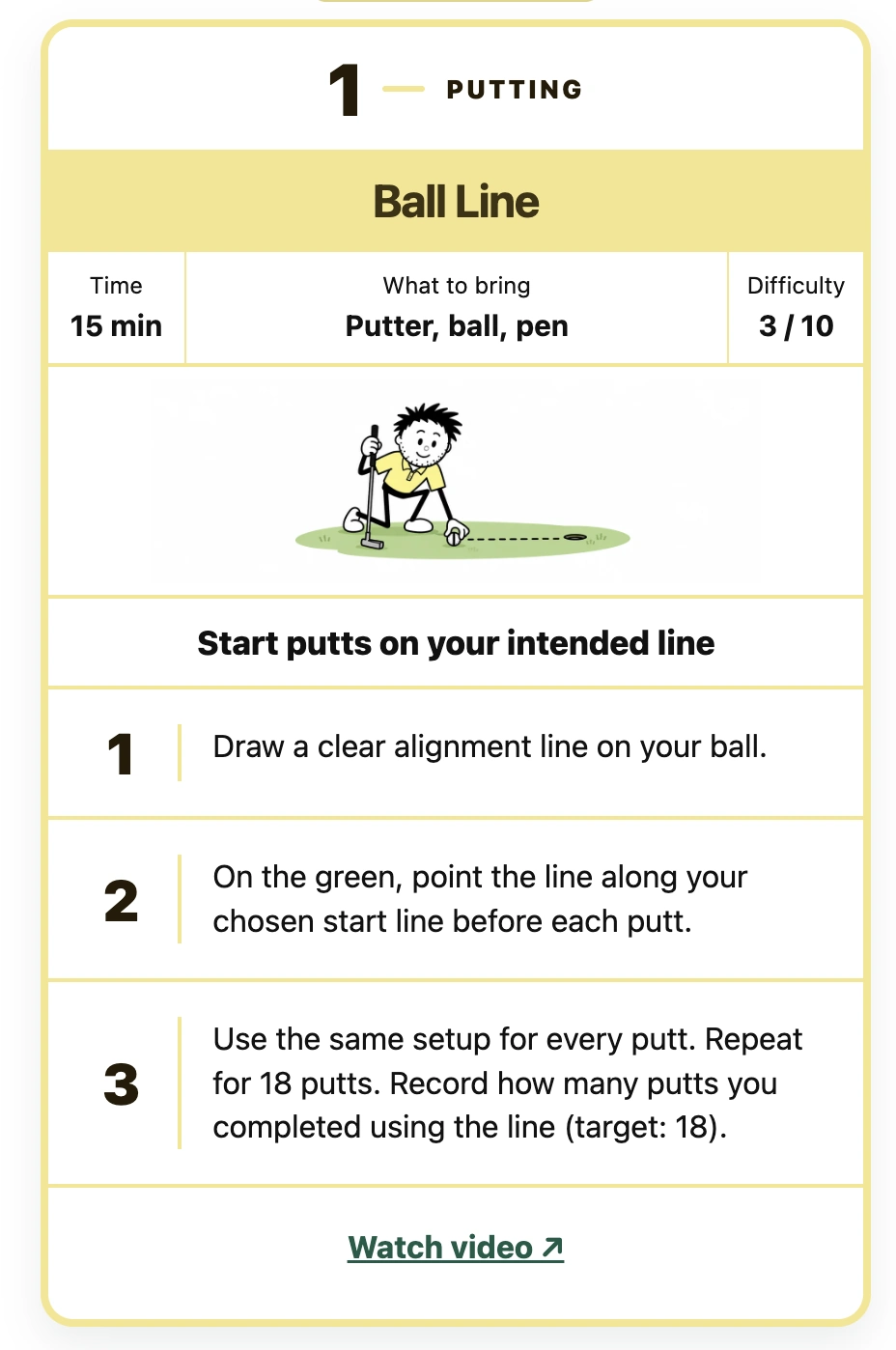
Check the time, equipment and difficulty before choosing a card. Use the illustrations to explain the setup, with a video demonstration where available.
Keep useful drills in My Cards, ready for another session. Choose cards that fit your coaching and each player’s needs.

A few useful answers
Before your next team session.
Is this for varsity teams or university golf clubs?
Both. Choose drills and difficulty levels to suit your players, available facilities and coaching goals.
Can I use the cards in coached sessions?
Yes. Choose a card, demonstrate the setup and use it as an activity within your session. You decide which drills fit your players.
Can players practise independently?
Yes. They can open a card on their phone, follow its illustrated steps and use the demonstration where available. Agree which drills they should work on between sessions.
Can I see all my players’ scores in one place?
Scores and notes stay in each player’s account. Ask players to show you their results, or collect scores together during team practice. Golf Circles let you choose shared drills and challenges.
Does each player need an account?
Each player needs their own account to save cards, record practice and join a Golf Circle. See the current membership options, or ask George about your team’s requirements.
What is included in the free trial?
Try the app for 14 days with no payment card required. Enjoy unlimited core drills and Golf Circles, challenges, scores and progress tracking during your trial. A paid membership is required after 14 days. Full details are on the membership page.
For your next team practice
Pick a card.
Get your team playing.
14 days free · No card required