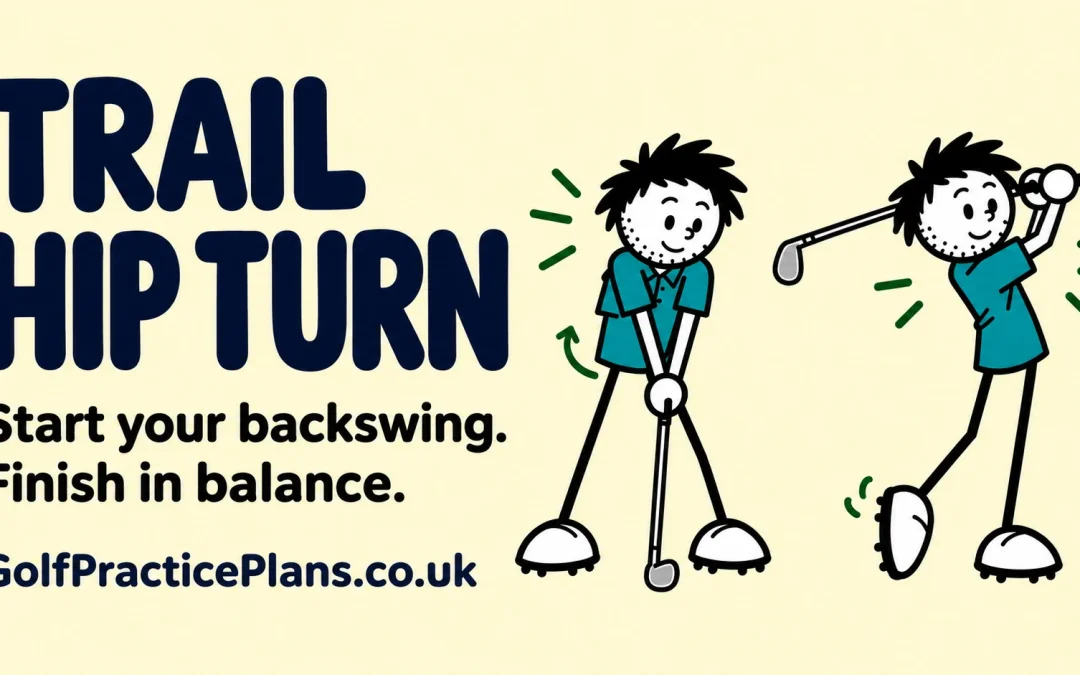
Trail Hip Turn Drill: Start Your Backswing, Finish in Balance
This drill is from the
Your trail hip is your right hip if you play right-handed, or your left hip if you play left-handed. Keep the turn comfortable and the early movement unhurried. The aim is to explore the card’s hip-turn cue while keeping control of the whole swing.
Start with the trail-hip turn, make five slow rehearsals, then play the eighteen-shot challenge.
↓ Download free infographicSave to your device or print for practice.
Watch the trail-hip turn demonstration
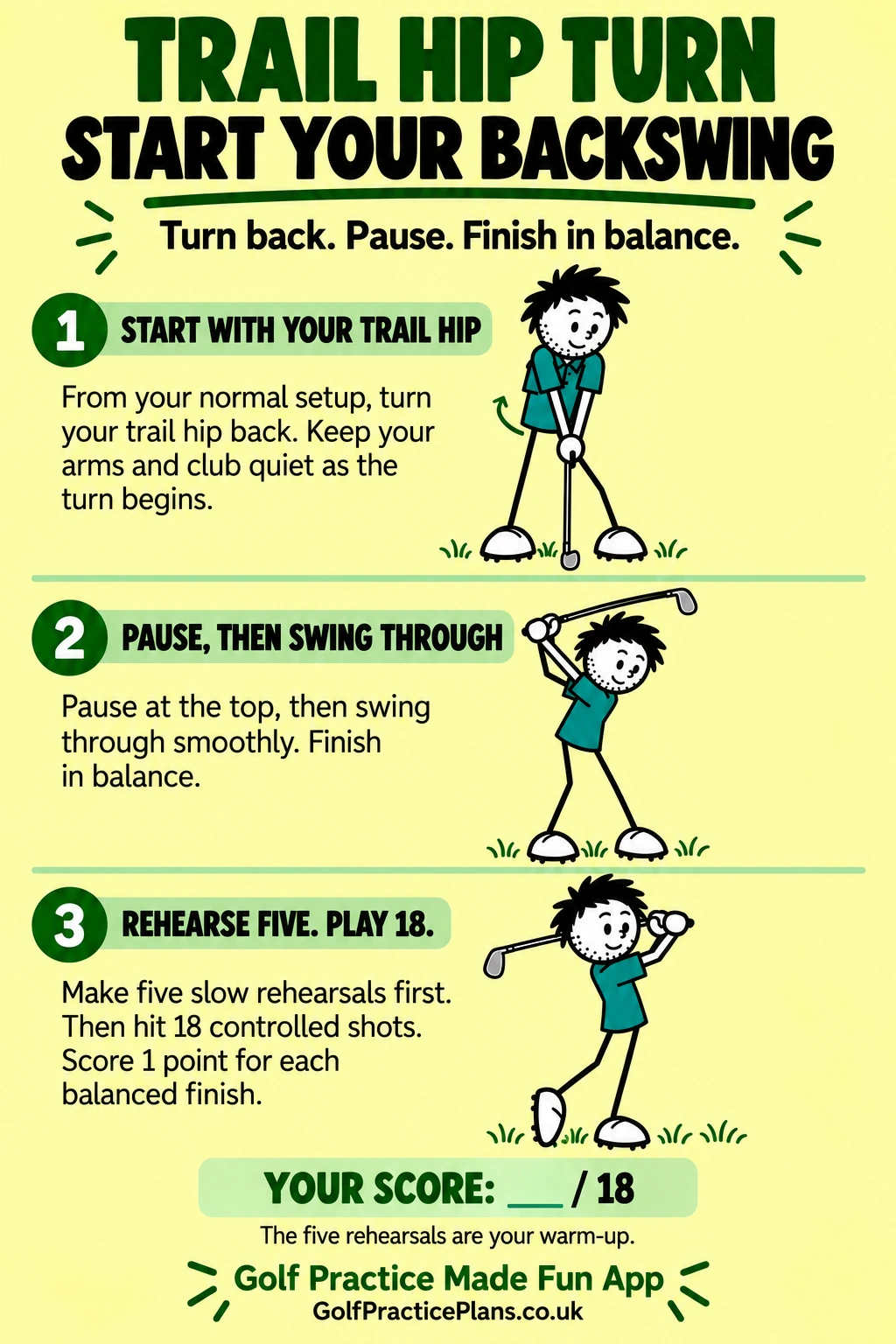
Step 1. Start with Your Trail Hip
| Action | What to do |
|---|---|
| Set up normally | Choose a familiar club and a comfortable range target. Take your normal address position. |
| Begin the turn | Turn your trail hip back to start the backswing. Let this be your first simple movement cue. |
| Keep the start quiet | Keep your arms and club quiet as the turn begins. This is a cue for the start of the movement; allow them to move as the backswing develops. |
Take the movement slowly enough to notice what starts first. Use a comfortable amount of turn rather than trying to reach a particular hip angle.
Step 2. Pause, Then Swing Through
| Action | What to do |
|---|---|
| Rehearse without a ball | Make a slow backswing using the trail-hip cue. |
| Pause at the top | Pause briefly before swinging through smoothly. |
| Finish in balance | Complete the movement under control, then reset. |
| Repeat five times | Make five slow rehearsals before you begin the scored shots. These rehearsals are your warm-up and do not count towards the eighteen. |
Keep the rehearsal deliberate and comfortable. You are practising a repeatable start and a controlled finish, rather than seeing how hard you can swing.
Keep the practice focused
| What you notice | What to try |
|---|---|
| A rushed takeaway | Return to one slow rehearsal and make the trail-hip cue easier to feel. |
| Trying to turn further each time | Use a comfortable turn rather than chasing a bigger movement. |
| Losing balance at the finish | Reduce the pace of the shot and return to the rehearsal. |
| Several swing thoughts at once | Come back to the card’s simple sequence: turn back, pause, finish in balance. |
Your focus: This drill is from the
Step 3. Play Eighteen Controlled Shots
| Action | What to do |
|---|---|
| Use the same cue | Begin each backswing by turning your trail hip back, keeping the arms and club quiet at the start. |
| Pause and swing through | Carry the paused rehearsal feeling into a controlled shot. Choose a pace that lets you finish in balance. |
| Score the finish | Award one point for a balanced finish and zero if you lose balance. |
| Record eighteen shots | Add your points for a total out of eighteen. Keep the five warm-up rehearsals separate. |
Keep the score simple
| Result | Points |
|---|---|
| Balanced finish | 1 point |
| Lost balance | 0 points |
Your score: ___ / 18. Record the club and a short note about the starting cue. When you repeat the drill, use a similar setup so your results are easier to compare.
The score measures the finish specified by this drill. It does not grade distance or accuracy, so keep any notes about ball flight separate.
Give your backswing one clear starting cue: turn your trail hip back, then swing through to a balanced finish. Begin with five slow rehearsals before playing eighteen controlled shots. Award one point for each balanced finish, giving you a simple score out of eighteen.
FAQs
What equipment do I need?
Club + balls.
How do I set up this drill?
Take the movement slowly enough to notice what starts first. Use a comfortable amount of turn rather than trying to reach a particular hip angle.
What should I focus on during practice?
Keep the rehearsal deliberate and comfortable. You are practising a repeatable start and a controlled finish, rather than seeing how hard you can swing.
How should I record my practice?
Your score: ___ / 18. Record the club and a short note about the starting cue. When you repeat the drill, use a similar setup so your results are easier to compare.
The score measures the finish specified by this drill. It does not grade distance or accuracy, so keep any notes about ball flight separate.
What should I keep in mind when practising?
A practice session is easier to repeat when it has one clear task and one simple score. Use the five rehearsals to settle into the movement, then give each of the eighteen shots your attention. Record what happened and take the useful feeling into your next session.
What drill do you recommend I do next?
Try Anti Hip Sway Drill next to use a stick to check for sideways hip movement.
You could also use Connected Backswing Drill to practise turning your chest and arms together. For another focused practice task, try Backswing Posture Drill to check your shoulder turn with a club across your chest.
Give your next practice a purpose.
Find illustrated drills, save your favourites and record your practice in the Golf Practice Made Fun App.
Try the App Free ↗14 days free · No card required