
Through-Stroke Length Putting Drill: Compare Line and Pace
Start-line and pace awareness
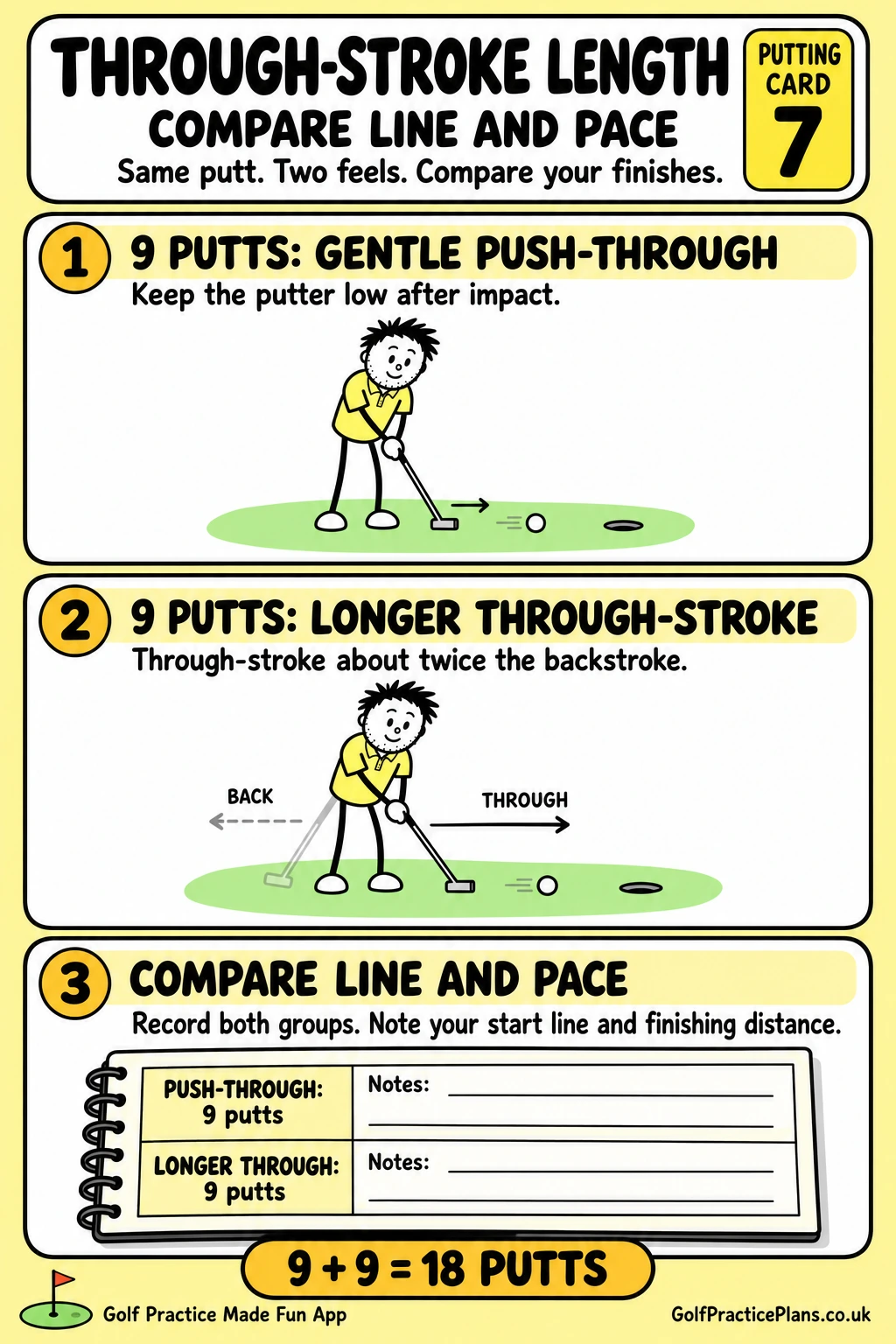
Your putter’s movement after impact gives you another way to explore your rhythm. Start with nine putts using a gentle push-through feel and a low finish. Play nine more with a through-stroke about twice the length of your backstroke, then compare the starting direction and finishing distances.
Keep the same starting position and target for both groups. The aim is to notice which feel gives you more repeatable results on that putt, rather than assume that a longer finish must suit everyone.
↓ Download free infographicSave to your device or print for practice.Free practice sheet · PDF
Watch Mel Sole’s putting lesson
Step 1. Try a gentle push-through feel
| Action | What to do |
|---|---|
| Choose a repeatable putt | Find a comfortable practice putt with room to use the same starting position for both groups. Use one putter and the same type of ball throughout. |
| Settle into your setup | Aim the putter at your chosen starting line and take your normal comfortable stance. |
| Keep the finish low | Make a gentle stroke with a push-through feel, keeping the putter low after impact. Use a smooth movement rather than a sudden jab. |
| Play nine attempts | Observe the initial roll and where each ball stops. Collect balls before they interfere with another putt. |
Keep the first group’s notes simple. Did the ball tend to start on your chosen line? Did finishes cluster at a similar distance, or vary noticeably between attempts?
Step 2. Lengthen the through-stroke
| Action | What to do |
|---|---|
| Keep the same setup | Use the same target, starting position and putter. This lets you compare the two stroke feels on the same task. |
| Make a measured backstroke | Take the putter back smoothly. You only need enough movement for the practice distance you chose. |
| Swing farther through | Try a through-stroke about twice the length of the backstroke. Treat the proportion as a practice cue, not a reason to force the putter forwards. |
| Play nine more putts | Watch the starting direction and finishing distance again. You have now completed 18 attempts. |
Keep the comparison useful
| Action | What to do |
|---|---|
| The longer finish feels forced | Slow the rehearsal down and reduce the effort. Keep the movement comfortable. |
| You change the distance between groups | Return to the original starting point so the task stays the same. |
| One holed putt decides your verdict | Look at the pattern across all nine attempts in each group. |
| The putter finish looks better but pace gets worse | Record the ball’s result as well as the movement. A longer through-stroke is only useful to you if the comparison supports it. |
Start line and distance control are separate observations. You might prefer one feel for the initial roll while the other produces more consistent finishing distances.
Your focus: Start-line and pace awareness
Step 3. Compare line and pace
| Action | What to do |
|---|---|
| Review the first group | Note the starting-direction pattern and how consistently the gentle push-through putts reached the target distance. |
| Review the second group | Describe what changed with the longer through-stroke. Include anything that became less comfortable or less repeatable. |
| Record completed attempts | Count all 18 putts, rather than awarding points for good results. Keep each group’s observations in your notes. |
| Choose what to repeat | Keep a useful cue from the session, or repeat the comparison before deciding whether the change helps. |
Your comparison notes
| Group | Start line | Pace and finish |
|---|---|---|
| Gentle push-through ___ / 9 completed | What did you notice about the initial roll? | Were finishes mostly short, close to the target or beyond it? |
| Longer through-stroke ___ / 9 completed | Did the starting direction change? | Was the finishing distance easier to repeat? |
Practice total: ___ / 18 completed putts. This comparison records attempts and observations. There is no extra point for holing a putt.
Open Putting card 7 from My Cards in the Golf Practice Made Fun App. Record your completed attempts and add the distance and your notes for each group.
FAQs
What equipment do I need?
Putter + balls.
How do I set up this drill?
Keep the first group’s notes simple. Did the ball tend to start on your chosen line? Did finishes cluster at a similar distance, or vary noticeably between attempts?
What should I focus on during practice?
Start line and distance control are separate observations. You might prefer one feel for the initial roll while the other produces more consistent finishing distances.
How should I record my practice?
Practice total: ___ / 18 completed putts. This comparison records attempts and observations. There is no extra point for holing a putt.
What should I keep in mind when practising?
Give both feels a fair run from the same starting point. A useful practice session ends with something you have noticed, even if the result is that your usual stroke feels more reliable. Record the pattern and use it to choose your next putting task.
What drill do you recommend I do next?
Try Putting Gate Drill next to practise starting putts on your chosen line.
You could also use 10-20-30 Putting Pace Challenge to compare your putting pace from ten, twenty and thirty feet. For another focused practice task, try 2 to give your putting stroke a simple counted rhythm.
Give your next practice a purpose.
Find illustrated drills, save your favourites and record your practice in the Golf Practice Made Fun App.
Try the App Free ↗14 days free · No card required