Browse by category
DRILL OVERVIEW · PUTTING CARD 5
Long or Standard Putter: Compare Your Pace
Your drill at a glance
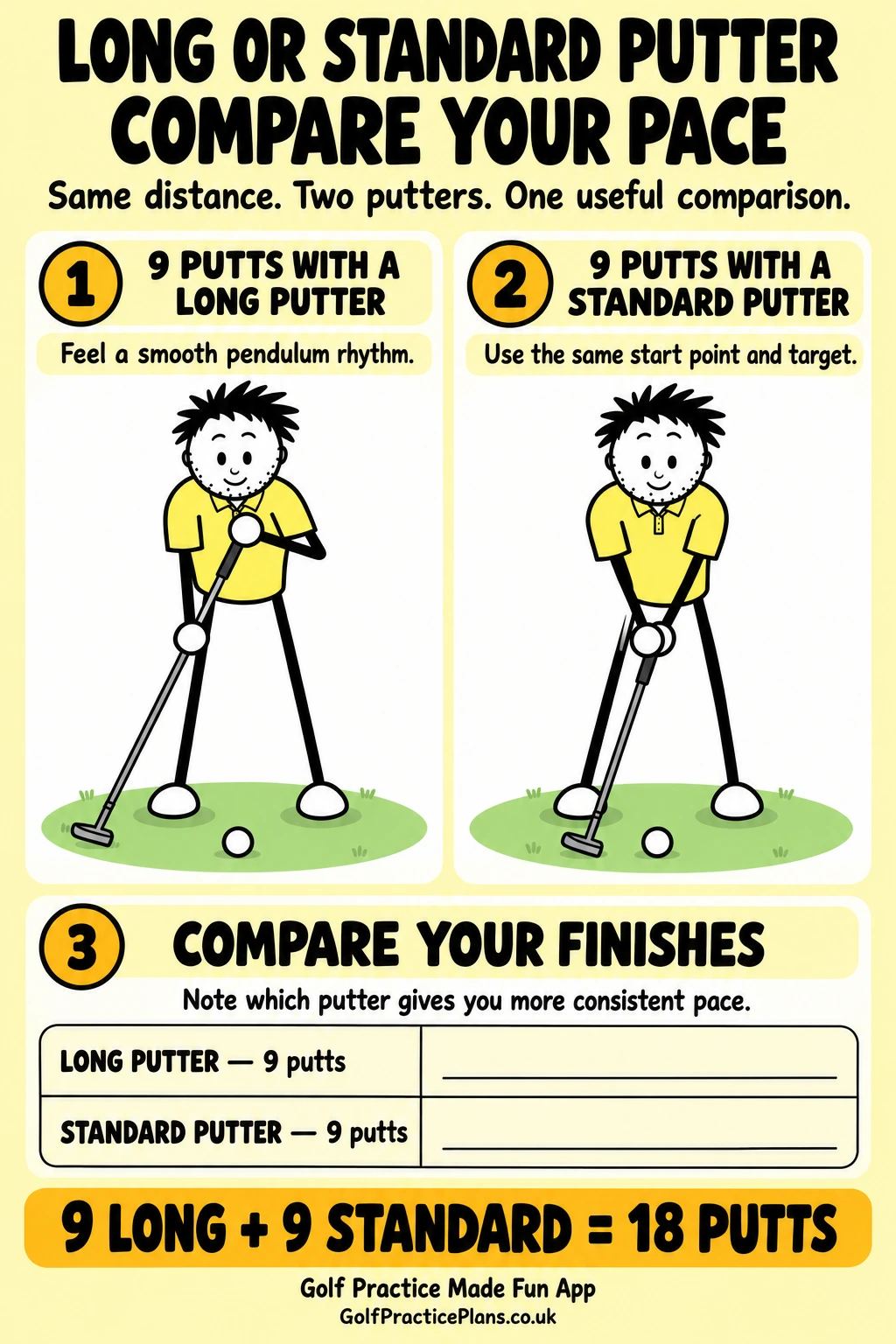
This is Putting card 5, Long or Standard Putter: Compare Your Pace, in the Golf Practice Made Fun App.
A change of putter can make your putting rhythm easier to notice. Use a long putter for nine attempts, then a standard putter for nine more from the same distance. Compare how the strokes feel and where the balls finish, rather than trying to prove that one putter is best.
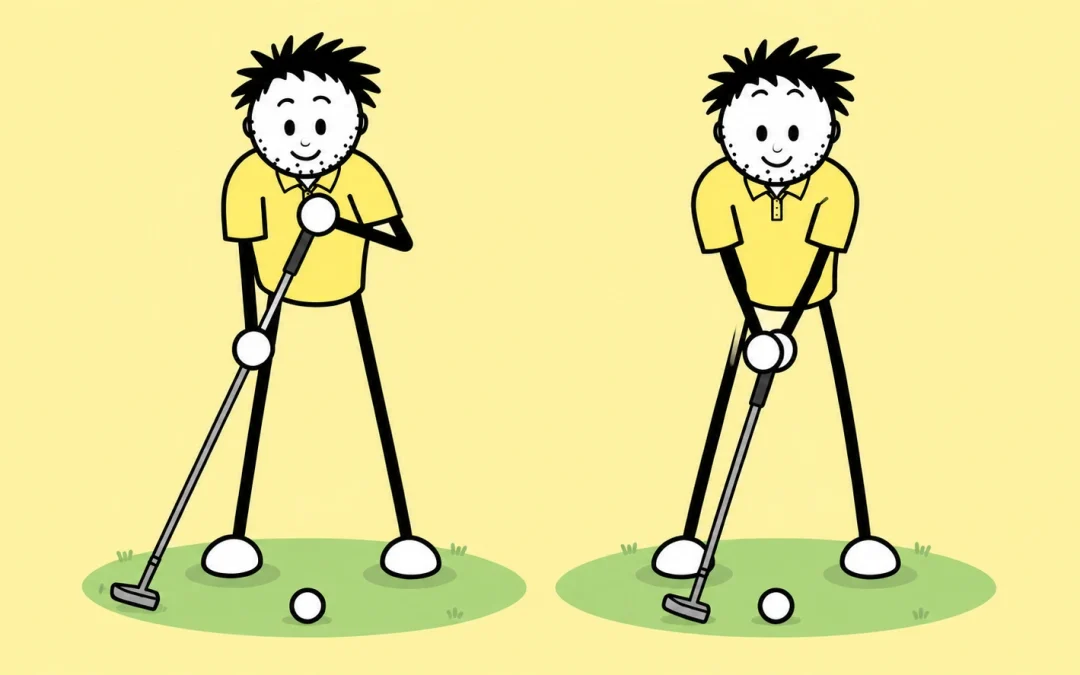
The long-putter position separates the hands along the grip; the standard-putter position brings them together lower down. Both illustrations show the backswing. Your task is to explore a smooth pendulum feel and see whether it carries into your usual putting stroke.
Jump to the long-putter practice, the standard-putter comparison or the results table.
The original pendulum putting lesson.
In Tip on Practicing Perfect Pendulum Putting Video, Scott Monroe demonstrates the putting rhythm behind this comparison. Watch the long-putter and standard-putter positions, then use the two sets of nine below as your App practice round.
The video owner has disabled playback on other websites. The illustrations and three-step practice below explain the comparison.
This older lesson uses a high-hand long-putter position. For play under the Rules of Golf, keep the stroke unanchored: do not hold the club or a gripping hand against your body, or create a fixed anchor with a forearm. See R&A Rule 10.1b.
Step 1. Play nine with a long putter.

| Action | What to do |
|---|---|
| Choose one practice putt | Find a clear area of the practice green. Choose a comfortable distance and one target, leaving room for other golfers. |
| Use a split-hand position | Hold the long putter with the upper hand high and the lower hand farther down the grip, as illustrated. Keep the stroke free of an anchor against your body. |
| Feel the pendulum rhythm | Make an unhurried backswing and let the putter swing through. Notice the rhythm rather than forcing the ball towards the hole. |
| Complete nine putts | Use the same starting point for all nine. Observe where each ball finishes, and clear balls before they obstruct another attempt. |
Keep a short note about the pace: were the finishes mostly short, mostly beyond the hole, or reasonably grouped? Also note whether the rhythm felt smooth or difficult to repeat.
Step 2. Play nine with a standard putter.
| Action | What to do |
|---|---|
| Keep the same test | Use the same target, starting position and type of ball. Changing the distance or slope would make the two groups harder to compare. |
| Return to your normal grip | Hold the standard putter with both hands together below the waist, using your usual comfortable setup. |
| Carry over the rhythm | Recall the smooth back-and-through feel from the first set. Let the shorter putter make its own comfortable stroke; you do not need to copy the exact swing size. |
| Complete nine more putts | Observe the finishing positions and how easily you repeat the pace. You have now played 18 attempts. |
Keep the comparison useful
| Action | What to do |
|---|---|
| You change the starting point | Return to the original position so both groups face the same putt. |
| You keep thinking about the club length | Come back to the simple task: a smooth stroke and a useful finishing position. |
| One or two putts dominate your impression | Look at the whole group of nine. Note the pattern rather than judging a putter from one result. |
| The second set feels easier | Remember that you have already had nine attempts at this putt. The result is a practice observation, not a definitive equipment test. |
Step 3. Compare your pace and finishes.
| Action | What to do |
|---|---|
| Review each group | Compare how often balls finished short, close to the target or farther beyond it. Use a tape measure if you want to record actual finishing distances. |
| Describe the rhythm | Write a few words about what felt easier to repeat with each putter. |
| Record all 18 attempts | This card tracks completed putts. Record 18 when you have finished nine with each putter, and keep the comparison in your notes. |
| Choose a useful next step | Keep the rhythm cue that helped. Repeat the same comparison another day if you want to see whether the pattern persists. |
Your comparison notes
| Putter | Putts completed | Pace and finish notes |
|---|---|---|
| Long putter | ___ / 9 | Mostly short, close or beyond? How did the rhythm feel? |
| Standard putter | ___ / 9 | What changed? Which pace was easier to repeat? |
18 attempts, rather than 18 points. There is no extra point for holing a putt on this card. Finish both groups, record the completed attempts and use your notes to compare the results.
In the Golf Practice Made Fun App, open Putting card 5 from My Cards. Save your completed attempts and note the distance, the two putters used and the pattern of finishes.
George’s Practice Tip.

Take one useful feeling from this session. If the long putter helps you notice a smoother rhythm, see whether you can keep that feeling with your standard putter. Judge the pace of the whole group and write down what you learned.
For another pace-control task, try the Uphill and Downhill Birdie Pace Challenge. Browse more Putting drills.
MAKE THE NEXT BUCKET COUNT
Pick a card. Practise with purpose.