
Browse by category
Hold Steady. Turn Smoothly. Finish Balanced.
Your practice at a glance
These golf drills are from the Golf Practice Made Fun App.
A more controlled golf swing starts with being able to turn and hold comfortable positions without losing your balance.
Begin with Kettlebell Posture and Turn to explore rotation from a golf stance, try the Isometric Golf Swing Drill for steady holds against light band tension, then use Medicine Ball Hip Rotation to give your turn a controlled throwing task. Work towards each drill’s eighteen-attempt format, resting between efforts and using fewer repetitions when needed. Use light equipment, a secure band anchor and a wall approved for medicine-ball throws.
Drill 1. Kettlebell Posture and Turn: Stay Steady as You Rotate

Kettlebell Posture and Turn helps you practise turning your hips and chest while keeping a light weight close and your golf posture steady.
Holding the weight near your chest gives you a clear reference for a controlled turn. A small movement lets you notice whether you round your back, stand up or reach away with your arms. Keep the resistance light enough that your posture and balance stay comfortable in both directions.
| Step | What to do |
|---|---|
| 1 | Choose a light kettlebell and a clear, steady floor surface. Hold its handle with both hands close to your chest, elbows bent. Stand with feet about shoulder-width apart, soften your knees and hinge gently from your hips with a long back. |
| 2 | Turn your hips and chest gently to one side, carrying the kettlebell beside your body while your face stays facing forwards. Keep the weight close, following the buttons on your shirt rather than reaching away with your arms. Return slowly to the middle, then turn the other way. |
| 3 | Complete up to eighteen slow turns, alternating sides. One turn and return to the middle counts as one repetition. Rest as needed and use a smaller turn or lighter weight if your posture changes or you lose balance. Stop if the movement hurts. |
Drill 2. Isometric Golf Swing: Hold Your Position with Control
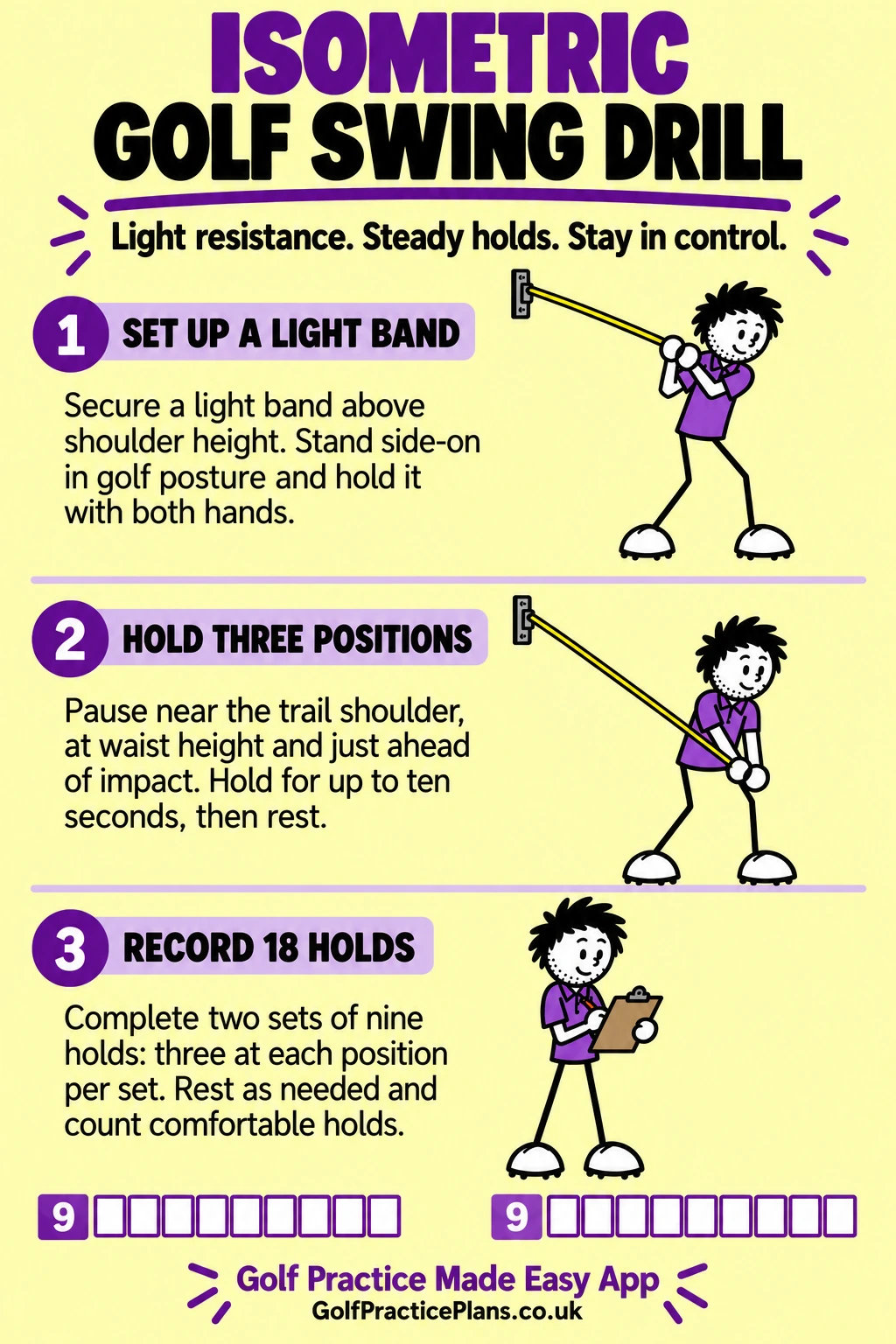
The Isometric Golf Swing Drill gives you a way to practise holding three downswing positions steadily against light resistance.
Pausing at each position lets you focus on balance, posture and normal breathing without trying to move quickly. Light band tension provides resistance to manage while you hold still. Choose a shorter hold or less tension whenever the band pulls you out of a comfortable stance.
| Step | What to do |
|---|---|
| 1 | Inspect a light resistance band and attach it securely above shoulder height according to its instructions. Stand side-on to the anchor in comfortable golf posture with soft knees. Hold the band with both hands and take up only gentle tension. |
| 2 | Move slowly into each of the three positions shown in the original demonstration: hands near the trail shoulder, around waist height, then just ahead of an imagined ball. Hold each for up to ten seconds while breathing normally. Release slowly and rest between holds. |
| 3 | Work towards three holds at each position, then repeat that sequence once: up to eighteen holds in total. Use fewer or shorter holds when needed. Keep your stance steady, avoid jerking or forcing a twist, and stop if the movement hurts. |
Drill 3. Medicine Ball Hip Rotation: Turn and Toss in Balance
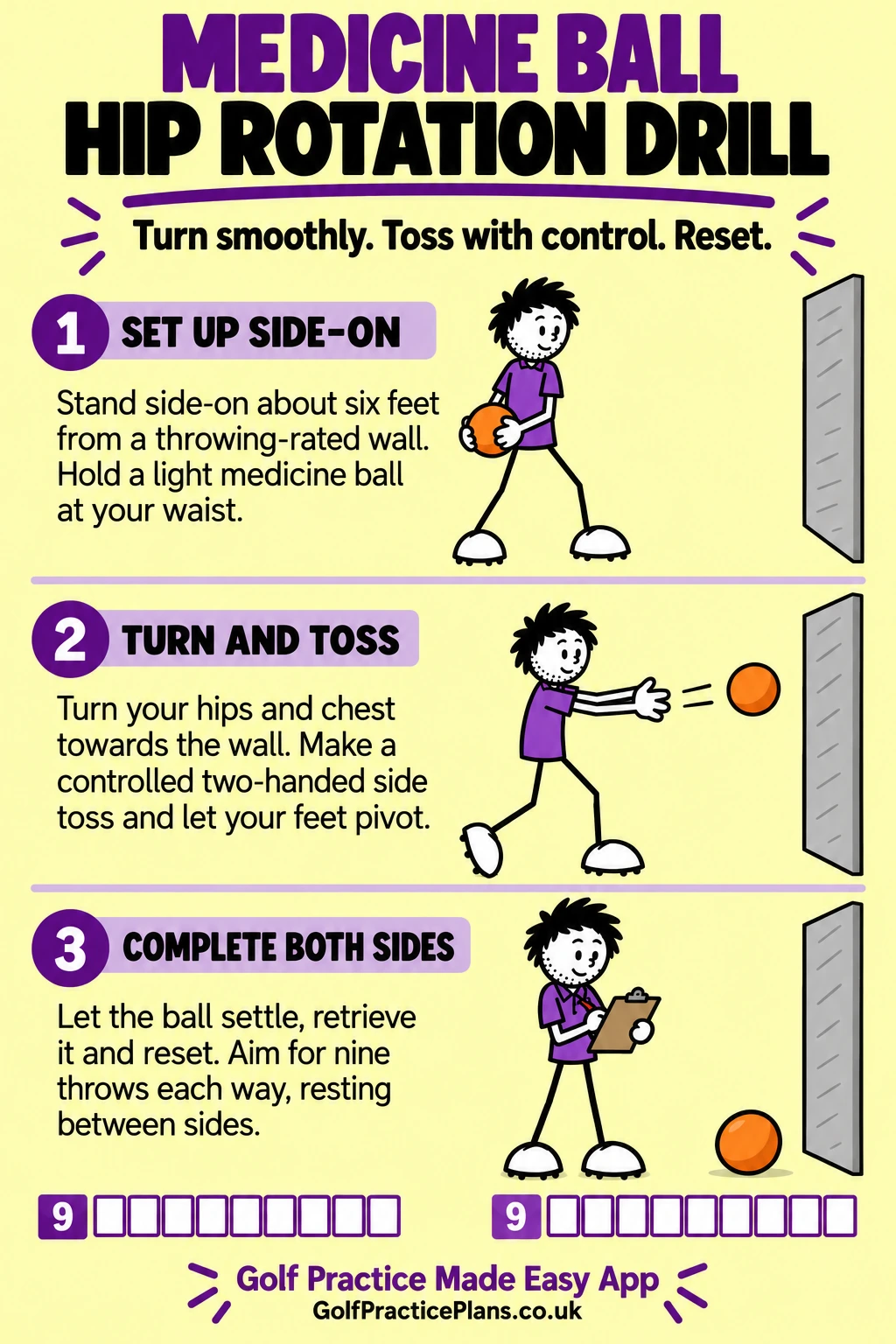
Medicine Ball Hip Rotation helps you coordinate your hips and chest through a controlled side toss with a balanced finish.
The throw gives your rotation a clear task and an endpoint you can check. Using a light ball and a gentle effort makes it easier to turn together without relying on the arms alone. Resetting after every throw gives both sides the same attention and keeps the movement deliberate.
| Step | What to do |
|---|---|
| 1 | Choose a light medicine ball rated for wall throws and a wall designed or approved for that use. Clear the rebound area. Stand side-on about six feet from the wall, adjusting the distance to suit the equipment, with soft knees and the ball held near your waist. |
| 2 | Turn a little away from the wall, then rotate your hips and chest towards it. Release the ball with both hands in a controlled side toss from around waist height, allowing your feet to pivot. Let the rebound settle before retrieving the ball and resetting. |
| 3 | Complete up to nine light throws each way, resting between efforts. Reduce the force or range if you lose balance, and stop if the turn hurts. Aim for a smooth turn, balanced finish and full reset rather than a harder throw. |