
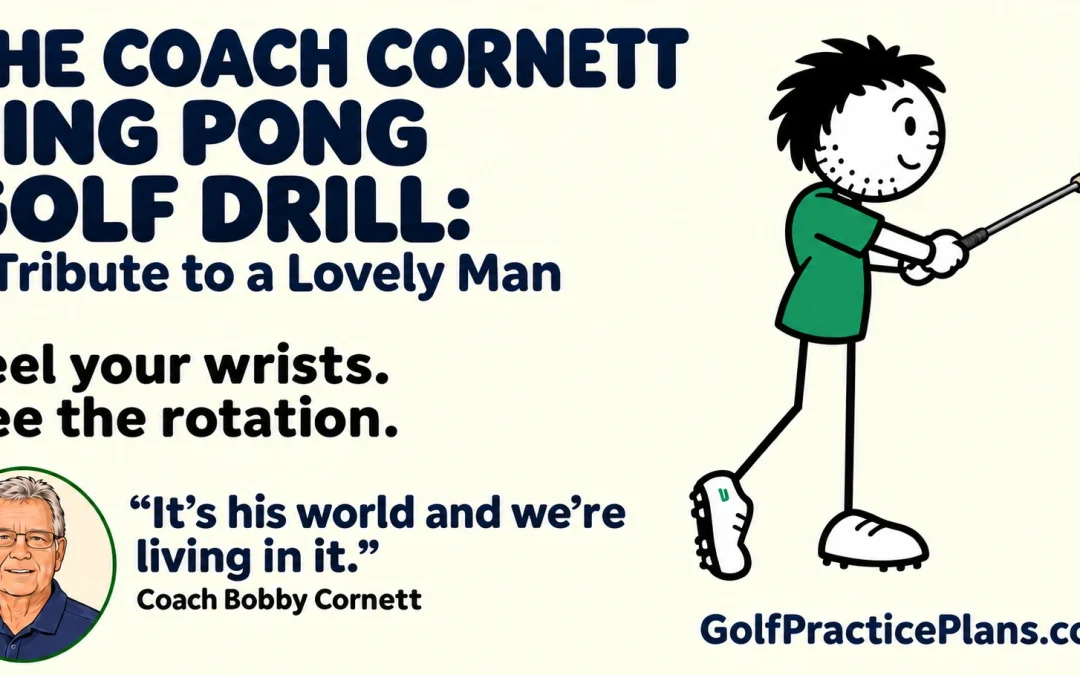
The Coach Cornett Ping Pong Golf Drill: a Tribute to a Lovely Man
Feel your wrists. See the rotation.
Some coaches leave you with a swing thought. Coach Cornett left me with a sentence I can still hear:

“It’s his world and we’re living in it.”Coach Bobby Cornett
That was his response when someone did something stupid, such as cutting him off while he was driving us to a tournament in the university minibus. A little perspective, delivered with humour.
↓ Download free infographicSave to your device or print for practice.
Bobby Cornett was my golf coach at Texas Wesleyan University from 1995-99. What I remember most is his influence on my mind game, his humour, and his ability with a table tennis bat.
Back in the mid-1990s, I won the first collegiate table tennis tournament he organised. I was the annoying "defender", retrieving most shots and only attacking when the shot was an easy one. It’s a fond memory that makes a table tennis-inspired golf drill a particularly personal way to remember him.
Coach took his table tennis seriously. He reached a career-high USA Table Tennis rating of 2,097 and helped bring the collegiate table tennis programme to Texas Wesleyan.
He was handy away from the sporting arena, too. He enjoyed working on his 1974 Ford truck and visiting estate sales with his wife, Denny, finding things he could repair or put to another use. Turning an overlooked object (or wet-behind-the-ears teenage golfer, like me) into something "useful" seems a fitting connection for a golf drill involving a table tennis bat.
His TWU golf teams won 90 tournaments and four national championships during his coaching career. Those achievements deserve remembering.
But I also think the smaller moments deserve remembering: a table tennis tournament he organised, a journey in the minibus, his trademark "It's his world" remark that still brings a smile to one of his former players. It's been decades since I graduated from TWU, and the memories have faded a bit with age, but the "feeling" of him being a good, good man still looms large. That will never fade for me.
Coach was also heavily into the mind game. That deserves a place in this tribute alongside the table tennis.
If you’d like to practise the mental side of your own game, these three drills from this site are a good place to start:
- Chew the Fat Behind the Ball: talk through your target, club and intended shot before stepping in to play. Give yourself a clear plan.
- Jack Nicklaus Visualisation Drill: picture where you want the ball to finish and how it will get there before you swing.
- Breathing Technique Drill: bring some attention to your breathing and notice tension before playing the shot.
The Coach Cornett Ping Pong Golf Drill
Imagine a red-and-black table tennis paddle in place of your clubhead. You can practise this drill with your normal golf club, using the imagined paddle to picture the wrist positions and forearm rotation.
In the video below, golf instructor Josh McKinley demonstrates the movement with a real paddle attached to a golf shaft. For this version, use your own club and imagine those red and black faces. The paddle in the illustrations shows what to picture.
Watch the paddle drill
Step 1. Rehearse the downswing
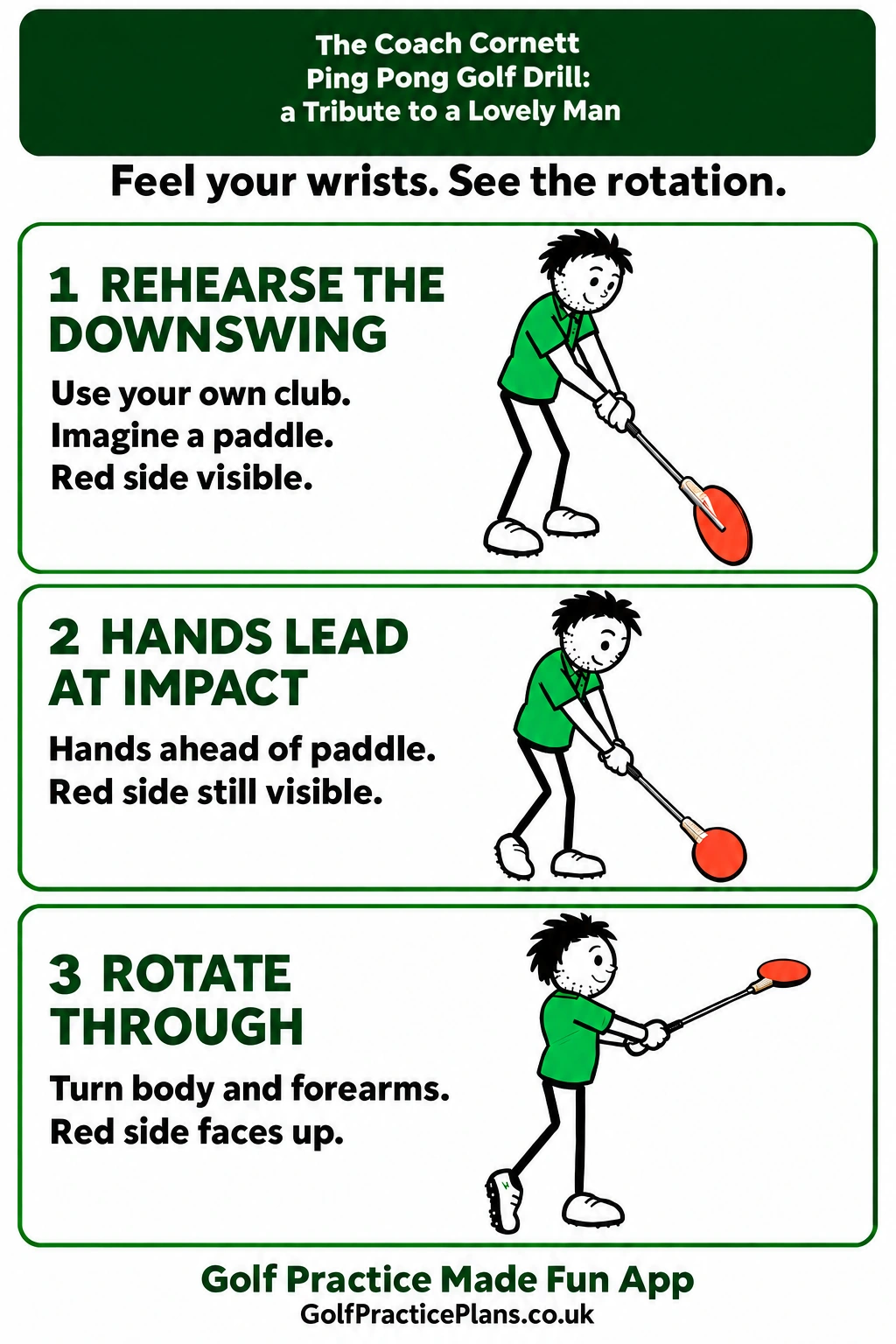
Take your normal grip and golf posture with your own club. Imagine a table tennis paddle replacing the clubhead. Rehearse the downswing slowly, picturing its red face visible from your viewpoint.
| Action | What to do |
|---|---|
| Check your wrists | Use a flexed lead wrist and a bent-back trail wrist. |
| Picture the paddle | Picture the imagined paddle staying inside your hands as you move down towards impact. |
Step 2. Let your hands lead at impact
Move into the impact position without striking a ball. Your hands lead the clubhead, and you picture the imagined paddle’s red face still visible.
| Action | What to do |
|---|---|
| Keep your hands ahead | Your hands lead the clubhead into the imagined impact position. |
| Retain the wrist positions | Keep the lead wrist flexed and the trail wrist bent back; avoid an early flip. |
| Let the right knee move inward | For the right-handed setup shown, let your right knee move towards your left leg as your hips turn through. |
Step 3. Rotate through with red on top
Continue turning through the shot and allow your forearms to rotate. Picture the imagined paddle’s red face pointing upwards in the follow-through.
| Action | What to do |
|---|---|
| Turn through | Continue the body turn as your forearms rotate. |
| Check the colour | Imagine the red face pointing upwards after impact. |
| Repeat slowly | Reset and join the three positions into one smooth rehearsal without a ball. |
George’s Practice Tip: You don’t need to build a training aid. Use your own club and picture the red-and-black paddle. Move slowly enough to imagine its direction before, at and after impact.
This drill is dedicated to Coach Cornett, with thanks for the golf, the table tennis and the perspective.
FAQs.
Do I need a table tennis paddle attached to a club?
No. Use your normal golf club and imagine a red-and-black table tennis paddle in place of the clubhead. The illustrations show what to picture.
How could I make a table tennis training club?
You would need a red-and-black table tennis paddle, an old golf club you no longer use, suitable small clamps, protective padding and strong cloth tape.
- Prepare the shaft. Keep the golf grip and ask a club repairer to remove the clubhead and make the shaft end safe. Avoid cutting a graphite shaft yourself.
- Position the paddle. Overlap its handle with the lower end of the shaft, with the paddle replacing the clubhead. Align the flat paddle face with the direction the clubface would point. Use the video to check the orientation of its red and black sides.
- Secure it. Have the paddle handle firmly attached to the shaft with suitable clamps and protective padding, then cover the fixings with cloth tape. Tape alone should not be the main fastening. A club repairer can help assemble it if you are unsure.
- Check before rehearsing. Gently test that the paddle cannot twist or slide off and that no sharp edges are exposed. Use it only for slow rehearsals in a clear space, without hitting balls or making full-speed swings. Stop if anything loosens.
You can get started without making anything: use your normal club and imagine the red-and-black paddle instead.
What does the drill help me practise?
It gives you a visual reference for wrist positions and forearm rotation through the downswing, impact and follow-through. Move slowly so you can recognise each position.
Where should I picture the red face?
In the right-handed demonstration, picture the red face visible as you approach impact and at impact. As you turn through and allow your forearms to rotate, picture the red face pointing upwards.
Should I hit balls during this drill?
Use slow rehearsals without a ball for this version. Pause before impact, at impact and just after it, then join the positions into one smooth movement.
Can left-handed golfers use it?
Yes. Mirror the right-handed demonstration. Your lead wrist is your right wrist and your trail wrist is your left wrist; reverse the leg references too.
Why is the drill dedicated to Coach Cornett?
Bobby Cornett was my golf coach at Texas Wesleyan University from 1995-99 and a very good table tennis player. I won the first collegiate table tennis tournament he organised, making this paddle-inspired drill a personal way to remember him.
What drill do you recommend I do next?
Try the Hands Together Impact Sequence Drill for another rehearsal of the movement into impact.
To practise the mental side Coach cared about, try the Jack Nicklaus Visualisation Drill.
Give your next practice a purpose.
Find illustrated drills, save your favourites and record your practice.
Start your free trial ↗14 days free · No card required