
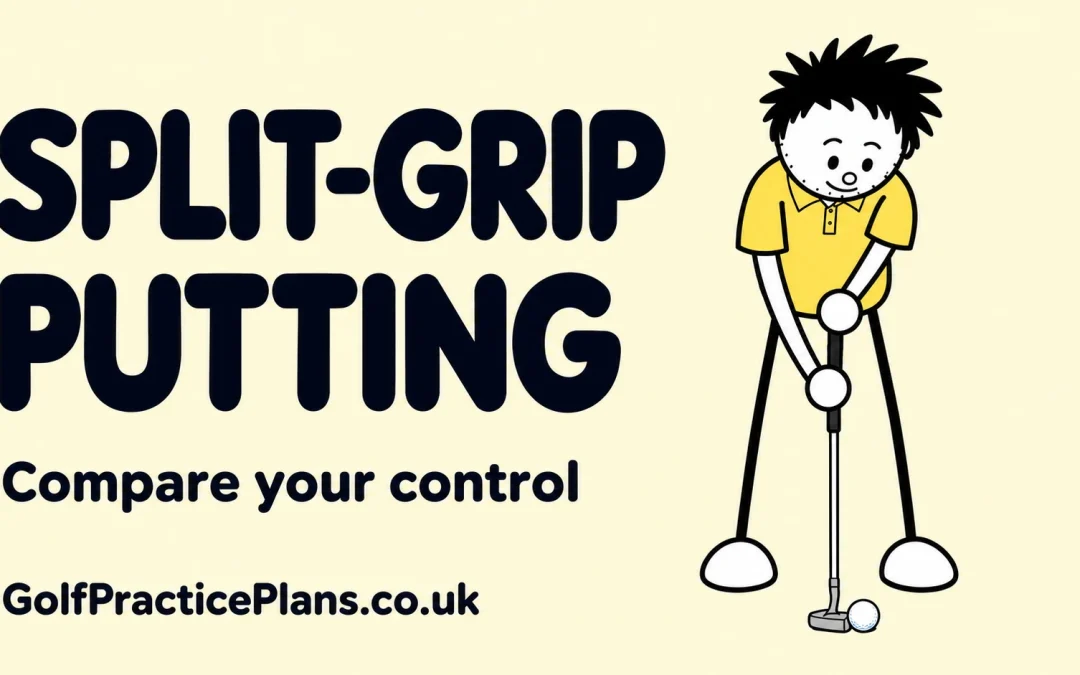
Split-Grip Putting: Compare Your Control
Give your hands a little breathing room.
Your hands can be very helpful. Occasionally, they’re a little too helpful. This drill puts a small gap between them on the handle so you can notice any flicking as the putter meets the ball.
Compare the starting direction, contact and sense of control. You’re looking for a useful feeling you can repeat.
↓ Download free infographicSave to your device or print for practice.Free practice sheet · PDF, 2 pages

Watch the split-grip putting lesson
Step 1. Split your grip

Choose a level short putt. Take your normal setup, then slide your trail hand down the handle by about one hand-width.
For a right-handed golfer, the right hand goes lower and the left hand stays above it. For a left-handed golfer, reverse those hands. Both hands still hold the putter, with a clear gap between them.
Check the lower hand before you start. In the illustrations, the golfer’s right arm comes from the left side of the picture and reaches the lower glove. The left arm reaches the upper glove.
Step 2. Roll nine split-grip putts
Make nine putts with a small shoulder movement. Notice what your hands do through contact and how the ball starts.
Take time to reset the ball and aim the face before each attempt. Keep the same hand separation throughout this group so you’re comparing one setup with another.
Tick one completed putt on the practice sheet each time. Finish all nine, even if an early attempt wanders off. The next putt gets a fresh setup.
Your cue: “Separate the hands. Keep the stroke small.”
| Watch for | Try this |
|---|---|
| Sliding the wrong hand down | Keep the lead hand high and move the trail hand lower. |
| Using a large stroke for a short putt | Make a smooth, small shoulder movement suited to the distance. |
| Changing several things for the second group | Keep the same starting point, target, stance and intended pace. |
Step 3. Compare your usual grip
Return your hands to your usual grip and play nine more putts from the same spot. Compare the two groups before choosing a cue to keep.
Keep your stance, starting point, target and intended pace similar. That gives the grip change a fair comparison. The record counts completed putts; keep your observations about quality alongside it.
Count nine completed putts in each group. Add them for 18 attempts and record the start direction, contact and control separately.
Give both groups a fair hearing. A holed putt can flatter a messy stroke, and a good stroke can miss. Look at the pattern across the nine attempts as well as how the grip felt.
| Grip | Completed putts | Direction / contact / control |
|---|---|---|
| Split grip | ___ / 9 | ___ |
| Usual grip | ___ / 9 | ___ |
| Total | ___ / 18 |
Record completed attempts separately from your observations. Write down one useful feeling to try again next session.
“I wasn’t just hitting balls around … I always liked to keep a score.”
Jack Nicklaus, describing his practice sessions
FAQs
Which hand goes lower on the putter?
The trail hand goes lower. For a right-handed golfer, the right hand sits below the left. For a left-handed golfer, the left hand sits below the right. Both hands keep holding the putter.
How far apart should my hands be?
Slide the trail hand about one hand-width down the handle, leaving a clear, comfortable gap. Keep the same separation throughout the first group so the comparison is consistent.
How do I record this drill?
Tick nine completed split-grip putts, then nine with your usual grip, for 18 attempts in total. This is a completion record, not a points score for holed putts. Note starting direction, contact and control separately.
Should I switch permanently to a split grip?
This drill is a comparison. After the first nine putts, return to your usual grip and look for a useful feeling you can repeat. The practice task does not require a permanent grip change.
What should I compare between the two groups?
Look at starting direction, centred contact, hand action and the sense of control across each group of nine. Keep the putt and intended pace similar. A single holed or missed putt is less informative than a repeated pattern.
What drill do you recommend I do next?
Try Putting Gate Drill next to practise starting putts on your chosen line.
You could also use 10-20-30 Putting Pace Challenge to compare your putting pace from ten, twenty and thirty feet. For another focused practice task, try Picture, Look, Roll to rehearse a clear picture, look and roll routine.
Give your next practice a purpose.
This is Putting Card 39 in the Golf Practice Made Fun App. Find illustrated drills, save your favourites and record your practice.
Try the App Free ↗14 days free · No card required