
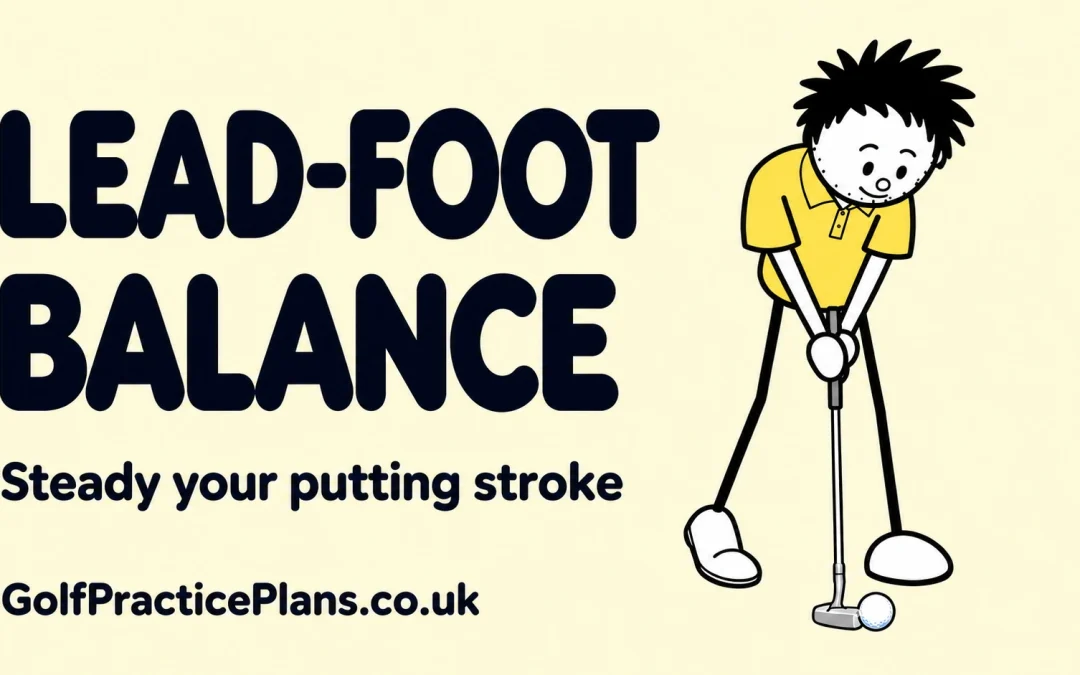
Lead-Foot Balance: Steady Your Putting Stroke
Set your support. Settle your stroke.
If your body has more moving parts than your putter, give this a go. Your lead foot takes most of the weight, while your trail toes act as a little kickstand. The aim is a quiet body and a smooth stroke — no circus balancing required.
Keep the starting spot and target the same so you can compare your balance, contact and body movement.
↓ Download free infographicSave to your device or print for practice.Free practice sheet · PDF, 2 pages

Watch the lead-foot putting lesson
Technique source: Todd Kolb, US GOLF TV’s putting guide. The nine-plus-nine practice round below is the App’s format for comparing the two stances.
Step 1. Set your support

Choose a level short putt and move most of your weight over your lead foot. Keep your trail toes lightly on the ground behind you.
Place the lead foot roughly in line with the ball. Keep your normal grip, a comfortable putting posture and enough contact from the trail toes to feel settled.
For a right-handed golfer, the lead foot is the left foot. Reverse that for a left-handed golfer. You still hold the putter with both hands; the change is in your support.
The trail toes are there to help. This is a supported stance. Keep enough toe contact to feel settled before you start the stroke.
Step 2. Play nine supported putts
Make nine small, smooth putting strokes. Keep your body quiet and notice whether you can stay balanced from the start of the stroke to the finish.
Collect and reset the ball after each putt. Take a moment to settle your support again rather than rushing into the next attempt.
If you feel unsettled, reset and use a little more support from the trail toes. Let the ball wait until your stance feels comfortable.
Your cue: “Use the trail toes for support. Keep the body quiet.”
| Watch for | Try this |
|---|---|
| Lifting the trail toes off the ground | Keep them lightly grounded behind you to support the stance. |
| Starting the stroke while unsettled | Reset and use more toe support before putting. |
| Judging the comparison by holed putts alone | Record balance through each stroke, with contact and body movement noted separately. |
Step 3. Compare your normal stance
Put both feet down in your usual stance and play nine more putts. Use the same start and target, then compare the two groups.
Use the same balance judgement for every attempt. A holed putt earns no extra point: the record is there to help you notice how steadily you make the stroke.
Write each group’s balanced strokes out of nine. Add the two groups for a total out of 18, and keep their contact notes separate.
Finish the comparison before drawing conclusions. Look for a pattern across the two groups. One lovely putt — or one wobbly one — has a habit of grabbing all the attention.
| Score | When to award it |
|---|---|
| 1 point | You stay balanced through the stroke. A holed putt earns no extra point. |
| 0 points | You lose your balance during the stroke. |
| Stance | Balanced strokes | Contact / movement |
|---|---|---|
| Lead-foot support | ___ / 9 | ___ |
| Normal stance | ___ / 9 | ___ |
| Total | ___ / 18 |
Keep your balance score and contact notes separate, then choose one settled feeling to try again in your normal stance.
“I wasn’t just hitting balls around … I always liked to keep a score.”
Jack Nicklaus, describing his practice sessions
FAQs
Which foot carries most of my weight?
Your lead foot does: the left foot for a right-handed golfer, or the right foot for a left-handed golfer. Keep the trail toes lightly on the ground behind you with that heel raised. Both hands stay on the putter.
Should I balance completely on one foot?
No. This is a supported stance. Your trail toes act as a kickstand, and you should keep enough contact with the ground to feel settled before making a small putting stroke.
What if I feel wobbly?
Let the ball wait. Reset and use a little more support from your trail toes. Keep the stroke short and comfortable rather than making the stance more awkward.
How do I score the two groups?
Play nine supported putts, then nine from your normal stance. Score 1 whenever you stay balanced through the stroke, or 0 if you lose your balance. Record each group out of nine and the combined total out of 18; a holed putt earns no extra point.
How do I carry the feeling into my normal stance?
Use the same starting spot and target for the second nine. Try to keep the settled feeling and quiet body from the supported group, then compare balance, contact and body movement across both groups.
What drill do you recommend I do next?
Try 2 next to give your putting stroke a simple counted rhythm.
You could also use Putter-Head Gate to check whether the putter moves cleanly between two tees. For another focused practice task, try Putting Gate Drill to practise starting putts on your chosen line.
Give your next practice a purpose.
This is Putting Card 38 in the Golf Practice Made Fun App. Find illustrated drills, save your favourites and record your practice.
Try the App Free ↗14 days free · No card required