
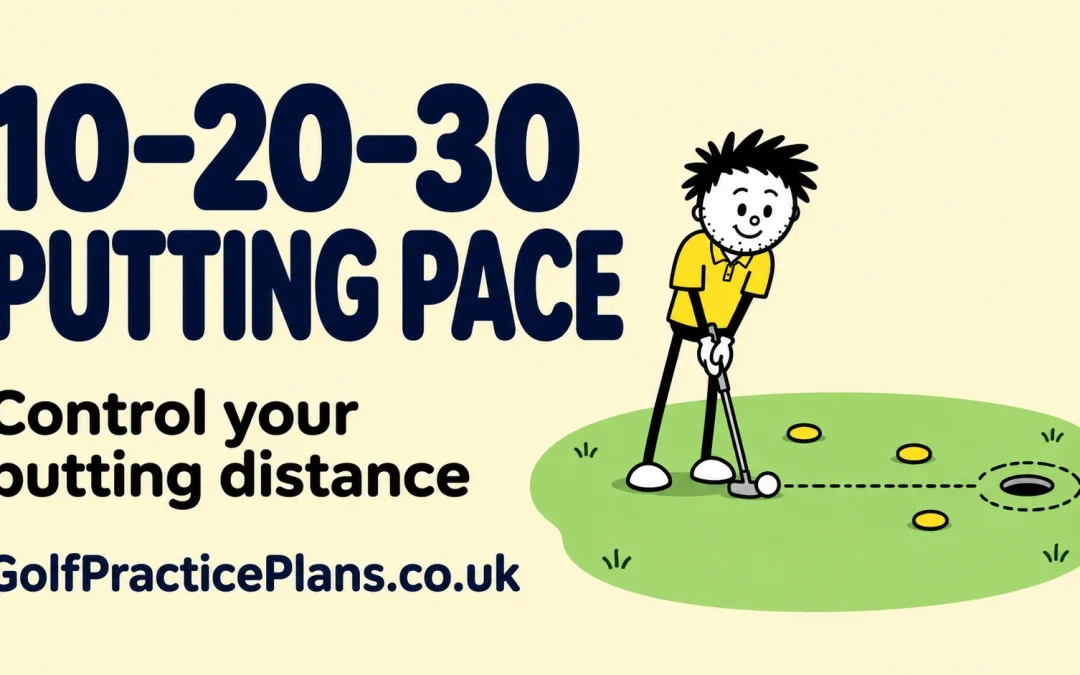
10-20-30 Putting Pace Challenge: Control Your Distance
Distance control
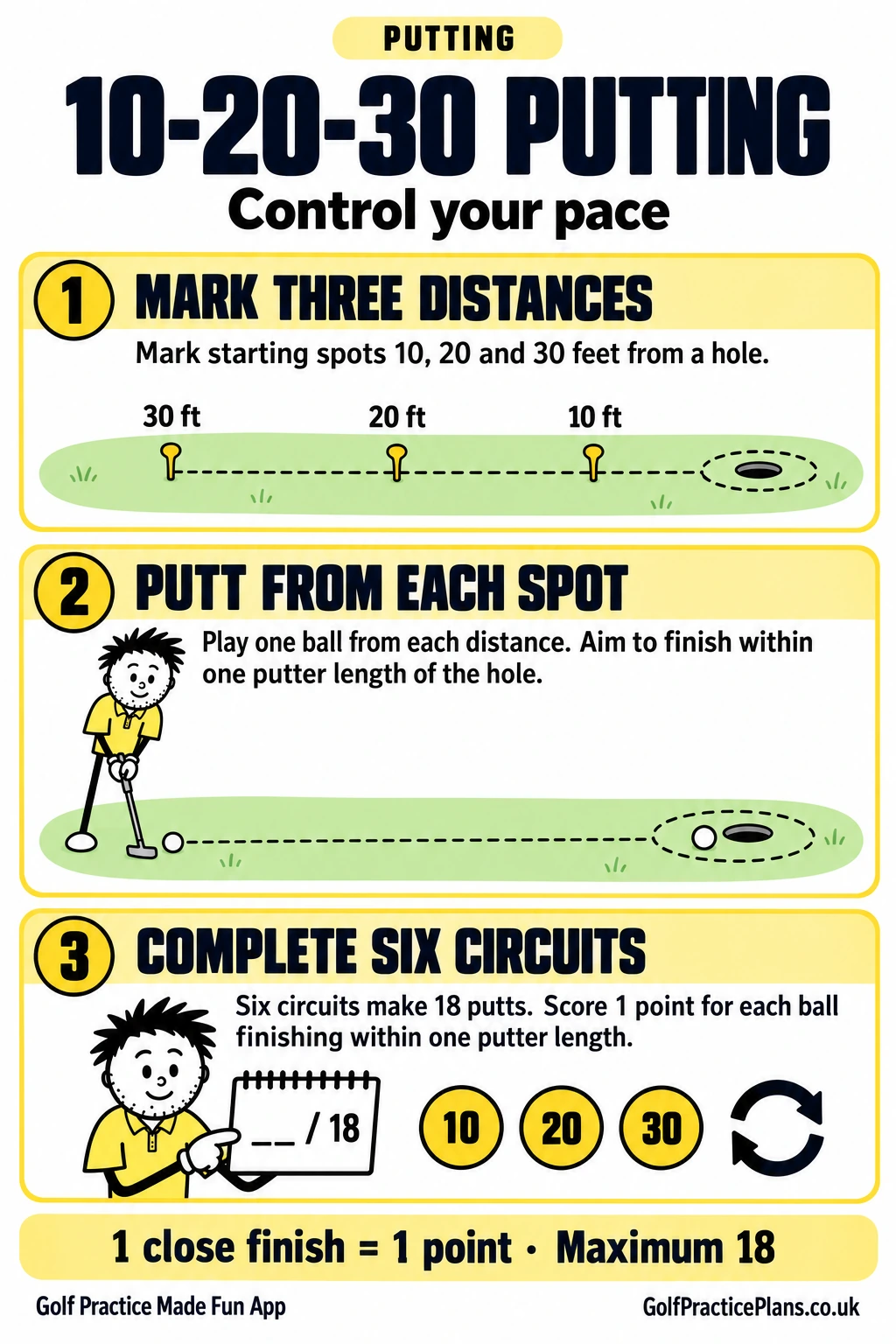
Give your putting pace three different distances to work with. Play from 10, 20 and 30 feet, aiming to finish within one putter length of the hole. Repeat that circuit six times and score one point for each close finish.
↓ Download free infographicSave to your device or print for practice.Free practice sheet · PDF
Watch Blair O’Neal’s pace drill
Step 1. Mark three distances
| Action | What to do |
|---|---|
| Choose one practice hole | Find a practice-green hole with space to putt from all three distances. Start on a reasonably level area if you want a simpler first session. |
| Mark 10, 20 and 30 feet | Measure each starting distance from the same hole. Use small flat markers or clear reference points beside your putting line. |
| Check your finish zone | Use your putter to check what one putter length from the hole looks like. Use the same putter throughout the round. |
| Keep the route clear | Place markers beside the ball’s path and collect finished balls before they interfere with the next attempt. |
The numbers describe the distance from each starting spot to the hole. The 30-foot position is farthest away; the 10-foot position is nearest.
Step 2. Putt from each spot
| Action | What to do |
|---|---|
| Start at 10 feet | Choose your line and roll one ball towards the hole, aiming to leave it within one putter length. |
| Move to 20 feet | Play one putt from the second spot. Give yourself a fresh look at the distance before setting up. |
| Finish at 30 feet | Play one putt from the farthest spot. You have now completed one circuit of three putts. |
| Keep the goal clear | Judge the finishing distance after each attempt. The task is to leave the ball close without forcing a make. |
Blair’s lesson uses a counting cue for rhythm. You can try her “one thousand one” cue during a rehearsal, then focus on the distance and your intended roll.
Make the comparison useful
| Action | What to do |
|---|---|
| One distance keeps finishing short | Note which starting spot it was. Give the next putt from that distance a fresh rehearsal rather than changing every part of your setup. |
| You hole a putt | Count one point. A holed putt is a close finish, with no extra bonus. |
| A finish is near the boundary | Check it with your putter before deciding whether it earns a point. |
| A ball is outside the zone | Record zero and continue with the next distance. One miss does not restart the circuit. |
Use the same one-putter-length target throughout the session. You can keep a separate note of short, long and sideways misses to help choose your next practice task.
Your focus: Distance control
Step 3. Complete your round
| Action | What to do |
|---|---|
| Repeat the sequence | Continue in the order 10 feet, 20 feet, then 30 feet. |
| Complete six circuits | Three putts per circuit multiplied by six circuits gives 18 putts, with six attempts from each distance. |
| Award your points | Score one point for every ball finishing within one putter length of the hole. Score zero outside that distance. |
| Record your total | Add the points for all 18 putts. Your maximum score is 18. |
Your practice record
| Starting distance | Close finishes |
|---|---|
| 10-foot putts | ___ / 6 |
| 20-foot putts | ___ / 6 |
| 30-foot putts | ___ / 6 |
| Final score | ___ / 18 |
Six circuits × three distances = 18 putts. One close finish earns one point, including a holed putt. There are no extra points.
Save your score on Putting card 10 in the Golf Practice Made Fun App. Add a note about the distance that felt easiest or needed the most attention.
Changing distance after each putt gives the session a clear pattern. You will finish with six attempts from each starting spot and one total out of 18.
FAQs
What equipment do I need?
Putter + balls.
How do I set up this drill?
The numbers describe the distance from each starting spot to the hole. The 30-foot position is farthest away; the 10-foot position is nearest.
What should I focus on during practice?
Blair’s lesson uses a counting cue for rhythm. You can try her “one thousand one” cue during a rehearsal, then focus on the distance and your intended roll.
Use the same one-putter-length target throughout the session. You can keep a separate note of short, long and sideways misses to help choose your next practice task.
How should I record my practice?
Six circuits × three distances = 18 putts. One close finish earns one point, including a holed putt. There are no extra points.
Changing distance after each putt gives the session a clear pattern. You will finish with six attempts from each starting spot and one total out of 18.
What should I keep in mind when practising?
Write down the three distance totals as well as your overall score. Two rounds can both finish on 10 out of 18 while telling quite different stories. Those smaller totals will help you see which putts deserve another session. Your putter is already doing the measuring; let the notebook do the remembering.
What drill do you recommend I do next?
Try Putting Gate Drill next to practise starting putts on your chosen line.
You could also use Picture, Look, Roll to rehearse a clear picture, look and roll routine. For another focused practice task, try Breaking Putts to bring your read and pace together on breaking putts.
Give your next practice a purpose.
Find illustrated drills, save your favourites and record your practice in the Golf Practice Made Fun App.
Try the App Free ↗14 days free · No card required