

Browse by category
DRILL OVERVIEW · PUTTING CARD 34
Lead-Hand Putting: Control Your Start Line
Your drill at a glance
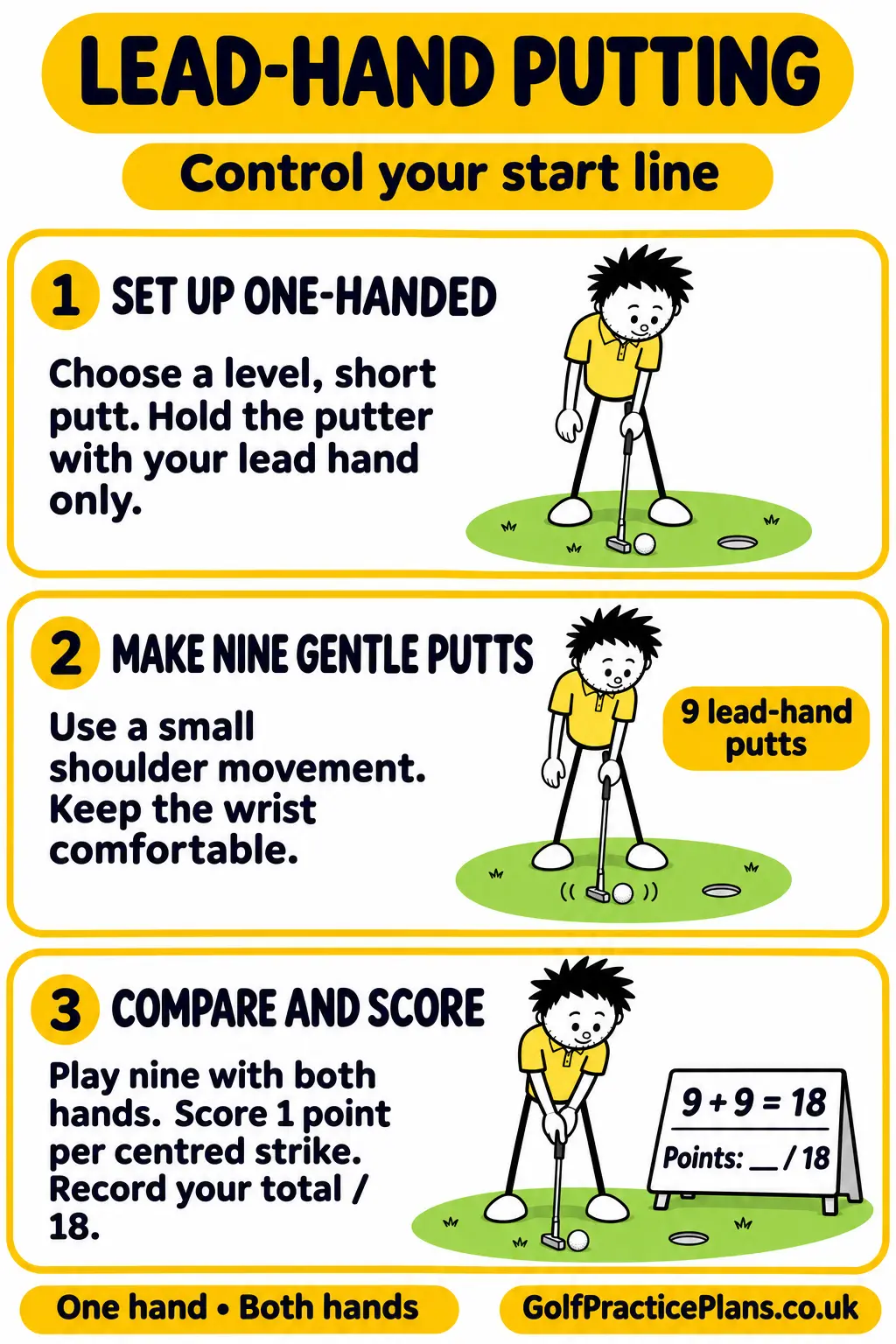
One hand. A little feedback. Lead-Hand Putting: Control Your Start Line is Putting Card 34 in the Golf Practice Made Fun App.
Find out how your lead hand influences contact and start direction. Choose a level, short putt and make nine gentle strokes with your lead hand only. Then use your normal two-handed grip for nine more from the same spot. Compare the contact and the direction the ball starts.
Keep the movement small and your wrist comfortable. Score one point for each centred strike, giving you two scores out of nine and a total out of 18.
Jump to set up one-handed, make nine gentle putts or compare and score.
Watch the lead-hand putting lesson.
Watch iGolftv’s left-hand-only putting lesson, then try the drill from the same short, level starting position.
Step 1. Set up one-handed.
Take your usual stance and hold the putter with your lead hand, leaving the other hand by your side.
| Action | What to do |
|---|---|
| Choose your putt | Find a level, short putt on the practice green. Use the same starting spot for both groups. |
| Identify your lead hand | For a right-handed golfer, this is the left hand. For a left-handed golfer, it is the right hand. |
| Take your normal stance | Set up as you usually would, with the putter head behind the ball. |
| Let the other hand rest | Hold the putter with your lead hand only. Let the other arm hang by your side. |
One ball is enough. Retrieve it after each attempt and return it to your starting position.
Step 2. Make nine gentle putts.
Use a small shoulder movement and notice the quality of contact and the ball’s starting direction.
| Action | What to do |
|---|---|
| Make a small stroke | Move the putter with a gentle shoulder movement, keeping the stroke suitable for your short putt. |
| Keep the wrist comfortable | Avoid forcing the wrist into an artificially straight position. |
| Notice the strike | Pay attention to whether contact feels centred on the putter face. |
| Watch the start | Notice whether the ball starts in the direction you intended. |
| Complete nine attempts | Repeat from the same spot. Record one point for each centred strike and keep your lead-hand total out of nine. |
Keep each stroke gentle enough to control. There is no prize for seeing how far you can send a one-handed putt.
Step 3. Compare and score.
Play nine more with both hands, then compare the two groups and add your centred-strike scores.
| Action | What to do |
|---|---|
| Use your normal grip | Return to your usual two-handed putting grip. |
| Play nine more | Use the same ball position and target as the lead-hand group. |
| Score centred contact | Award one point for each centred strike. Record this second group out of nine. |
| Compare the groups | Review the contact and starting direction with one hand and with both hands. |
| Add your total | Add the two group scores and record your centred-strike total out of 18. Higher is better. |
Your practice record
| Part of the round | Record |
|---|---|
| Lead hand only | Centred strikes: ___ / 9 · Starting direction: ___ |
| Normal two-handed grip | Centred strikes: ___ / 9 · Starting direction: ___ |
| Total | ___ / 18 |
| Useful observation | Contact and start direction felt: ___ |
Score the strike. A centred strike earns one point whether the ball goes in or misses. Keep your observations about starting direction alongside the score.
George’s Practice Tip.
Let the one-handed strokes give you feedback. Keep the movement small, complete the nine attempts and notice what changes when your other hand returns to the grip.
After the practice session, write one useful sentence about contact or starting direction. A clear observation gives you something to explore next time.
For another simple comparison, try Hover or Ground. To explore grip pressure, use Trail Index Finger: Try a Lighter Grip.
MAKE THE NEXT BUCKET COUNT
Pick a card. Practise with purpose.
