

Browse by category
DRILL OVERVIEW · PUTTING CARD 22
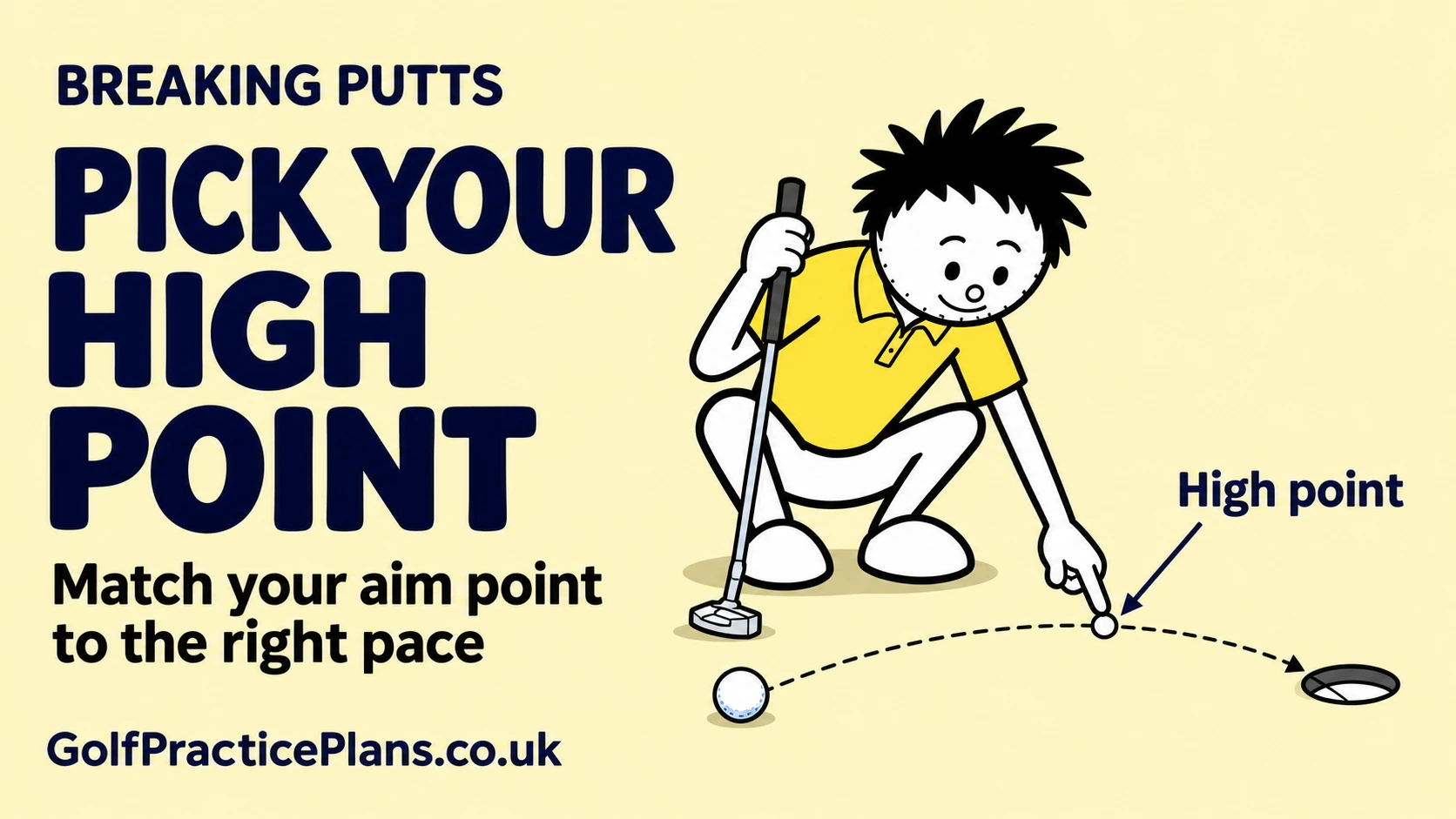
Breaking Putts: Pick Your High Point
Your drill at a glance

This is Putting card twenty-two, Breaking Putts: Pick Your High Point, in the Golf Practice Made Fun App.
Give your breaking putt a clear point to work towards. Read it from both sides, picture the curve and choose its high point. Putt to that point at your intended pace, then let the slope feed the ball towards the hole.
Play 18 attempts. Score one point whenever the ball finishes within one putter length of the hole, and record your total out of 18.
Jump to read both sides, match the pace or score your round.
Watch the breaking-putt lesson.
David Armitage, in this GOLF.com lesson, demonstrates choosing an apex, visualising the putt and committing to that point at your chosen pace.
Step 1. Read both sides.
| Action | What to do |
|---|---|
| Choose a breaking putt | Find a clear practice putt where you can see the slope affecting the ball’s route. |
| Look from both sides | Read from behind the ball and from the far side of the hole. Notice the direction of the slope and whether the putt runs uphill or downhill. |
| Picture the curve | Imagine the ball’s route and how it will feed towards the hole. |
| Choose the high point | Pick the point on the high side of that imagined curve that you will use as your focus. |
Make the read before you settle into your stance. A clear picture gives you a plan to follow.
Step 2. Match the pace.
| Action | What to do |
|---|---|
| Choose the pace | Picture how firmly the ball needs to roll to follow your intended route. |
| Commit to your point | Keep the chosen high point clear in your mind as you set the putter face and take your stance. |
| Make the putt | Putt to that point at the intended pace. Let the slope provide the turn. |
| Pause and review | Watch where the ball finishes. Check your line and pace before preparing for the next attempt. |
Your read and pace belong together. Use each finish as feedback, then make a considered decision for the next putt. No need for a committee meeting over every blade of grass.
Step 3. Score 18 putts.
| Result or action | What to record |
|---|---|
| Within one putter length | Score 1 point when the ball finishes within one putter length of the hole. |
| Outside one putter length | Score 0 points for that attempt. |
| Check close finishes | Use your putter as the distance reference when the finish is difficult to judge. |
| Complete 18 attempts | Keep a running total and record the final number of points out of 18. |
Your practice record
| Part of the round | Record |
|---|---|
| Putts 1–9 | ___ points / 9 |
| Putts 10–18 | ___ points / 9 |
| Total | ___ points / 18 |
| Practice note | Did your chosen high point and pace match the ball’s finish? |
One close finish earns one point. Use the same one-putter-length measure throughout all 18 attempts. Your total records how often the ball finished close to the hole.
George’s Practice Tip.
Once you have chosen the point and pace, give that plan a fair chance. If the ball finishes away from the hole, take a moment to review both parts before changing anything. The next putt is another useful piece of feedback.
For a visible starting reference on a breaking putt, try String Line. For a separate pace exercise, try Leapfrog Putting.
MAKE THE NEXT BUCKET COUNT
Pick a card. Practise with purpose.
