
Browse by category
DRILL OVERVIEW · PUTTING CARD 21
String Line: Aim a Breaking Putt
Your drill at a glance
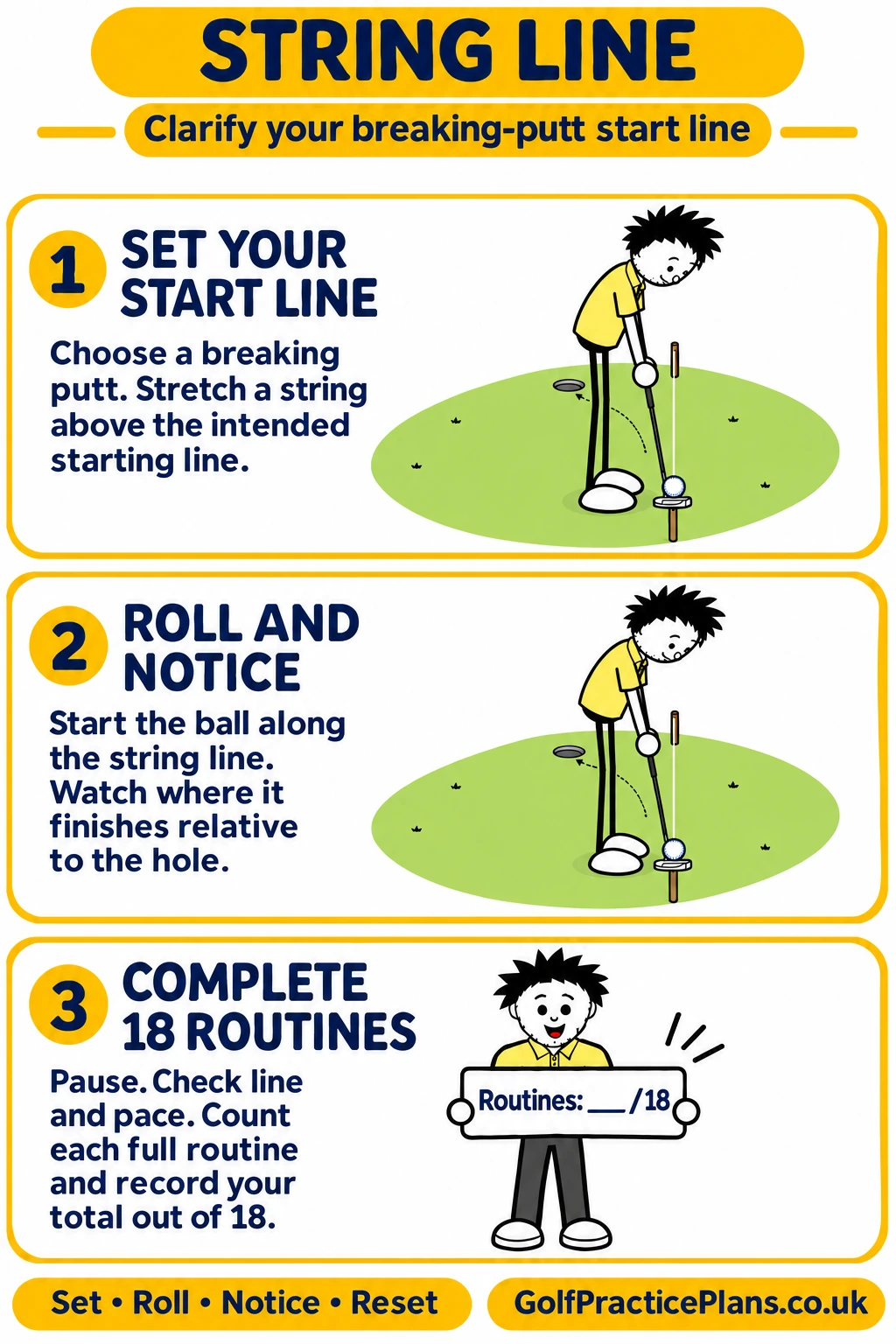
This is Putting card twenty-one, String Line: Aim a Breaking Putt, in the Golf Practice Made Fun App.
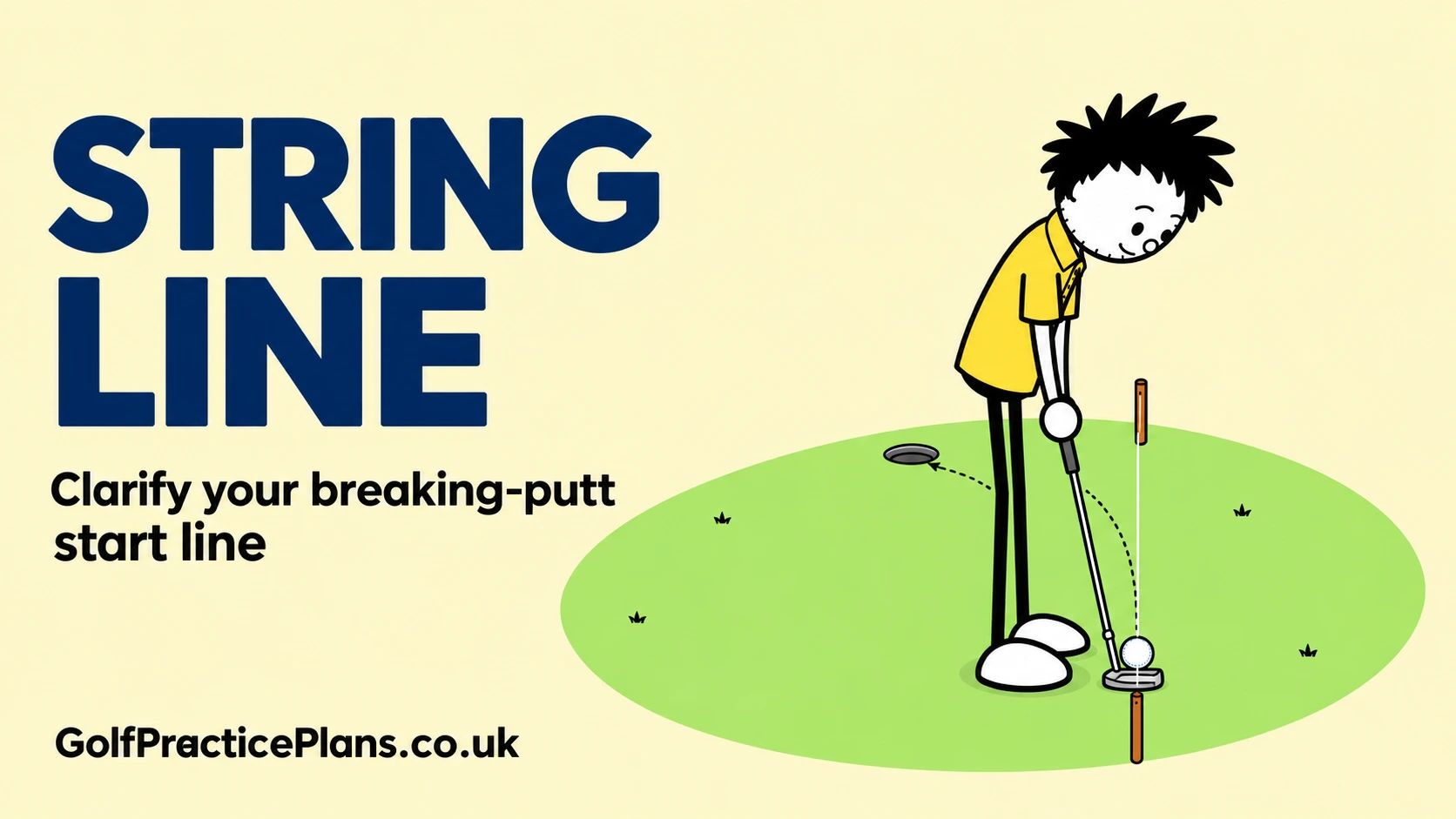
Give your breaking putt a clear starting reference. Stretch a string above your intended start line, place the ball directly beneath it and roll the ball along that initial line. Watch how the slope takes it towards, past or short of the hole.
The string stays straight while the ball’s path can curve away from it. Use the finish as feedback on your chosen line and pace, then pause before the next attempt.
Jump to set your start line, roll and notice or complete your round.
Watch the elevated-string lesson.
Nick Kumpis of Smartline Putting demonstrates an elevated string on breaking putts, showing how the starting direction and pace affect the result.
Step 1. Set your start line.
| Action | What to do |
|---|---|
| Choose a breaking putt | Find a clear practice putt with a visible slope and read how you expect it to turn. |
| Choose the initial direction | Pick the line on which you want the ball to start, allowing for the break. |
| Raise the string | Use a putting-string aid, or a taut string between suitable supports, above that intended line. Leave clearance for the ball and putter. |
| Place the ball beneath it | Centre the ball directly under the string. Keep the near support behind your stroke area and the far support clear of the ball’s expected path. |
| Set the face | Place the putter behind the ball with the face square to the starting line. |
Check the string from behind the ball before taking your stance. It gives you a straight visual reference for the direction you have chosen.
Step 2. Roll and notice.
| Action | What to do |
|---|---|
| Check line and pace | Pause, look at your intended starting direction and picture the pace needed. |
| Make the stroke | Start the ball along the line beneath the string, then let it roll. |
| Watch the early roll | Notice whether the ball starts along your chosen line before the slope takes it away. |
| Check the finish | Note where it stops relative to the hole: short, long or to either side. |
| Use the feedback | Review the initial direction and pace before the next attempt. Make one considered adjustment at a time. |
Let the slope do the turning. Trying to steer the putter towards the hole can send the ball off your chosen starting line.
Step 3. Complete 18 routines.
| Action | What to do |
|---|---|
| Repeat for 18 attempts | Return the ball beneath the string and prepare again for each putt. |
| Follow the full routine | Check the setup, pause to consider line and pace, make the putt and observe its finish. |
| Count complete routines | Count an attempt when you have followed that whole sequence. |
| Record your total | Save the number of full routines completed out of 18. |
Your practice record
| Part of the round | Record |
|---|---|
| Attempts 1–9 | ___ full routines / 9 |
| Attempts 10–18 | ___ full routines / 9 |
| Total | ___ full routines / 18 |
| Practice note | What did the finishes show about your start line and pace? |
Count the full routine. A putt that misses the hole can still count when you complete all the checks and observe its finish. Record routine completion out of 18.
George’s Practice Tip.
Give each putt a moment’s review before fetching the next ball. First check where it started, then where it finished. The string is an honest little coach, although it does leave you to collect the balls.
For another visual setup check, try the Putting Mirror Drill. For a simple preparation sequence, use Picture, Look, Roll.
MAKE THE NEXT BUCKET COUNT
Pick a card. Practise with purpose.
