Browse by category
DRILL OVERVIEW · PUTTING CARD 12
Two-Ball Test: Check Your Putter Face
Your drill at a glance
This is Putting card twelve, Two-Ball Test: Check Your Putter Face, in the Golf Practice Made Fun App.
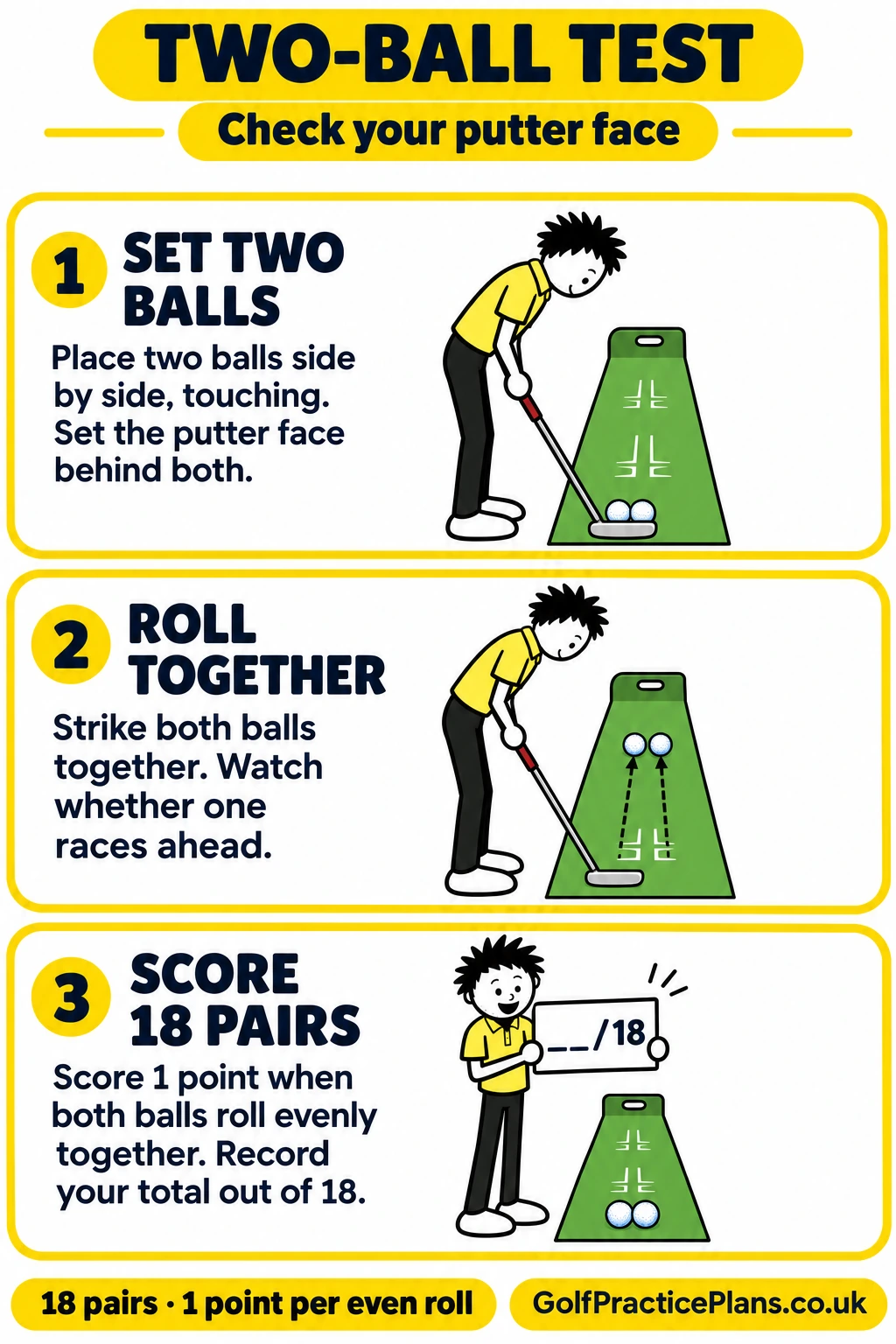
Two balls can show you something one ball cannot. Set them side by side across your putter face and strike both with the same stroke. Watch whether they roll away evenly or one gets ahead.
The task gives you feedback about how the face arrives at the balls. Use a level, smooth part of the practice green and keep the stroke length comfortable. You do not need to aim at a hole.
Jump to set two balls, read the roll or score your pairs.
Watch the two-ball putting lesson.
Maria Palozola demonstrates how to set the balls level with each other and use their roll to check the putter face. She explains what it can mean when the heel-side or toe-side ball travels farther.
Step 1. Set two balls side by side.
| Action | What to do |
|---|---|
| Choose a smooth area | Find a level patch of the practice green so bumps and slope interfere as little as possible. |
| Place the balls together | Set two balls touching side by side. The line between their centres runs across your intended direction of roll. |
| Set the face behind both | Place one ball opposite the heel side of the face and the other opposite the toe side. Both should be the same distance in front of the face. |
| Take your normal stance | Use your usual comfortable putting setup. Check that both balls fit across the striking face. |
Look down at the pair before each attempt. They sit alongside each other across the face; both need to be struck by the putter in the same stroke.
Step 2. Strike together and watch the roll.
| Action | What to do |
|---|---|
| Make a smooth stroke | Use enough pace to see both balls roll clearly, keeping a similar stroke length from pair to pair. |
| Watch the pair | Look for both balls moving forward evenly together. Notice whether one races ahead. |
| Reset the face | Bring the balls back, set them level again and check the face before the next stroke. |
| Keep the task consistent | Use the same starting area and a similar pace throughout your round. |
What the feedback can tell you
| What you see | What to check |
|---|---|
| Both roll evenly | This is the result you are trying to repeat: both balls leave together without one clearly racing ahead. |
| Toe-side ball leads | In Maria’s demonstration, this indicates the toe arrived sooner than the heel, with the face more closed at contact. |
| Heel-side ball leads | This indicates the heel arrived sooner than the toe, with the face more open at contact. |
| Results vary widely | Check the ball setup and surface again. Look for a repeated pattern over several pairs before changing your stroke. |
This is a feedback exercise. Uneven ground and an uneven starting setup can also affect the result, so take care with those before drawing conclusions about your face control.
Step 3. Score eighteen pairs.
| Action | What to do |
|---|---|
| Play 18 pairs | Each stroke that strikes the two balls is one attempt. Collect and reset the same two balls between attempts. |
| Award one point | Score 1 when both balls roll evenly together. Score 0 if one clearly races ahead. |
| Finish every attempt | Keep going after an uneven pair. There is no need to restart the round. |
| Record your total | Add your points and write down your score out of 18. Note whether the heel-side or toe-side ball tended to lead. |
Your practice record
| Part of the round | Result |
|---|---|
| Pairs 1–9 | ___ / 9 |
| Pairs 10–18 | ___ / 9 |
| Final score | ___ / 18 |
| Pattern noticed | Even roll / toe-side leads / heel-side leads |
One pair is one scored attempt. Two balls are struck each time, but the maximum score for the round is 18.
Record the score and a brief note about the roll. Keep the setup and pace similar when you repeat the drill so your results are easier to compare.
George’s Practice Tip.
Reset the balls carefully after every stroke. A wonky starting pair can make an innocent putter look guilty. Give yourself a fair test, then look for a pattern across the whole round.
For another starting-line exercise, try the Putting Gate drill. To work on preparation before a putt, try Picture, Look, Roll.
MAKE THE NEXT BUCKET COUNT
Pick a card. Practise with purpose.