


Browse by category
DRILL OVERVIEW · PUTTING CARD 42
Find the Fall Line: Locate a Straight Putt
Your drill at a glance

Find straight. Understand the break. Find the Fall Line: Locate a Straight Putt is Putting Card 42 in the Golf Practice Made Fun App.
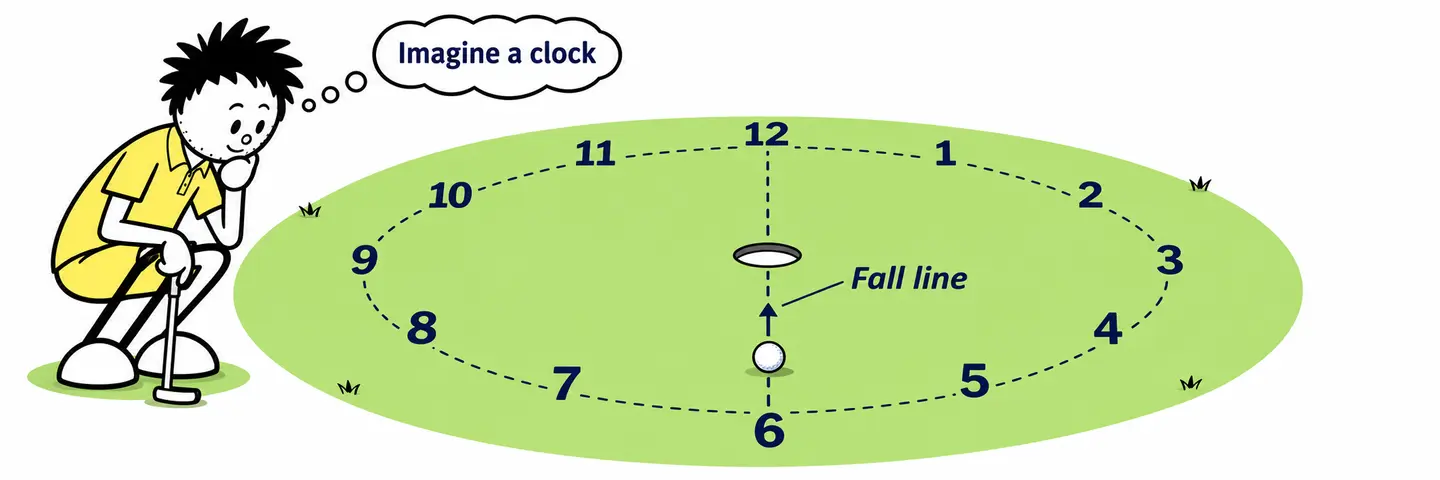
Imagine a clock face around the hole. The hole is its hub. Find a straight uphill putt about 10 feet away and call that position six o’clock. Twelve is directly opposite, beyond the hole. The line joining six, the hole and twelve gives you a reference for the slope.
Brad Faxon’s lesson shows how this reference helps you read nearby putts. On a simple slope, moving towards five produces an uphill putt that breaks left; moving towards seven produces one that breaks right. Check your read by rolling the ball.
Jump to imagine a clock, check the fall line or predict and score.
Watch the straight-putt lesson.
Brad Faxon explains how finding a straight putt gives you a reference for the pitch of a green in this Titleist lesson. Watch how he checks the read by rolling the putt.
Step 1. Imagine a clock.
Find a straight uphill putt and picture a clock face around the hole.
| Action | What to do |
|---|---|
| Choose a simple slope | Find a hole on a gently sloping part of the practice green. |
| Find six o’clock | Look for a straight uphill putt about 10 feet from the hole. This starting position is six o’clock. |
| Make the hole the hub | Imagine the hole at the centre of the clock face. Twelve is directly opposite six, beyond the hole. |
| Keep it imaginary | Picture the numbers on the green. You only need a putter and ball. |
Step 2. Check the fall line.
Confirm the straight uphill putt, then compare the break from five and seven o’clock.
| Action | What to do |
|---|---|
| Confirm straight | Roll the putt from six o’clock and watch for sideways turn. Adjust your position if needed until you find the straight uphill putt. |
| Identify the fall line | The line from six through the hole to twelve is your straight reference: the fall line. |
| Move towards five | On this simple slope, the uphill putt from five o’clock breaks slightly left as you face the hole. |
| Move towards seven | From seven o’clock, the uphill putt breaks slightly right as you face the hole. |
| Use the reference | Compare each new position with the straight putt before choosing your line and pace. |
The clock describes the slope around this hole. Find your reference again when you move to another hole or a different slope.
Step 3. Predict and score.
Use the fall line to predict each roll, then check your read in the App’s 18-prediction challenge.
| Action | What to do |
|---|---|
| Predict first | Before each putt, say whether you expect the ball to roll straight, left or right. |
| Roll and check | Putt towards the hole and compare the roll with your prediction. |
| Score the read | Award one point when you correctly predict the direction of the break, including a straight roll. |
| Complete 18 predictions | Move to different positions around the same hole, using the fall line as your reference. |
| Record your total | Add your correct predictions and record your score out of 18. |
Your practice record
| Action | What to do |
|---|---|
| Correct predictions | ___ / 18 |
| Straight uphill position | Where I found six o’clock: ___ |
| Useful observation | What changed when I moved to five or seven: ___ |
App scoring challenge. The 18-prediction format is an addition for the Golf Practice Made Fun App. Brad Faxon’s lesson teaches the straight-putt reference and clock-face method.
George’s Practice Tip.
Find your six o’clock putt before trying to read every curve around the hole. Once you have a straight uphill reference, compare the neighbouring putts with it and watch how their break changes.
After the practice session, note where you found the fall line and what you noticed from five and seven o’clock. Keep the clock in your imagination and let the roll confirm your read.
To connect your read with pace, try Breaking Putts: Match Your Line and Pace. For another target-focused comparison, use Eyes on the Hole.
MAKE THE NEXT BUCKET COUNT
Pick a card. Practise with purpose.
