
Browse by category
DRILL OVERVIEW · PUTTING CARD 31
Breaking Putts: Match Your Line and Pace
Your drill at a glance
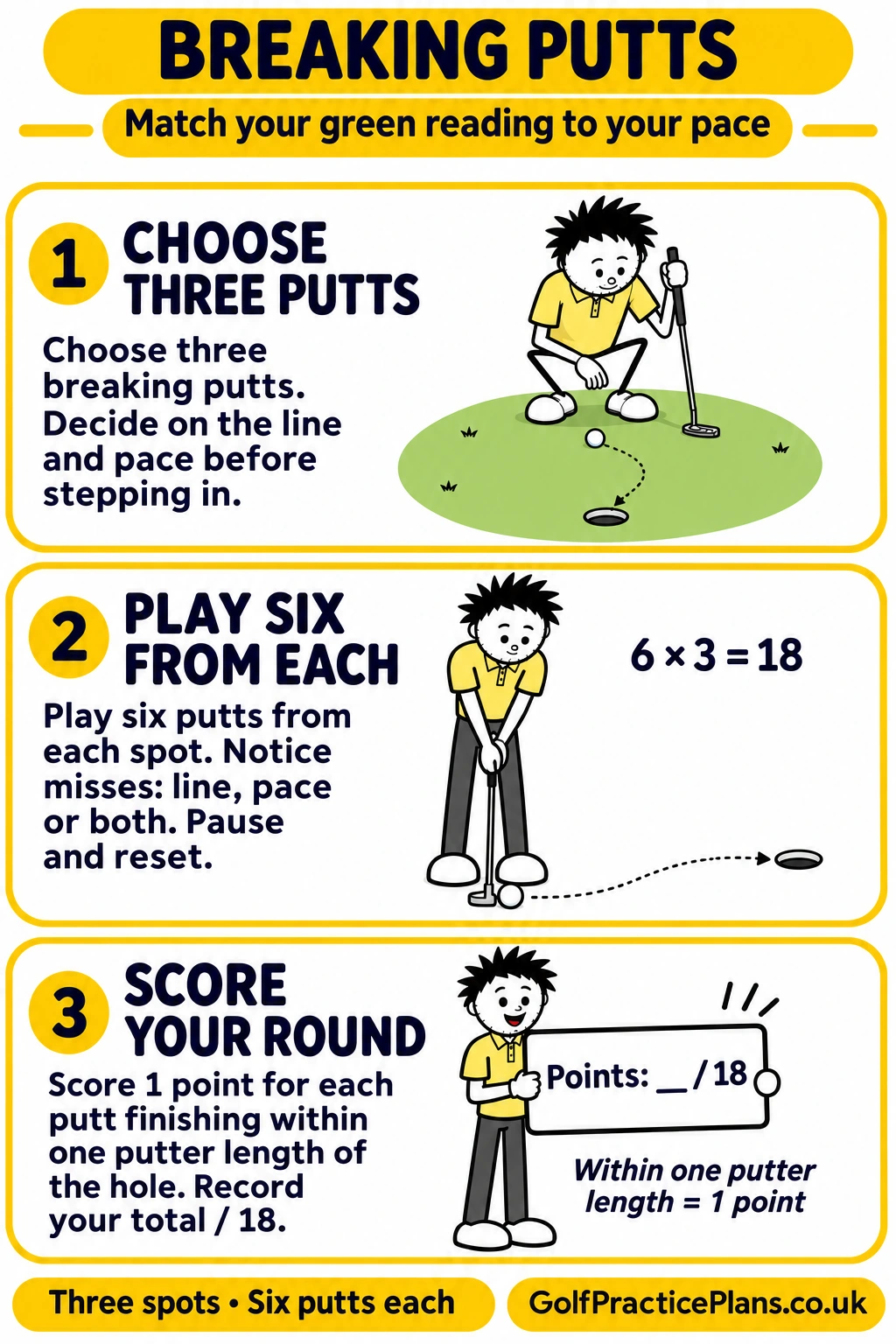
Choose your line. Set your pace. Breaking Putts is Putting Card 31 in the Golf Practice Made Fun App.
Give your read a pace to go with it. Choose three breaking putts and play six attempts from each position. Decide on both the starting line and the pace before stepping in, then watch what the ball actually does.
After a miss, consider line, pace or both. Pause before the next attempt and make a fresh decision, rather than immediately sending another ball after the first.
Jump to choose three putts, play six from each or score your round.
Watch the green-reading and pace lesson.
Danny Maude covers reading greens through sight and feel, alongside distance control. Watch his explanation of assessing the slope and planning the distance a putt needs to travel.
Step 1. Choose three putts.
| Action | What to do |
|---|---|
| Find three breaking putts | Choose three starting positions on the practice green where the ball needs to curve towards the hole. |
| Read the first putt | Look at the slope between the ball and hole before taking your stance. |
| Choose line and pace together | Decide where you want the ball to start and the pace you intend to use. |
| Step in with a decision | Set the putter behind the ball and prepare to roll it along your chosen starting line. |
Give yourself a clear intention before the stroke. “Somewhere up there” is a fairly ambitious job description for a golf ball.
Step 2. Play six from each.
| Action | What to do |
|---|---|
| Play six attempts | Return to the same starting position for six putts before moving to the next spot. |
| Watch the start and finish | Notice the direction the ball starts and where it comes to rest. |
| Review the miss | Consider whether the result came from your line, pace or both. Make a brief note if useful. |
| Pause and reset | Check line and pace before every attempt. Repeat the process at all three starting points. |
A quick review between putts
| What to review | Ask yourself |
|---|---|
| Line | Did the ball start where you intended? Does your chosen line need another look? |
| Pace | Did the ball finish at the distance you intended? |
| Both | Review the starting line and pace together when neither produced the result you wanted. |
Use the feedback for the next decision. Keep the pause even when the previous putt was a good one.
Step 3. Score your round.
| Action | What to do |
|---|---|
| Check the finishing distance | After each attempt, assess whether the ball has finished within one putter length of the hole. Use your putter as the reference when needed. |
| Award one point | Count one point for a finish within that distance. A holed putt also qualifies. |
| Record each spot | Keep a score out of six for each of your three starting positions. |
| Add the total | Add all three scores and record your total out of 18. Higher is better. |
Your practice record
| Part of the round | Record |
|---|---|
| Starting spot 1 | ___ / 6 |
| Starting spot 2 | ___ / 6 |
| Starting spot 3 | ___ / 6 |
| Total | ___ / 18 |
| Useful observation | Line / pace / both: ___ |
Score the finish. One point means the ball finishes within one putter length of the hole. Your notes about line and pace help you learn from the round; they do not add points.
George’s Practice Tip.
Keep the review short enough to be useful: what line did you choose, what pace did you intend, and what happened? Then reset. A short note is plenty before you reset for the next putt.
For another way to plan a breaking putt, try Pick Your High Point. To make the pause before the stroke more consistent, use Picture, Look, Roll.
MAKE THE NEXT BUCKET COUNT
Pick a card. Practise with purpose.
